The New York State Department of Taxation and Finance is the agency that administers and collects New York’s state taxes, along with several local ones. It processes returns, audits individuals and businesses, issues bills and collects what is owed. Its deadlines and procedures are its own, and its collection clock runs twice as long as the IRS’s.
At Victory Tax Lawyers, we help taxpayers nationwide with tax audits, notices and tax debt. Our attorneys bring more than 10 years of experience handling tax controversy, resolution, and litigation matters, have secured over $100 million in tax relief for clients, and have assisted more than 10,000 taxpayers across all 50 states. Our attorneys are licensed in California, and our team includes an IRS enrolled agent. For New York matters, members of our team can be appointed on a New York power of attorney, and we coordinate with New York-admitted counsel where a matter requires it.
Contact us today and let us help with your tax liability.
This guide is for people and businesses who have heard from the New York tax department, or expect to.
What Does the New York Department of Taxation and Finance Do?
The Department of Taxation and Finance (often shortened to DTF) is New York’s main tax collector. According to the department’s own overview, it collected $162 billion in state and local taxes in fiscal year 2025 and administers 49 state and local taxes and fees.

The taxes most people run into are these:
- Personal income tax. New York City residents report city income tax on the state return, and Yonkers residents report the Yonkers surcharge there too, per the department’s New York City and Yonkers guidance.
- Corporation tax, including the Article 9-A franchise tax on general business corporations and S corporations.
- Sales and use tax.
- Withholding tax on employee wages.
- Estate tax. For deaths in 2026, the basic exclusion amount is $7,350,000, according to the department’s estate tax page.
- Excise and other taxes, such as cigarette and tobacco, motor fuel and highway use taxes, and the real estate transfer tax.
The department reports that more than 96 percent of the taxes it collects are paid voluntarily. The other 4 percent comes from audits, collections and criminal investigations, which is where our clients usually are.
For routine business, the department’s Online Services account lets you pay, view notices and respond to letters. You can also request an installment payment agreement online for a balance of $20,000 or less with 36 or fewer monthly payments. Penalty and interest keep accruing while you pay.
How Is DTF Different From NYC Finance, the Department of Labor, and the IRS?
New York splits tax work across several agencies, and New York City adds its own. Here is who handles what.
| Agency | What it administers | What it means for you |
|---|---|---|
| NYS Department of Taxation and Finance (DTF) | State personal income tax (plus NYC and Yonkers income tax on the state return), corporation tax, sales and use tax, withholding, estate tax, excise taxes | The agency behind most New York State tax notices, audits, warrants and income executions |
| NYC Department of Finance | City business taxes (Unincorporated Business Tax, General Corporation Tax for S corporations, Business Corporation Tax) and property tax | A separate city agency with its own returns and bills; resolving a state matter does not resolve a city business tax bill |
| NYS Department of Labor | Unemployment insurance contributions and employer registration | Sets employer contribution rates and handles unemployment insurance registration; a Labor matter follows Labor's own rules |
| Internal Revenue Service (IRS) | Federal income, payroll and other federal taxes | A separate taxing authority with separate notices, appeal routes and a ten-year collection period |
Two points trip people up. First, New York City personal income tax goes on your state return, and DTF collects it. The NYC Department of Finance handles city business taxes such as the Unincorporated Business Tax, charged at 4% on taxable income allocated to the city, and it values roughly 1.1 million taxable properties for property tax.

Second, payroll is shared. Employers file one combined quarterly return, Form NYS-45, covering withholding, wage reporting and unemployment insurance. Withholding belongs to DTF, but unemployment insurance is a Department of Labor program. Our New York Department of Labor audit page covers that side.
The IRS is separate again, but DTF compares state returns with IRS information, and a state bill caused by an IRS change carries no state protest rights.
Who Does New York Treat as a Resident?
In our experience, residency drives many of the largest New York income tax disputes. Residents are taxed on all their income, wherever it is earned. Nonresidents are taxed only on New York source income, such as wages for work done in the state and income from New York real property.
There are two ways to be a resident, according to the department’s residency FAQs:
- Domicile. Your domicile is your permanent, primary home, the place you intend to return to. A New York domicile does not change until you show, by clear and convincing evidence, that you abandoned it and set up a new one elsewhere.
- Statutory residency. Even if you are domiciled elsewhere, you are a resident if you keep a permanent place of abode in New York for substantially all of the year and spend 184 days or more in the state. Any part of a day counts as a day.
New York City and Yonkers use the same tests, though a nonresident who works in Yonkers may still owe the Yonkers nonresident earnings tax.
What Does a New York Residency Dispute Look Like in Practice?
Picture a Manhattan executive who buys a house in Florida, changes her driver’s license and files a New York nonresident return. She keeps her Manhattan apartment and still flies back for board meetings and holidays. In her mind she moved.
The department can attack that return two ways. It can argue her domicile never changed, because her business and family ties stayed in New York. Or it can accept the Florida domicile and argue she was still a statutory resident, since she kept a Manhattan apartment, which turns the case into a count of her New York days. A partial day counts.
We recommend building the record before an audit starts: a day-by-day calendar backed by travel, phone and card records, and the date each New York tie ended.
How Long Does DTF Have to Assess and Collect?
For assessment, New York’s general rule matches the IRS’s. Under Tax Law section 683, personal income tax must be assessed within three years after the return was filed. That becomes six years if you left out more than 25 percent of your New York adjusted gross income, and there is no limit if no return or a fraudulent return was filed. Sales and use tax has a similar three-year rule under section 1147.
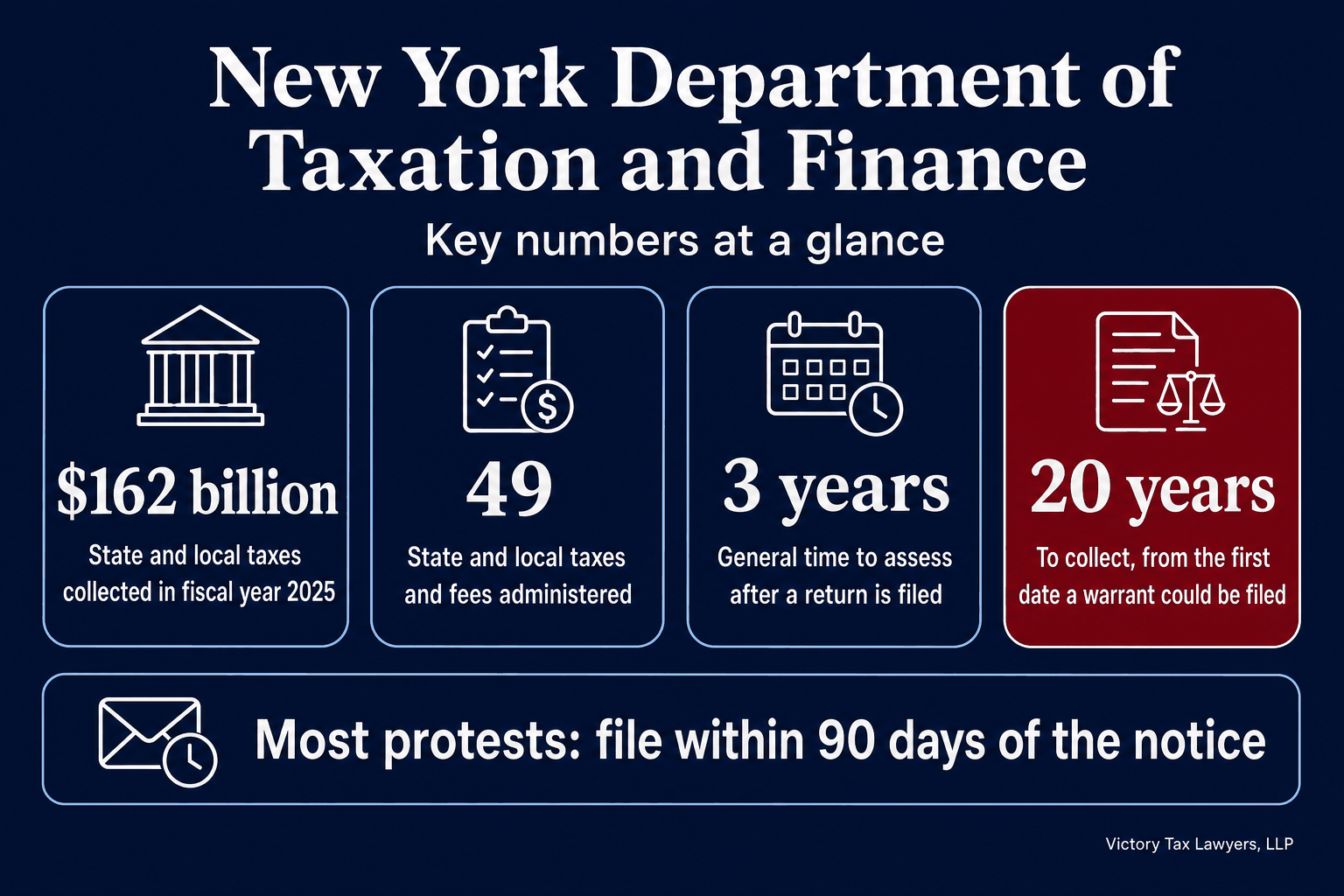
Collection is where New York departs from federal practice. Under Tax Law section 174-b, a state tax liability is extinguished 20 years after the first date a warrant could be filed, whether or not the department ever files one. The IRS generally gets ten years. According to the department’s technical memorandum on the 20-year rule, a payment or a written acknowledgment of the debt no longer extends that period, although you and the department can agree in writing to extend it.
Most enforcement tools work without a lawsuit:
- Tax warrants. The department describes a tax warrant as equivalent to a civil judgment. It becomes public record and creates a lien on your real and personal property. See our tax lien page.
- Bank levies. After filing a warrant, the department can serve a levy on your bank or anyone else holding your money. See our tax levy page.
- Income executions. An income execution asks you to pay up to 10% of your gross wages each payday. If you do not, the department sends it to your employer.
- Driver’s license suspension. With at least $10,000 in past-due tax personally assessed against you, the department can recommend suspending your New York driver’s license, after a notice that gives you 60 days to resolve the debt.
What Triggers a DTF Audit?
The department’s audit page lists the reasons it picks returns, among them:
- failing to file a return
- failing to report income or sales
- claiming excessive credits or exclusions
- incorrect or fraudulent refund claims
- mismatches with information from the IRS, banks, employers and other businesses
- results of prior audits
- misuse of exemption certificates
Most audits start with a letter asking for information, usually about returns from the last three years. Less often, an auditor sets up an appointment at your home or business. Publications 130-D (desk audits) and 130-F (field audits) set out your rights, including the right to a representative.
How you answer that first letter shapes the rest. For a closer look at the income and business side, see our New York DTF audit representation page. Retailers and service businesses facing a sales tax review should read our New York sales tax audit page.
How Do You Dispute a DTF Assessment?
When an audit ends, the department sends a Statement of Proposed Audit Changes. If you still disagree after sending back more information, it issues a Notice of Determination or a Notice of Deficiency, the notices that usually carry protest rights.
According to the department’s protest page, you then have two routes.
The first is a conciliation conference with the Bureau of Conciliation and Mediation Services (BCMS), an independent bureau inside the department. You request it online or on Form CMS-1-MN by the deadline on your notice. The department says more than 98% of protests start here, and over 90% of those are resolved here. After the conference, the conferee sends a proposed Consent. Sign it within 15 days to close the case, or reject it and receive a Conciliation Order that binds both sides unless you petition the Division of Tax Appeals.
The second is a petition to the Division of Tax Appeals. A personal income tax Notice of Deficiency or a sales tax Notice of Determination must generally be challenged within 90 days of the mailing date, or 150 days if the notice went to someone outside the United States, and those limits cannot be extended. An administrative law judge hears the case. Smaller disputes (under $20,000 of tax per 12-month period, or $40,000 for sales tax) can go to small claims, but that result cannot be appealed.
Either side can take the judge’s determination to the Tax Appeals Tribunal within 30 days. Tribunal decisions bind the department, and a taxpayer who loses can go on to the Appellate Division, Third Department.
Some bills carry no protest rights: those caused by a math or clerical error, an IRS change to your federal return, or not paying tax you reported. For those, you can request a review with supporting documents. Penalty and interest keep running during any protest, but you can pay the amount due to stop the accrual and still continue the protest.
Where the amount is right but you cannot pay it, the department offers installment payment agreements and an Offer in Compromise program for taxpayers who are insolvent, discharged in bankruptcy or facing undue economic hardship. See our offer in compromise page.
A word on who may represent you. Form POA-1 covers all department matters except estate tax, and it names individuals, not firms, per the department’s POA-1 guidance. Before BCMS and the Division of Tax Appeals, only New York attorneys, New York CPAs, IRS enrolled agents and public accountants enrolled with the State Education Department may appear, and an attorney licensed in another state needs special permission. Members of our team can be appointed on Form POA-1 for audits and collection matters, and we coordinate with New York-admitted counsel where a matter requires it.
How Should You Respond to a DTF Notice?
We use the same short process whenever a New York notice arrives.

Step 1: Identify the Notice
Find the notice name, tax type, period, amount and response date. A Request for Information (Form DTF-948) wants documents. A Notice of Deficiency wants a decision about protesting.
Step 2: Verify the Numbers
Compare the notice with your filed return, payment records and Online Services account. If the bill came from a federal change, line up the IRS adjustment with the New York result.
Step 3: Preserve Your Records
Gather what supports your position before you reply. In residency and sales tax cases, key records get harder to find each month.
Step 4: Check Your Protest Rights
Look for protest language on the notice. Calling the department or asking for a review does not extend the protest deadline, so file the conciliation request or petition on time even while you talk.
Step 5: Respond to the Right Agency
Pay, request an installment agreement, ask for a review or file the protest, depending on what the notice allows. Send it to the agency that issued the notice and keep proof of when you filed.
Should You Handle a DTF Matter Yourself or Get Help?
If you agree with a modest bill and your records are complete, paying it or setting up a plan through Online Services may be all you need.
Help is worth more as the stakes or the procedure get harder. A residency audit can reach years of income. A filed warrant can lead to a bank levy, and an income execution expects its first payment within 20 days. And the protest deadline is fixed, so a late filing can cost the right to be heard before the bill becomes final.
When a wrong answer or a missed date would cost more than representation, help is usually the cheaper choice.
Ready to Get Help With a New York Tax Notice?
Which agency sent the notice, which tax and year it covers, whether you have protest rights, and whether the IRS is involved all change the right response. Our New York tax attorney page explains how we work with New York taxpayers, and if you already have a balance, our guide to owing New York State taxes covers payment options and collection risks.
With over $100 million saved for clients since 2017, Victory Tax Lawyers, a Los Angeles-based tax firm, delivers experienced legal help you can count on to get real tax solutions. Get the honest, effective tax assistance you deserve. Contact us for a free consultation today!
Frequently Asked Questions
These are the questions New York taxpayers ask most often about the Department of Taxation and Finance.
What Is the New York Department of Taxation and Finance?
It is the state agency that administers New York’s income, corporation, sales, withholding, estate and excise taxes. It audits returns, issues bills and collects unpaid balances, separately from the IRS and from New York City’s Department of Finance.
Does the Department of Taxation and Finance Collect New York City Income Tax?
Yes. New York City residents report city personal income tax on their New York State return, and Yonkers residents report the Yonkers surcharge the same way. City business taxes such as the Unincorporated Business Tax and property tax are handled by the NYC Department of Finance instead.
How Long Does New York Have to Collect a State Tax Debt?
Under Tax Law section 174-b, a state tax liability is generally extinguished 20 years after the first date a warrant could be filed. That is twice the federal ten-year collection period, so an old New York balance can outlast the matching IRS balance by a decade.
What Should I Do If I Get a Notice From the Department of Taxation and Finance?
Note its type, tax year, amount and deadline, then check the figures against your records. If it gives you protest rights and you disagree, file a conciliation request or a Tax Appeals petition by the printed deadline, usually 90 days.
Can a Tax Professional Help With a New York Tax Department Matter?
Yes. New York lets you appoint individual representatives on Form POA-1 for audits, bills and collection matters. Conciliation conferences and Tax Appeals hearings have stricter rules on who may appear, so check that your representative qualifies before those stages.
Legal Disclaimer: The information on this page is provided for general educational purposes and is not legal or tax advice. New York tax procedures, deadlines, thresholds, penalty and interest rates, and eligibility for relief change over time and depend on the specific facts of each matter. Limitation periods described here are general rules subject to exceptions, including circumstances in which no limitation period applies. Victory Tax Lawyers’ attorneys are licensed in California and are not admitted to practice law in New York. Reading this page does not create an attorney-client relationship with Victory Tax Lawyers. For advice about a notice you have received, consult a licensed tax attorney, certified public accountant, or enrolled agent.