Hire a tax attorney for tax law, legal issues, IRS audits, disputes, and complex tax situations requiring legal representation. A certified public accountant handles tax compliance, tax filings, accounting, and many tax planning needs. Tax attorneys specialize in legal matters, while CPAs focus primarily on accounting, compliance, and financial reporting. Choose a CPA or tax attorney based on your tax needs, or use a CPA and tax attorney together.
At Victory Tax Lawyers, we help taxpayers nationwide resolve IRS disputes and tax debt matters. Our attorneys bring more than 10 years of experience handling tax controversy, resolution, and litigation matters, have secured over $100 million in tax relief for clients, and have assisted more than 10,000 taxpayers across all 50 states. Our results include reducing a $1 million tax liability to $16,194 through an Offer in Compromise and converting six-figure tax debts into affordable monthly payment plans as low as $25 per month. If you are facing IRS issues, contact us today for a free consultation.
This blog explains when to hire a tax attorney, CPA, or enrolled agent and how choosing the right professional can protect your tax interests.
What Is the Difference Between a Tax Attorney and a Tax Professional?

A tax attorney is licensed to practice law. That means providing legal tax advice, interpreting tax codes, drafting formal legal opinions, and legal compliance work that turns on statutory language. Tax attorneys also represent clients in disputes with tax authorities and in court. Legal expertise is the product. When the question is what the statute means, or how to resolve legal tax matters with a tax agency, a law firm steps in.
A tax professional, usually a CPA or an enrolled agent, handles tax return preparation, financial reporting, and compliance. A CPA is first and foremost a financial professional. Tax accountants apply accounting principles to your financial records, identify credits and deductions, and keep filing taxes on schedule. CPAs also provide financial planning, auditing, and business consulting through accounting firms, and enrolled agents are federally licensed tax practitioners authorized by the U.S. Treasury.
Both can represent you before the IRS. The IRS grants attorneys, CPAs, and enrolled agents unlimited representation rights, meaning any of the three can handle audits, collection matters, and appeals. Tax preparers without one of those credentials handle standard tax return preparation but lack broad representation rights. That is the first real dividing line, and it sits below the one most people assume.
Most tax-professional comparisons stop at credentials and tell you that attorneys, CPAs, and enrolled agents have different training. We go further by focusing on the decision taxpayers actually face: whether their problem is primarily accounting, compliance, planning, legal risk, or potential litigation. That distinction matters because attorneys, CPAs, and enrolled agents can all represent taxpayers before the IRS, yet their professional training and legal authority are not interchangeable.
How Do the Credentials of a Tax Attorney and a CPA Compare?
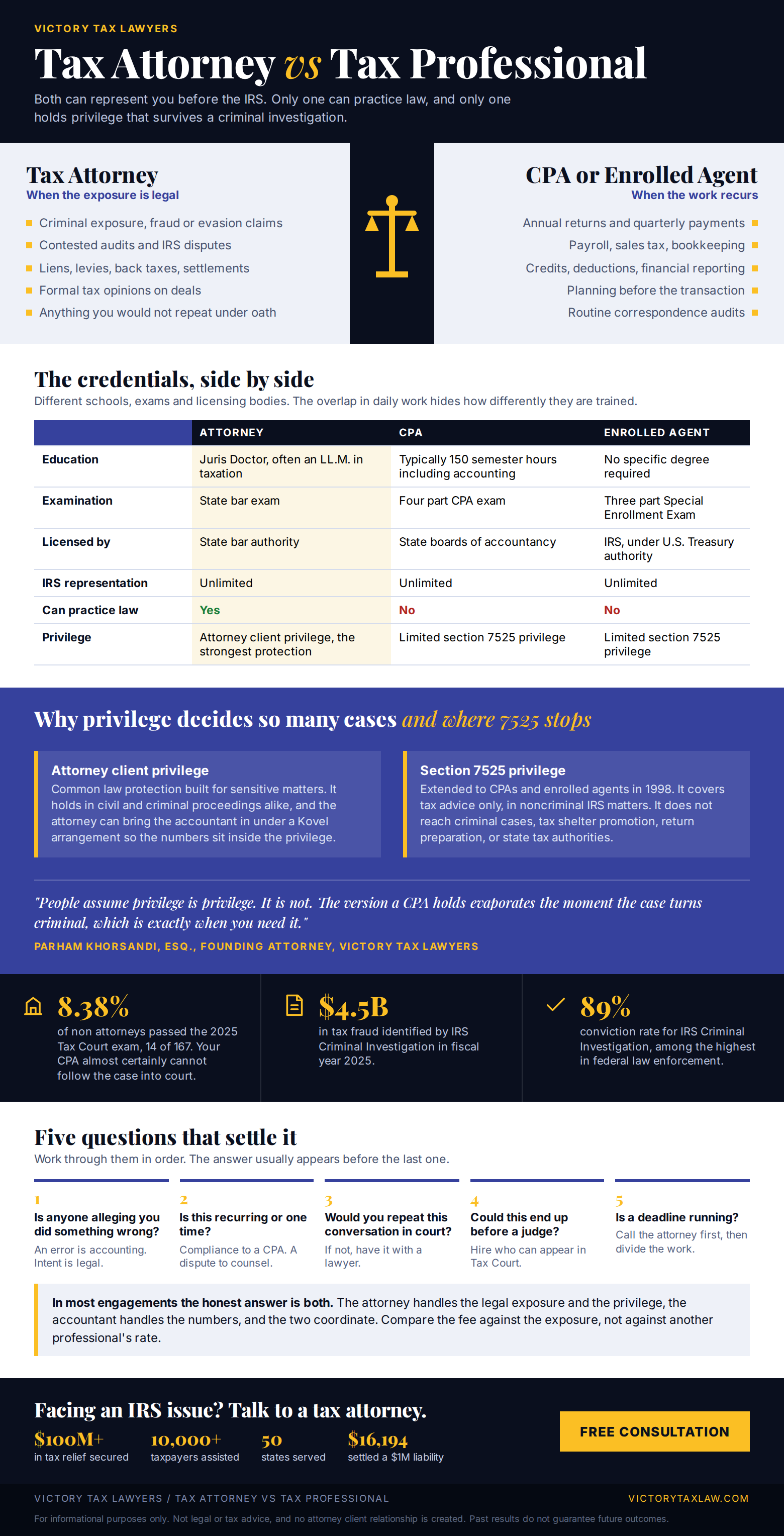
Different schools, exams, licensing bodies, and privileges create different paths. The overlap in daily work hides how differently they are trained. The comparison below sets out what stands behind each credential, because tax attorney education and CPA licensing produce genuinely different professionals.
| Credential | Attorney | CPA | Enrolled Agent |
|---|---|---|---|
| Education | Juris Doctor (J.D.) from law school; may also have a tax concentration or LL.M. in taxation. | Typically 150 semester hours of college coursework, including accounting | No specific degree required |
| Examination | State bar examination | Four-part CPA Examination | Three-part Special Enrollment Examination (SEE) |
| Licensed by | State bar authority | State boards of accountancy | IRS, under U.S. Treasury authority |
| Experience requirement | Varies by state | Generally requires qualifying experience under a licensed CPA | No professional experience requirement beyond exam and suitability requirements |
| Core legal training | Litigation, statutory interpretation, evidence, and legal procedure | Accounting, auditing, financial reporting, and financial oversight | Federal taxation, tax procedure, and taxpayer representation |
| Representation before the IRS | Unlimited | Unlimited | Unlimited |
| Can practice law | Yes | No | No |
| Privilege on communications | Attorney-client privilege generally provides the strongest protection | Limited tax practitioner privilege in certain federal tax matters | Limited tax practitioner privilege in certain federal tax matters |
In our experience, only the attorney can practice law, and only the attorney-client privilege survives a criminal investigation. The next section explains why attorney-client privilege decides so many cases.
Why Does Attorney-Client Privilege Matter More Than Taxpayers Expect?
Communications with tax attorneys are protected by attorney-client privilege, a common law protection built for sensitive tax matters and legal disputes. Congress extended a narrower version to CPAs and enrolled agents in 1998. Internal Revenue Code section 7525 extends the same confidentiality to a federally authorized tax practitioner. It covers tax advice only. It applies only in noncriminal matters before the IRS, or in noncriminal federal court proceedings.
The section 7525 privilege does not apply to criminal tax matters. It does not apply to written communications promoting participation in a tax shelter. It does not cover return preparation, which is not legal advice. It also does not bind state tax authorities.
In contrast, if a civil audit turns into a criminal investigation, your CPA can be compelled to testify about conversations you assumed were confidential, and their workpapers can be produced. Your attorney cannot. In our experience, this is why a tax professional who suspects criminal exposure will tell a client to call a lawyer before saying another word. Where the accounting work still needs doing, the attorney can engage the accountant under a Kovel arrangement so the analysis sits inside the legal privilege.
"People assume privilege is privilege. It is not. The version a CPA holds evaporates the moment the case turns criminal, which is exactly when you need it," says Parham Khorsandi, Esq., Founding Attorney of Victory Tax Lawyers. "When a client is even close to that line, the sequence matters more than the substance: call the attorney first, and let the attorney bring the accountant in."
Who Can Actually Represent You in United States Tax Court?

Attorneys, plus the small number of non-attorneys who pass the court's own examination. The common claim that only tax attorneys can appear in United States Tax Court is not quite right, though the numbers make it nearly true in practice.
An attorney in good standing with a state bar is admitted on application, a certificate of good standing, and a filing fee. No additional examination is required. A non-attorney may also be admitted under Rule 200 of the Tax Court Rules of Practice and Procedure, by passing a written examination and clearing a character and fitness review.
That examination is the filter. According to the court's own published statistics, 167 non-attorneys sat the 2025 examination and 14 passed, a rate of 8.38 percent. The 2023 rate was 6.13 percent. Across the last two decades, the pass rate has rarely exceeded 15 percent.
So the accurate statement is this. Your CPA or enrolled agent may represent you through an audit, an appeal, and a collection negotiation, but almost certainly cannot follow the case into Tax Court. When complex tax litigation is a realistic outcome, hiring the person who can try the case is simpler than changing horses later.
When Should You Hire a Tax Attorney?

Hire a tax attorney when the exposure is legal rather than arithmetic. The trigger is not the size of the number. It is whether the dispute is about what you owe or about what you did. Criminal exposure is the clearest case. Tax fraud allegations, evasion charges, and criminal tax matters belong with counsel immediately, and the enforcement numbers explain the urgency.
In its fiscal year 2025 annual report, IRS Criminal Investigation identified almost $4.5 billion in tax fraud. The same report puts its conviction rate at 89 percent, among the highest in federal law enforcement. Those are not odds you improve by explaining yourself without a lawyer.
Legal disputes over tax liabilities come next. Complex tax disputes with the IRS or with state tax authorities call for legal guidance. So do contested tax audits where the facts are unfavorable, and complex tax issues heading toward litigation. So does drafting and negotiating settlements, or resolving back taxes, a tax lien, or a bank levy.
Transactions form a quieter third category. Some deals cannot close without required tax opinions, and those formal legal opinions come from a law firm rather than from an accountant. The tax generated by a business sale, a restructuring, or a cross-border move often turns on statutory interpretation, which is legal work by definition.
Finally, hire an attorney when confidentiality itself is the asset. If you would not want a conversation repeated under oath, it needs to happen inside attorney-client privilege. Our audit representation practice starts most engagements with exactly that conversation.
When a Tax Problem Becomes a Legal Problem
Consider a taxpayer facing a $1 million IRS tax liability. At that level, the question is not simply how to prepare a return or calculate deductions; the taxpayer needs to determine whether the liability can be legally challenged or resolved through an Offer in Compromise.
In one Victory Tax Lawyers matter, the firm reduced a client's approximately $1 million tax liability to $16,194 through an Offer in Compromise. This example shows why the right professional depends on the problem: accounting expertise can establish the numbers, while legal tax representation can address the dispute, negotiate with the IRS, and pursue available legal resolutions.
When Should You Hire a CPA or Enrolled Agent?
Hire a CPA or an enrolled agent for everything that recurs on a calendar. Routine, cyclical, and numbers-driven work is what they do better and cheaper than any law firm. Annual returns for individuals and businesses, quarterly estimated payments, payroll and sales tax management, and financial statement preparation all sit here.
So do a company's ongoing financial matters, including financial management, bookkeeping systems, financial oversight, and the reporting lenders and investors expect. A good CPA also earns their fee by finding what you missed, since CPAs excel at identifying tax credits and deductions across a full set of business finances.
In our experience, planning is the other strength. Tax-efficient investment strategies, retirement and estate planning, and the tax implications of a purchase or a hire are all forward-looking questions that a CPA or a tax advisor handles well. Tax strategies designed before the transaction are almost always cheaper than legal repair afterward.
We have found that basic IRS matters belong here too. CPAs and EAs are well suited to routine correspondence audits and straightforward collection matters, and a competent one will tell you when a matter has outgrown them. That handoff is the mark of a good tax professional rather than a failure of one.
What Does a Tax Attorney Cost Compared to Other Tax Professionals?
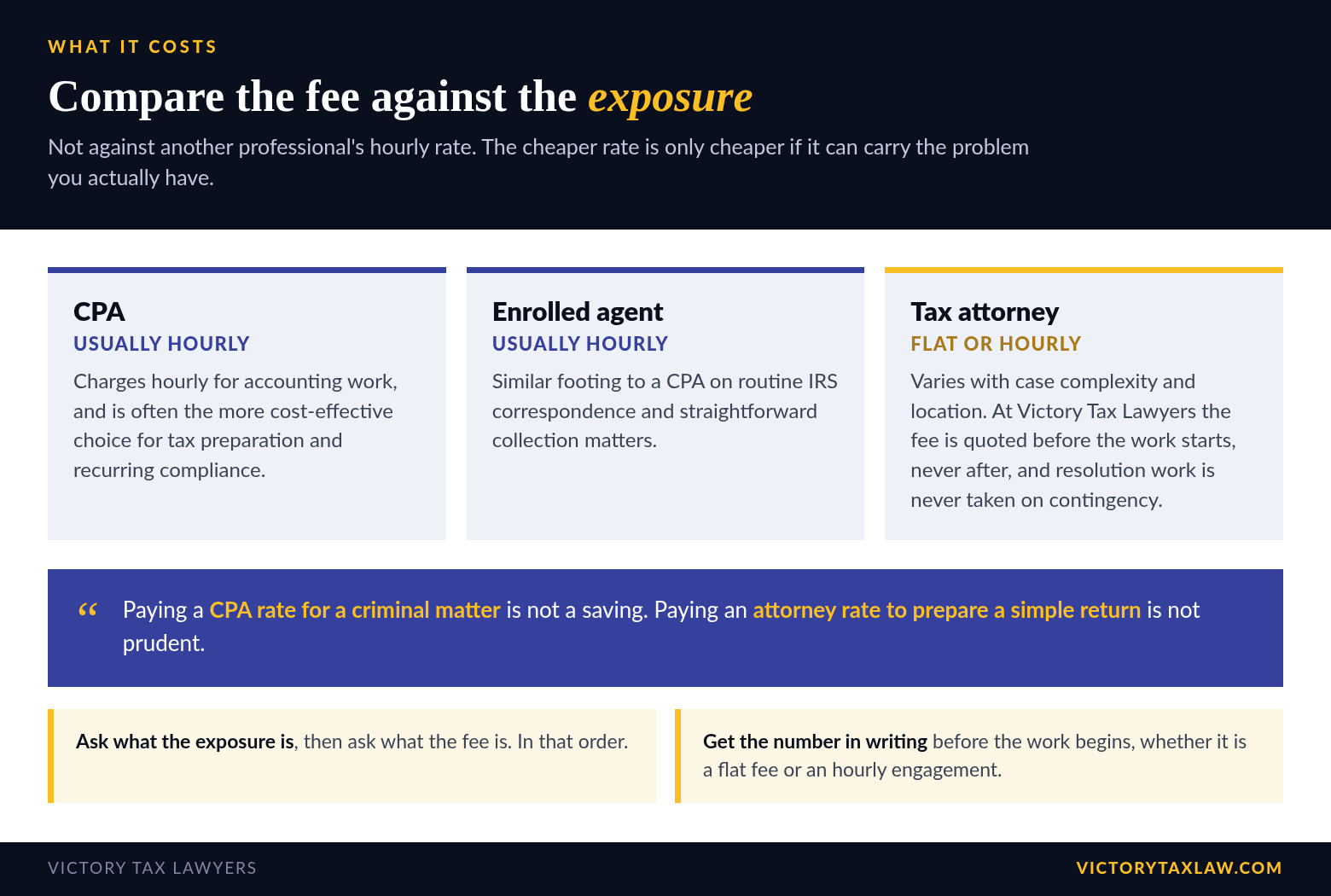
CPAs generally charge hourly for accounting work and are often more cost-effective for tax preparation. Tax attorney fees vary with case complexity and location, and firms structure them as flat fees or hourly engagements. At Victory Tax Lawyers, fees are flat or hourly depending on complexity, and we quote before the work starts, not after. We do not take tax resolution work on contingency, which is worth knowing when you compare firms that advertise otherwise.
Compare the cost against the exposure, not against another professional's rate. Paying a CPA rate for a criminal matter is not a saving. Paying an attorney rate to prepare a straightforward return is not a strategy. The right question is which risk you are buying protection against.
How Do You Decide Which One Your Situation Needs?
In our experience, five questions settle it in most cases. Work through them in order, and the answer usually appears before the last one. They move from the cheapest signal to the most serious.
Question 1: Is Anyone Alleging You Did Something Wrong?
If the issue is an error, an accountant can fix it. If the issue is intent, you need an attorney.
Question 2: Is This Recurring or One-Time?
Recurring compliance work belongs with a CPA or enrolled agent. A one-time dispute, transaction, or investigation belongs with counsel.
Question 3: Would You Be Comfortable if This Conversation Were Repeated in Court?
If not, have it with a lawyer, because the section 7525 privilege will not protect it in a criminal case.
Question 4: Could This End Up in Front of a Judge?
If litigation is possible, hire the professional who can appear in United States Tax Court.
Question 5: Is a Deadline Running?
Notices carry short response windows, and a missed deadline converts an arguable position into a final assessment. When a deadline is close, call the attorney first, then divide the work.
In most engagements, the honest answer is that you need both. The attorney handles the legal exposure and the privilege, the accountant handles the numbers, and the two coordinate. Our California tax attorney practice is built to work that way, and we serve clients through offices and teams reaching Los Angeles, Sacramento, San Francisco, and San Diego.
The Legal-Risk Test: A Simple Way to Choose Your Tax Professional
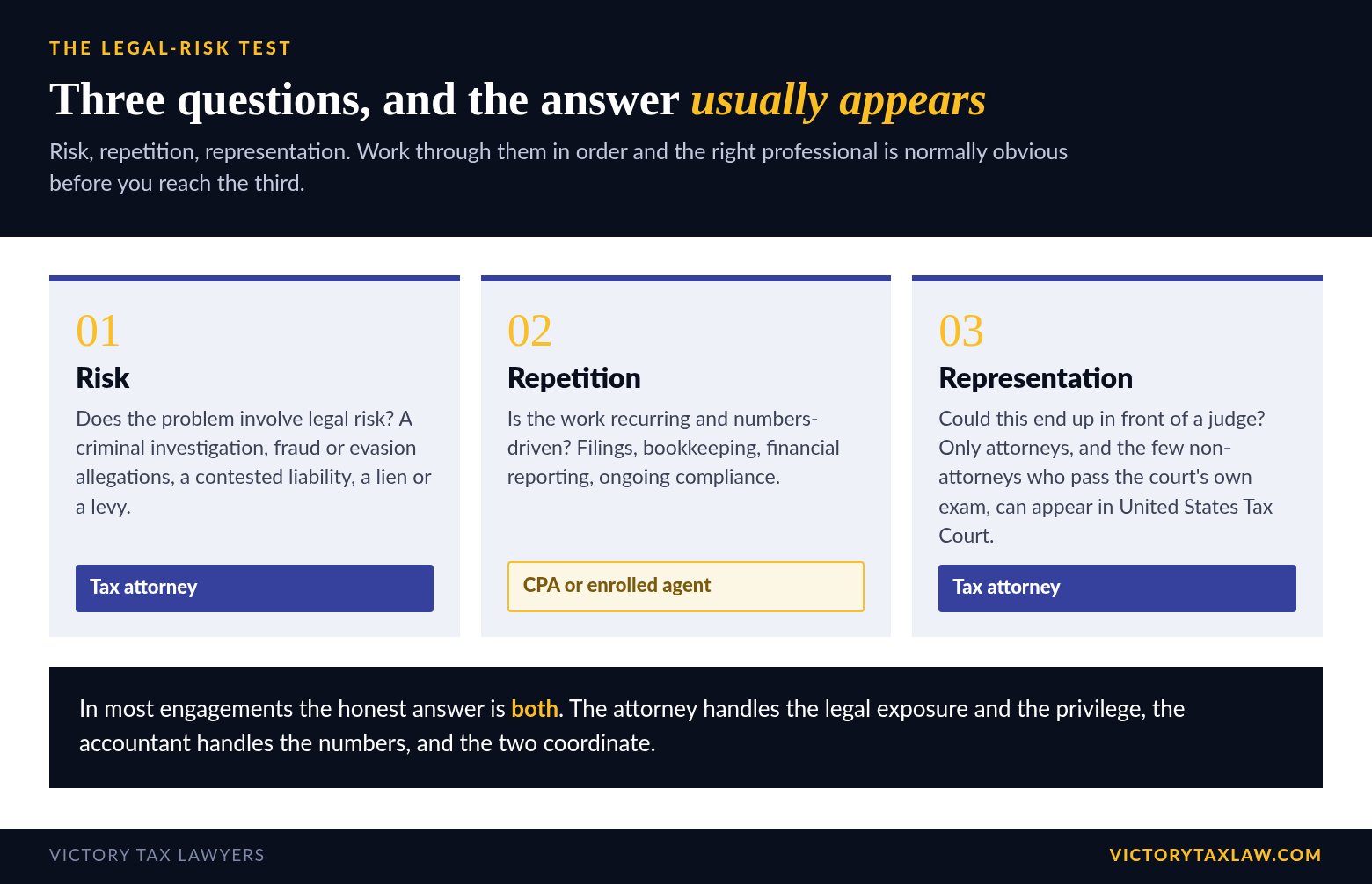
The easiest way to choose between a tax attorney, CPA, and enrolled agent is to evaluate three things: risk, repetition, and representation. If the problem involves legal risk, such as alleged fraud, criminal exposure, litigation, or a disputed interpretation of tax law, start with a tax attorney.
If the work is recurring and numbers-driven, such as tax filings, bookkeeping, financial reporting, or tax compliance, a CPA or enrolled agent is usually the better fit. If you need someone to negotiate or advocate before the IRS, all three credentials can provide unlimited representation rights, but only an attorney can practice law.
Ready to Talk With a Tax Attorney About Your Situation?
A tax attorney is not automatically the best professional for every tax problem. If you simply need an annual return prepared, books reconciled, financial statements reviewed, or a tax-efficient business structure evaluated, hiring a lawyer may add unnecessary cost. CPAs and enrolled agents can handle many tax matters and have unlimited representation rights before the IRS, making them strong choices when the primary need is compliance, preparation, planning, or routine representation.
With over $100 million saved for clients since 2017, Victory Tax Lawyers, a Los Angeles-based tax firm, delivers experienced legal help you can count on to get real tax solutions. Get the honest, effective tax assistance you deserve. Contact us for a free consultation today!
Frequently Asked Questions
These are the questions we hear most often from people deciding between a tax attorney and another tax professional.
What Is the Main Difference Between a Tax Attorney and a Tax Professional?
A tax attorney is a licensed lawyer who provides legal representation, legal advice, and courtroom advocacy on tax matters. A tax professional such as an enrolled agent or a CPA focuses on tax preparation, planning, and compliance.
How Can a Tax Attorney Help Me Compared to a Tax Professional?
An attorney can represent you in complex tax matters including audits, litigation, and Tax Court cases, and can build a legal strategy around a contested position. Communications with that attorney are also protected by full attorney-client privilege.
Are Tax Attorneys More Expensive Than Other Tax Professionals?
Attorney rates are generally higher than CPA or enrolled agent rates, and many firms, including ours, offer flat fees for defined matters. The comparison that matters is fee against exposure, not one hourly rate against another.
Can a Tax Professional Handle Legal Tax Issues?
CPAs and enrolled agents have unlimited representation rights before the IRS so that they can handle audits, appeals, and collection matters. They cannot practice law, cannot provide legal advice, and rarely appear in United States Tax Court.
How Do I Know Whether I Need a Tax Attorney or a Tax Professional?
Choose an attorney if you face a criminal investigation, contested liabilities, a tax lien, or a case that could reach Tax Court. Choose a CPA or enrolled agent for return preparation, planning, and routine compliance.
Legal Disclaimer: This article is for informational purposes only and does not constitute legal or tax advice. Reading it or contacting Victory Tax Lawyers does not create an attorney-client relationship. Tax outcomes depend on the specific facts of each matter, and past results do not guarantee future outcomes.