The Illinois Department of Revenue is the state agency that administers Illinois income tax, sales and use tax, and most of the state’s other taxes. It processes returns, audits them, issues notices, and collects balances, under its own procedures and deadlines that do not match the IRS’s. If you have an Illinois notice in hand, the most useful thing to know is which letter it is and how many days it gives you, and this guide covers both.
At Victory Tax Lawyers, we help taxpayers across the country with IRS problems and with the state matters that sit next to them. Our attorneys are licensed in California and admitted to the United States Tax Court, not in Illinois, so Illinois hearings, Independent Tax Tribunal cases, and court cases are handled with Illinois-admitted counsel. If you are dealing with an IDOR or IRS notice, contact us for a free consultation.
This guide is for Illinois residents, former residents, and businesses trying to work out what IDOR wants from them and what to do next.
What Does the Illinois Department of Revenue Do?
IDOR’s mission statement is “to serve Illinois’ taxpayers by administering Illinois tax laws and collecting tax revenues in a fair, consistent, and efficient manner.” In practice that covers a long list of taxes. IDOR’s FY2025 annual report shows $70.1 billion collected across all revenue sources, led by:
- Individual income tax, about $28.1 billion
- Sales and use tax, about $22.3 billion
- Business income tax, about $13.1 billion
- Motor fuel tax, about $2.9 billion
- Smaller amounts from public utility, cigarette, hotel, cannabis, liquor, and real estate transfer taxes
The main rates are simple compared with many states. According to IDOR’s income tax rates page, individuals pay a flat 4.95% of net income, and corporations pay 7%. Businesses also pay the Personal Property Replacement Tax, at 2.5% for C corporations and 1.5% for partnerships, S corporations, and trusts. The state sales tax rate is 6.25%, with local taxes on top.
IDOR has offices in Springfield, in the Willard Ice Building at 101 West Jefferson Street, and in Chicago at 555 West Monroe Street, along with regional offices in Des Plaines, Fairview Heights, Marion, and Rockford. Most taxpayers deal with it through MyTax Illinois, the Department’s online account system, where you can see balances, read notices, make payments, and set up payment plans.
How Is IDOR Different From the IRS and Other Illinois Agencies?
Illinois splits tax work across several bodies, and sending a dispute to the wrong one wastes time you may not have. The table below sets out who does what.
| Agency or body | What it handles | What it means for you |
|---|---|---|
| Illinois Department of Revenue (IDOR) | Income tax, sales and use tax (ROT), withholding, motor fuel, cigarette, and other state taxes | Audits, notices, and collections for most Illinois tax balances |
| Illinois Department of Employment Security (IDES) | Unemployment insurance contributions | Payroll audits and worker classification for unemployment tax |
| County assessors and local governments | Property tax | Property is assessed and taxed locally; IDOR’s role is equalization and oversight |
| Illinois Independent Tax Tribunal | Disputes with IDOR over $15,000 of tax | An independent forum, separate from IDOR, for contested notices |
| Internal Revenue Service (IRS) | Federal taxes | Separate notices, deadlines, and appeal rights |
Property tax trips people up most. IDOR’s own publication on property tax says “only local governments levy and collect property tax,” and the assessment on your property “is set by local officials.” A property tax bill problem goes to your county, not to IDOR.
A federal and a state matter can run at the same time on the same facts. Illinois law requires you to report a federal change to Illinois within 120 days, and an unreported change can be assessed at any time. Resolving the IRS case does not resolve the Illinois one.
How Long Does IDOR Have to Audit and Collect?
For income tax, 35 ILCS 5/905 says a Notice of Deficiency “shall be issued not later than 3 years after the date the return was filed.” That grows to 6 years if more than 25% of base income was left off the return. If no return was filed, or a fraudulent one was, there is no limit at all. Sales tax uses a rolling 3-year window counted back from each January 1 and July 1.
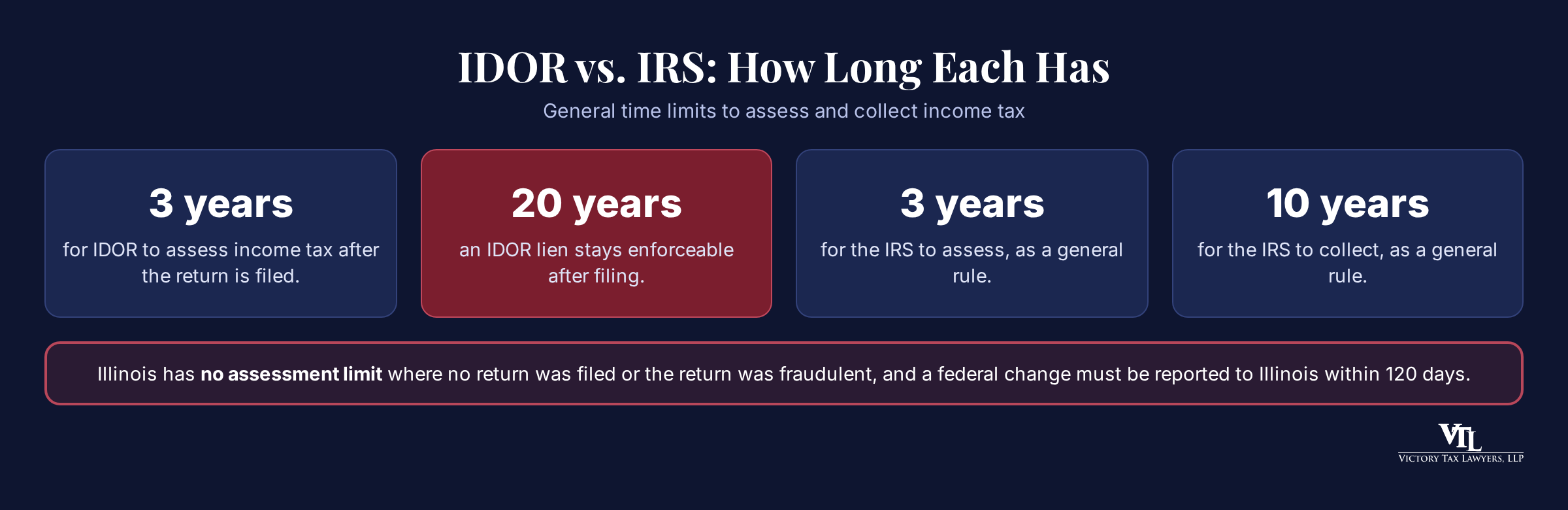
Collection is where Illinois can surprise people. Once IDOR files a lien in the State Tax Lien Registry, the lien lasts 20 years under 35 ILCS 5/1104 unless it is released sooner. IDOR’s collections page says the time it has to enforce a finalized debt “varies from 2 years to 20 years or longer,” depending on whether a lien was filed and what other actions were taken. The federal collection period is generally ten years. An old Illinois balance can outlast the IRS balance from the same year.
The enforcement tools are real. IDOR can levy bank accounts, take up to 15% of gross wages, file liens, offset state payments, and ask licensing agencies to act. Our guide to owing the Illinois Department of Revenue covers each one and the ways to stop them.
What Kinds of IDOR Notices Will You See?
IDOR’s letters page lists the common ones. A few matter more than the rest.
A Return Correction Notice (IDOR-1-RCN) means IDOR changed something on your return when it processed it, often a credit or payment that did not match its records.
A Notice of Tax Due (IDOR-2-BILL) is sent “when there is a balance due on your account.” The first bill breaks down the tax, penalty, and interest.
A Notice of Proposed Deficiency or Notice of Proposed Liability comes at the end of an audit. It opens a 60-day window to ask IDOR’s Informal Conference Board to review the adjustments.
A Notice of Deficiency or Notice of Tax Liability is the formal notice with protest rights. You have 60 days to protest to IDOR’s Office of Administrative Hearings or, above $15,000 of tax, to petition the Independent Tax Tribunal.
A Notice of Claim Denial means IDOR refused all or part of a refund claim. It also carries protest rights.
The letter’s name and date are the two things to find first. Our IDOR audit representation page explains the audit notices in detail.
What Triggers an IDOR Audit?
IDOR’s audit publication, PIO-60, says the Department selects audits “using several methods, including random selection, referrals, nature of business, audit history, and tax issues.” The FY2025 annual report names specific problems its auditors keep finding.
Residency is at the top for individuals. The report says some taxpayers file “as residents of states with no income tax, such as Florida, while still maintaining residences in Illinois.” Illinois regulations presume that anyone claiming a homestead exemption on Illinois property is an Illinois resident, and that a resident in one year stays a resident the next if they spend more days in Illinois than in any other state. Both presumptions can be overcome, but only with clear and convincing evidence.
Unreported federal changes come next. The report says taxpayers “often fail to report federal changes that affect their Illinois returns.”
For businesses, cash-heavy retail, missing exemption certificates, and remote sellers who cannot show where a sale was delivered all show up on the list. Our Illinois sales tax audit page covers those audits.
What Does an Illinois Residency Dispute Look Like in Practice?
Take a retiree who buys a condo in Florida, gets a Florida driver’s license, and files a part-year Illinois return. The family home in Illinois is still there, with the homestead exemption still claimed, and the retiree spends summers and holidays there.
IDOR sees a homestead exemption and a calendar full of Illinois days. The retiree sees a completed move. Under the regulation, the taxpayer has to overcome a presumption, and memories of intent do not do that. Closing records, the dropped homestead exemption, travel records, voter registration, and the date Illinois ties actually ended are what move the file.
How Do You Dispute an IDOR Assessment?
There are three stages, each with its own deadline, and they are listed on IDOR’s dispute page.
The Informal Conference Board. Before a formal notice issues, you can request review of unagreed audit adjustments on Form ICB-1 within 60 days of the proposed notice. You must sign a waiver extending the statute of limitations.
A formal protest or a Tribunal petition. After a Notice of Deficiency or Notice of Tax Liability, you have 60 days. Income tax protests use Form EAR-14, and other taxes use Form AH-4. If more than $15,000 of tax is at issue, excluding penalties and interest, you can petition the Illinois Independent Tax Tribunal instead. Its decisions are reviewed by the Illinois Appellate Court.
Payment under protest. You can pay on Form RR-374 and file in circuit court within 30 days of the payment.
If the amount is not in dispute but you cannot pay it, the route is different. Payment plans open once the balance reaches Collections, and the IDOR Board of Appeals can consider an offer in compromise on the ground that the full debt cannot be collected.
What Is the Best Way to Respond to an IDOR Notice?
We use the same four steps for every Illinois notice: identify, verify, preserve, respond.
Identify the letter, the tax, the period, the amount, and the deadline. A proposed notice and a statutory notice look similar and carry different rights.
Verify the figures against your filed return, your payment records, and your MyTax Illinois account. If the notice follows an IRS change, compare the federal adjustment with the Illinois treatment rather than assuming the two match.
Preserve the records that support your position before you respond, especially in residency and business audits, where records get harder to find every year.
Respond to the right body within the deadline. Illinois’ Taxpayers’ Bill of Rights, in 20 ILCS 2520, gives you the right to appeal within set time periods, and in some cases to recover professional fees if IDOR assessed without reasonable cause. Those rights only help if the deadline is met.
Should You Handle an IDOR Matter Yourself or Hire a Tax Professional?
Not every notice needs a professional. If you agree with a small balance, paying it through MyTax Illinois or setting up a pre-approved payment plan online is often the simplest answer. The same goes for a Return Correction Notice where you can see the mistake and fix it with one document.
Help becomes worth paying for when the dollars, the facts, or the procedure get harder. A residency case turns on years of records. An audit of a cash business turns on how the sales records are presented. A Tribunal petition must look like a circuit court complaint, and IDOR requires an attorney as the representative before the Tribunal. Missing a 60-day deadline turns a dispute into a final bill.
The trade-off is plain. Handling a simple notice yourself saves fees. Getting it wrong on a large one can cost far more than representation would have.
Ready to Speak With Someone About Your IDOR Notice?
An IDOR problem is rarely just a number. Which letter it is, which tax and year it covers, whether the IRS is involved, and which deadline is running all change the right response. If the IRS is part of the picture, that is our core practice, and we coordinate with Illinois counsel where the Illinois side needs an Illinois-admitted attorney. Our Illinois tax attorney page explains how we divide that work.
Contact us for a free consultation today.
Frequently Asked Questions
These are the questions Illinois taxpayers ask most often about the Department of Revenue.
What Is the Illinois Department of Revenue?
It is the state agency that administers and collects most Illinois taxes, including individual and corporate income tax, sales and use tax, withholding, and motor fuel tax. It operates separately from the IRS, with its own notices, deadlines, and appeal routes.
What Taxes Does the Illinois Department of Revenue Not Handle?
Unemployment insurance contributions belong to the Illinois Department of Employment Security. Property tax is assessed and collected by local governments, with IDOR in an equalization and oversight role. Federal taxes belong to the IRS.
How Long Does IDOR Have to Assess Income Tax?
Generally 3 years from the date the return was filed, or 6 years if more than 25% of base income was omitted. There is no limit if no return was filed, the return was fraudulent, or a federal change was never reported.
What Should I Do If I Get a Notice From the Illinois Department of Revenue?
Find the notice name, the tax period, and the deadline, then check the figures against your records and your MyTax Illinois account. If it is a Notice of Deficiency or Notice of Tax Liability and you disagree, protest within 60 days.
Can a Tax Attorney Help With Illinois Department of Revenue Issues?
Yes, with audits, Informal Conference Board reviews, collections, payment plans, and Board of Appeals petitions. Formal hearings and Independent Tax Tribunal cases require an attorney, and Victory Tax Lawyers handles those with Illinois-admitted counsel because our attorneys are licensed in California.
Legal Disclaimer: The information on this page is provided for general educational purposes and is not legal or tax advice. Illinois Department of Revenue procedures, deadlines, rates, and relief programs change over time and depend on the facts of each matter. Limitation periods described here are general rules subject to exceptions. Victory Tax Lawyers, LLP attorneys are licensed in California and admitted to the United States Tax Court; they are not admitted to practice law in Illinois. Reading this page does not create an attorney-client relationship. Past results do not guarantee future outcomes.