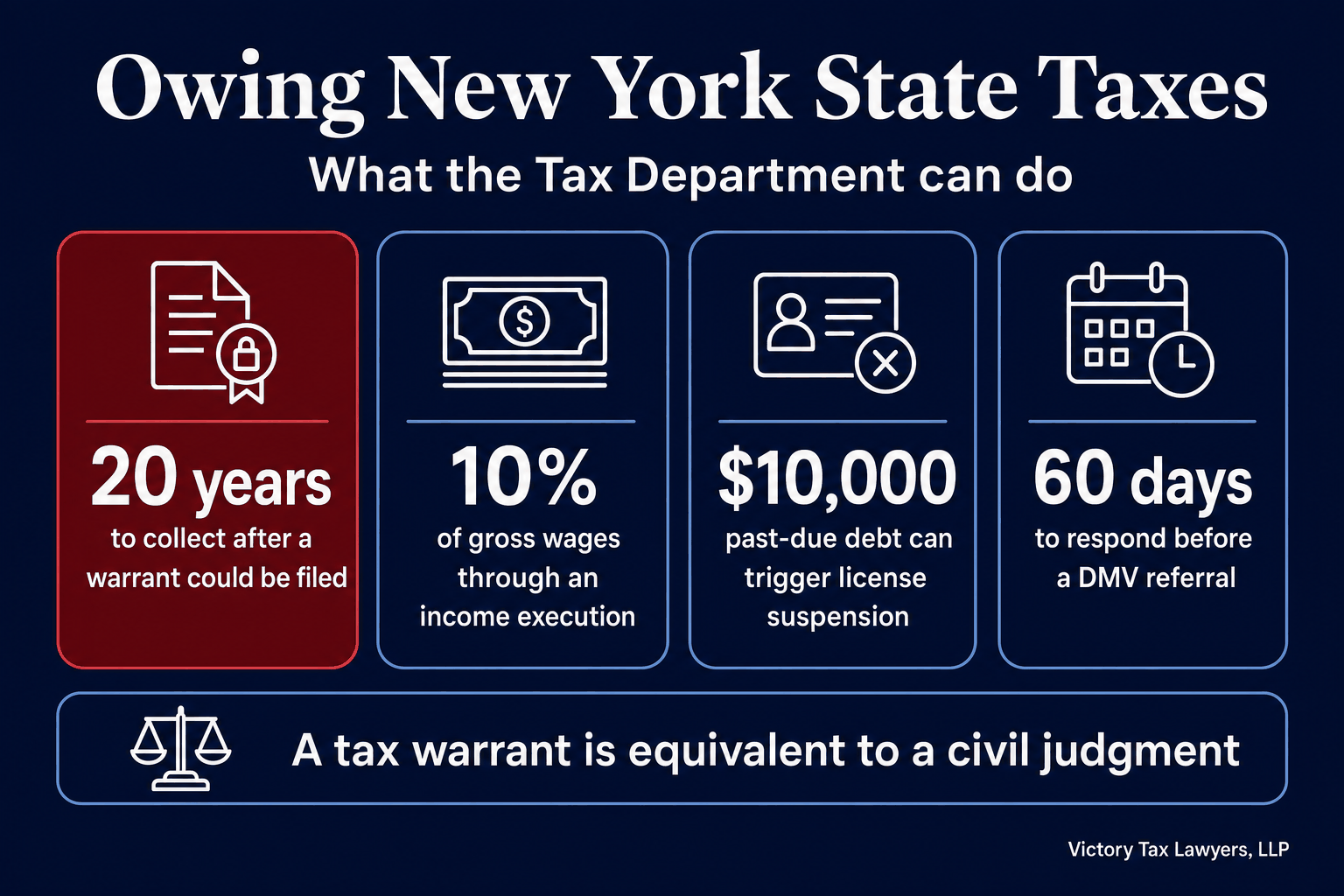
If you owe New York State taxes and do not resolve the bill, the Department of Taxation and Finance can file a tax warrant that works like a civil judgment, garnish up to 10% of your gross wages, levy your bank account, take your refunds, and, for debts of $10,000 or more, move to suspend your driver’s license. You have options before and after that point: paying in full, a one-time extension, an installment payment agreement, a protest if the bill is wrong, or an offer in compromise if you qualify.
Contact us today and let us help with your tax liability.
New York runs its own warrant system, wage garnishment procedure, and offer program, separate from the IRS. At Victory Tax Lawyers, we help taxpayers with a New York State Department of Taxation and Finance balance choose the payment route that fits their finances.
How Does New York Collect an Unpaid Tax Bill?

It starts with a bill, usually from the Notice and Demand, Notice of Additional Tax Due, Notice of Deficiency, or Notice of Determination series. The amount due and due date sit in the upper-right corner. Some of these notices carry protest rights and some do not, which decides what you can still argue later.
According to the Department’s page on collection rights, the collection unit contacts you once you have not paid a bill, the deadline to appeal it has passed, or you have used up your appeal rights. At that point the debt is fixed and final. Publication 131 explains that the Civil Enforcement Division then takes over, and that you get a chance to pay before enforcement begins.
After that, the paperwork changes. You get a copy of any tax warrant filed. In most cases, Form DTF-978, Notice to Judgment Debtor or Obligor, comes before a levy and lists property that may be exempt. A license referral starts with a Notice of Proposed Driver’s License Suspension, which Division of Tax Appeals records show arrives with a Consolidated Statement of Tax Liabilities (Form DTF-967-E) listing each open assessment. Some accounts go to a private collection agency.
What Is a New York Tax Warrant?
A tax warrant is equivalent to a civil judgment against you. The Department files it electronically with the New York State Department of State and with the county clerk’s office listed on the warrant, and it becomes a public record. A filed warrant creates a lien on your real and personal property and can get in the way of buying, selling, or borrowing against it.
Before filing, the Department sends notice of the debt and a chance to resolve it. That is the cheapest point to act. An installment payment agreement can prevent further collection, but the warrant stays on file as a lien until the full warranted balance is paid. Once it is, the Department sends a Satisfaction of Judgment to the Department of State and the county clerk.
If you are selling or refinancing and cannot pay the warrant in full, you may qualify for a release or subordination of the lien. Our tax lien page covers how liens affect property deals.
Can New York Garnish Your Wages or Levy Your Bank Account?
Yes, once a warrant is on file. The Department must file a tax warrant before it issues an income execution or serves a levy.
An income execution is New York’s version of wage garnishment. The Department sends it to you first and asks you to pay up to 10% of your gross wages each payday, starting within 20 days of the notice. If you do not, it goes to your employer, who deducts the payment. It stays in place until the liability, including added penalties and interest, is paid in full.
A levy is a legal seizure of property held by someone else. Most often that means your bank, which has 90 days to respond. Exempt money can include Social Security, SSI, public assistance, support payments, unemployment and workers’ compensation benefits, and pensions.
If everything else fails, the Department may seize and auction non-exempt property, and for a business that can mean changed locks. Publication 131 lists grounds for releasing a levy, including an installment agreement that provides for release and, for individuals, economic hardship. Our tax levy page explains levy release.
Can New York Suspend Your Driver’s License Over Taxes?
It can. If you have at least $10,000 in past-due tax debt assessed against you personally, the Department may recommend that DMV suspend your New York driver’s license. The license suspension program runs in this order:
- You receive a Notice of Proposed Driver’s License Suspension, which gives you 60 days to resolve the debt.
- If you do not respond, the Department refers you to DMV.
- DMV sends an Order of Suspension or Revocation 15 days before the suspension date.
Exemptions cover commercial license holders, people whose wages are already garnished, those paying court-ordered child support, and recipients of public assistance or SSI. An installment payment agreement stops a pending referral or puts an existing suspension on hold while you comply. For undue economic hardship, file Form DTF-5.1 with Form DTF-5, Statement of Financial Condition. That filing is not a protest. DMV lists unpaid New York State tax debt as a cause of indefinite suspension and sends drivers back to the Tax Department to clear it.
Will New York Take Your Tax Refund?
It can. Under the state’s offset programs, a refund or other money owed to you can be applied to the debt. A past-due New York income tax debt is also referred to the federal government and to states in the Multi-State Offset Program, so your federal refund can go toward it too. Whatever the offset leaves unpaid still has to be resolved.
How Much Do Penalties and Interest Add?
The Department’s penalty rules for personal income tax are:
- Late filing: 5% of the tax due for each month or part of a month the return is late, up to 25%. If the return is more than 60 days late, the minimum penalty is the lesser of $100 or the total amount due.
- Late payment: 0.5% of the unpaid amount for each month or part of a month, up to 25%, on top of interest.
- Interest: compounded daily, with the rate reset every quarter. For October 1 through December 31, 2026, the published rate on late income tax payments is 9.5% a year, and 14.5% for sales and use tax.
Penalties can be waived for reasonable cause; interest usually cannot. Both keep running during a payment plan.
How Long Does New York Have to Collect?
Twenty years. Under Tax Law section 174-b, a tax liability is extinguished 20 years after the first date a warrant could be filed, whether or not one ever was. That date is the day after the payment deadline on the notice and demand, or, if you had hearing rights, the day that chance ran out.
Since a 2011 amendment, explained in TSB-M-11(10)C, a payment or written acknowledgment no longer restarts the clock, though you and the Department can agree in writing to extend it. Waiting it out is not a plan.
How Do You Pay New York State Taxes You Owe?

The Department’s payment page lists these main routes:
- Quick Pay: free from your bank account, no account login needed, using the case number on your notice.
- Online Services: free from a bank account, or by card for a fee.
- Mail: a check or money order payable to Commissioner of Taxation and Finance, with the ten-digit assessment or case number on it.
Payments can take up to 10 days to post. If you can pay in full within 60 days, request a one-time extension by phone instead of a payment plan.
Can You Set Up a Payment Plan With New York?
Often, yes. An installment payment agreement (IPA) is for balances you cannot pay within 60 days. You need a bill before you can request one. You can apply online through Online Services if the balance is $20,000 or less and needs no more than 36 monthly payments. Larger balances or longer terms go through the Department by phone.
The Department looks at your payment and filing history, your finances, and your compliance. It may ask for Form DTF-5, and it may file a tax warrant as a condition of the plan. Payments come out automatically on the 5th or 15th of the month. New taxes must be filed and paid on time, and a new bill does not roll into the existing agreement. Falling out of compliance lets the Department end or modify the plan on 30 days’ notice.
| Option | Best for | What to know |
|---|---|---|
| Pay in full | Balances you can clear now | Quick Pay from a bank account is free; stops further penalty and interest |
| One-time extension | Balances you can pay within 60 days | Requested by phone; no payment plan needed |
| Online installment payment agreement | Balances of $20,000 or less, paid in 36 months or fewer | Automatic withdrawals; penalty and interest keep accruing; an existing warrant stays on file |
| Installment agreement by phone | Larger balances or longer terms | Reviewed against your finances; Form DTF-5 or a warrant may be required |
| Offer in compromise | Insolvency, bankruptcy discharge, or undue economic hardship | Full financial disclosure; the Department does not accept every offer, and collection may continue during review |
| Review or protest | Bills you believe are wrong | Protest deadlines on the notice are strict; a review request does not extend them |
Does New York Accept Offers in Compromise?
It does, within limits. The Offer in Compromise program is open to individuals and businesses that are insolvent or discharged in bankruptcy, and to individuals who are not insolvent but would suffer undue economic hardship if they paid in full. Qualifying is only the first hurdle. The Department also weighs whether accepting is in the best interest of the state. It normally expects any trust taxes, meaning unpaid sales or withholding tax, to be paid in full, not counting penalty and interest.
Undue economic hardship means you cannot pay reasonable basic living expenses, measured against the IRS Collection Financial Standards. Private school tuition, charitable giving, and credit card payments generally do not count.
The forms depend on where the liability stands:
- Form DTF-4.1 covers fixed and final liabilities, and it is the most common.
- Form DTF-4 covers liabilities still subject to protest or administrative review. It also allows an offer based on doubt about whether you owe the tax.
- Form DTF-5, Statement of Financial Condition, goes with either one.
A mailed application also needs three years of federal returns, 12 months of account statements, and a credit report less than 30 days old. Individuals who owe only personal income tax, $15,000 or less in total, may be able to apply online. Under Publication 220, a New York State Supreme Court justice must approve an offer when the fixed and final amount tops $100,000, not counting interest and penalties. Collection can continue during review. Our offer in compromise page explains how we evaluate whether an offer is realistic.
What If You Think the Bill Is Wrong?
Read the notice before you pay. A Notice of Deficiency or Notice of Determination generally gives you 90 days to request a conciliation conference or petition the Division of Tax Appeals. The Department’s dispute guidance warns that a request for review does not extend that deadline. For audit bills, see our New York DTF audit page and New York sales tax audit page.
How Do You Resolve New York Tax Debt, Step by Step?
Step 1: Confirm What You Owe
Match every open assessment in Online Services against your notices. Some bills may still be protestable.
Step 2: Find Out Where You Are in Collection
Is a warrant filed? Is an income execution or levy active? Has a license notice arrived? Each stage has its own deadline.
Step 3: Decide Whether to Dispute Any Part of the Bill
If protest rights remain, file before the deadline on the notice.
Step 4: Gather Your Financial Information
Larger installment agreements, hardship applications, and offers all turn on Form DTF-5. Gather income, expenses, assets, and statements first.
Step 5: Choose the Resolution Route
Pay in full, take a one-time extension, set up an IPA, or evaluate an offer, depending on the balance and your finances.
Step 6: Stay Compliant Afterward
File and pay every new return on time. A missed filing can default a payment plan or an accepted offer.
How Does Victory Tax Lawyers, LLP Help With New York Tax Debt?

Victory Tax Lawyers helps taxpayers facing New York State tax debt sort out what they owe and which option fits. Under the Department’s power of attorney rules, anyone named on Form POA-1 may represent a taxpayer in routine matters, audits, and assessments, so we can be appointed to deal with the Civil Enforcement Division directly. Our team includes an IRS enrolled agent. Our attorneys are licensed in California, not New York. Hearings before the Bureau of Conciliation and Mediation Services and the Division of Tax Appeals are limited to New York-licensed attorneys, New York CPAs, IRS enrolled agents, and New York public accountants. Where a matter needs New York-admitted counsel, we coordinate with them.
That work covers confirming the balance, requesting installment agreements, preparing Form DTF-5 and offer applications, and seeking levy relief. A federal resolution does not clear a state balance. Our New York tax attorney page covers combined IRS and state representation, and our back taxes page covers older balances.
Ready to Resolve Your New York Tax Debt?
The cheapest time to deal with a New York balance is before the warrant is filed. After that, you are working around a public lien, a possible income execution, and sometimes a license referral.
Reach Out to Victory Tax Lawyers to Understand Your Options.
Frequently Asked Questions
These are the questions New York taxpayers ask most often about state tax debt. We did our best to answer them.
How Do I Know If I Owe New York State Taxes?
Check your Online Services account with the Department of Taxation and Finance, which shows open bills and the notices sent to you. A bill or notice lists the amount due and the due date in its upper-right corner. You can also search the state’s tax warrant database if you think a warrant may have been filed.
Can New York Garnish My Wages for Back Taxes?
Yes. After it files a tax warrant, the Department can issue an income execution. It first asks you to pay up to 10% of your gross wages each payday on your own. If you do not, it sends the income execution to your employer, who deducts the payments until the balance is paid.
How Long Does New York Have to Collect Unpaid Taxes?
Under Tax Law section 174-b, a tax liability is extinguished 20 years after the first date a warrant could be filed, whether or not one was filed. Since 2011, a payment or a written acknowledgment of the debt no longer extends that period, although you and the Department can agree in writing to extend it.
Will New York Suspend My Driver’s License for Unpaid Taxes?
It can, if you have at least $10,000 in past-due tax debt assessed against you personally. The Department first sends a Notice of Proposed Driver’s License Suspension and gives you 60 days to resolve the debt. An installment payment agreement, a statutory exemption, or an approved hardship application can stop or pause the suspension.
Does New York Have an Offer in Compromise Program?
New York has an Offer in Compromise program for taxpayers who are insolvent, have been discharged in bankruptcy, or, for individuals, would face undue economic hardship if they paid in full. The Department reviews each offer against its criteria and does not accept every offer, so the first step is evaluating whether you qualify.
Legal Disclaimer: The information on this page is provided for general educational purposes and is not legal or tax advice. New York State Department of Taxation and Finance procedures, penalty rates, interest rates, eligibility thresholds, and collection practices change over time and depend on the specific facts of each matter. The limitation periods and dollar figures described here are general rules subject to exceptions. Victory Tax Lawyers, LLP’s attorneys are licensed in California and are not admitted to practice law in New York. Reading this page does not create an attorney-client relationship with Victory Tax Lawyers, LLP. For advice about a notice you have received, consult a licensed tax attorney, certified public accountant, or enrolled agent.