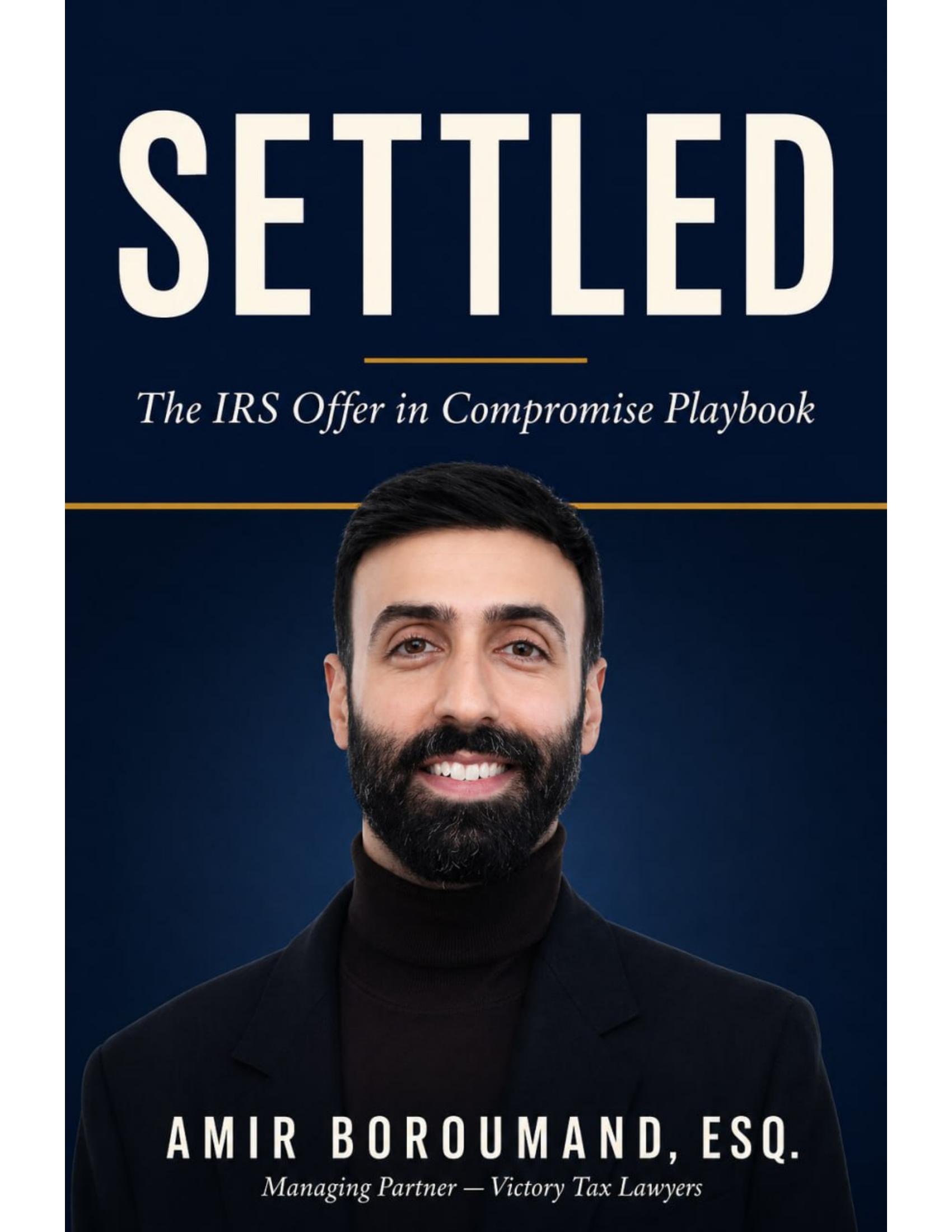
SETTLED
The IRS Offer in Compromise Playbook — An Attorney's System for Settling IRS Tax Debt Without the Marketing, Without the Mills
Get the Free PlaybookWhy most Offers in Compromise get rejected — and the ones that don't
The IRS receives roughly thirty thousand Offers in Compromise each year. In fiscal year 2024, it accepted only 7,199 of them — barely more than one in five. The other four out of five are rejected, and the overwhelming majority are rejected for the same handful of reasons, every year, over and over.
Tax attorney Amir Boroumand has spent fifteen years filing, negotiating, and appealing Offers in Compromise. As Managing Partner at Victory Tax Lawyers, he has closed cases where a million-dollar liability was resolved for less than two cents on the dollar — and he has cleaned up Offers from other firms that should never have been filed. In SETTLED, he walks through the actual formula the IRS uses: Reasonable Collection Potential, asset valuation under the quick-sale rule, allowable expenses under the Collection Financial Standards, and the page-by-page mechanics of Form 433-A (OIC) and Form 656.
If you owe the IRS and you are wondering whether an Offer in Compromise is the right tool — or whether the firm pitching you one knows what they are doing — read this first.
What's Inside
- The Reasonable Collection Potential formula, line by line — with three worked examples at three income levels
- How the IRS values your assets — and the deductions most filers miss
- Allowable monthly expenses: what the IRS accepts, what it rejects, and how to document expenses that exceed the standards
- Form 433-A (OIC) and Form 656, walked through page by page
- The five most common rejection reasons — and how to avoid each one
- Seven anonymized real cases from the firm's settlement log, with the math behind the result
- When an Offer in Compromise is the wrong tool — and what to use instead (Partial Pay IA, Currently Not Collectible, bankruptcy, innocent spouse)
- Ten questions to ask any tax attorney before you sign an engagement letter
About the Author

Amir Boroumand, Esq.
Managing Partner — Victory Tax Lawyers, LLP · Los Angeles
Amir Boroumand is the Managing Partner of Victory Tax Lawyers, LLP, a Los Angeles tax controversy firm. He has spent nearly fifteen years representing taxpayers in Offer in Compromise, installment agreement, audit, and collection-defense matters before the IRS. Under his leadership, Victory Tax Lawyers has resolved more than ninety million dollars in tax liabilities for clients across the United States.
He is admitted to practice in the State of California, before the United States Tax Court, and before the United States District Court for the Central District of California.
Download the Playbook — Free
50 pages · PDF · Delivered to your inbox in seconds.
Request a Free Consultation
100% Free · Confidential · No Obligation
We respect your privacy. Your information is used only to deliver the playbook and any related follow-up communication. We do not sell or rent your information. You can unsubscribe at any time.