New York sales tax audit representation means a qualified representative, appointed on Form POA-1, deals with the New York State Department of Taxation and Finance for your business during a sales and use tax audit. The audit usually covers three years, and if your records are complete, DTF needs your consent before it assesses from a test period instead of a detailed audit. If you disagree with the result, you generally have 90 days from the Notice of Determination to protest.
Contact us today and let us help with your tax liability.
What Is NY Sales Tax Audit Representation?
The Department of Taxation and Finance (DTF) runs New York's sales and use tax. It issues the Certificate of Authority every seller needs and audits businesses to check that the tax they remitted matches what they sold. Its audits follow their own rules, forms and deadlines, separate from the IRS.
New York gives you the right to representation at any point in an audit. According to Publication 130-F, you may also pause a meeting or interview to get a representative, and anyone acting for you needs a signed Form POA-1, Power of Attorney. The form names individuals, not firms, so the POA-1 lists the specific people handling your file.
Victory Tax Lawyers helps business owners facing a New York sales tax audit. Our attorneys are licensed in California, and our team includes an IRS enrolled agent. New York allows any individual named on Form POA-1 to represent a taxpayer during the audit itself. Formal protests follow a stricter rule, covered below. Once the POA-1 is on file, the auditor's requests come to us.
Every register tape, invoice and bank statement you hand over becomes part of the auditor's workpapers, so we review them first. For income tax, residency or withholding audits, see our page on NY DTF audit representation. The California version of this process is covered on our CDTFA audit representation page.
Who Gets Selected for a New York Sales Tax Audit?
DTF lists its audit selection reasons on its audit information page. They include failing to file a return, failing to report income or sales, claiming excessive credits or exclusions, and differences that show up when the department compares a return with data from the IRS, banks, employers and other businesses. Prior audit results and misuse of exemption certificates are also on the list. The table pairs those triggers with what the auditor examines.
| Audit Trigger | What the Auditor Examines | Why It Raises Risk |
|---|---|---|
| Failure to file or report sales | Filing history, sales records and bank deposits for the period | Missing returns remove the three-year limit on assessment. |
| Differences with outside data | Returns compared with information from the IRS, banks, employers and other businesses | Reported sales that do not match third-party data point to underreporting. |
| Excessive credits or exclusions | Claimed exempt sales, credits and deductions on the returns | Every exclusion needs documents behind it, or it becomes taxable. |
| Misuse of exemption certificates | Form ST-120 and other exemption certificates tied to specific sales | Missing or improper certificates can leave both buyer and seller liable. |
| Prior audit results | Findings and recordkeeping recommendations from earlier audits | Repeat issues suggest problems that were never corrected. |
| Records that cannot be reconciled | POS data, register tapes, purchase records and the returns | Inadequate records open the door to sampling or estimated assessments. |
The first contact is usually a letter asking for information. Field audits are generally scheduled at least 15 days ahead, most business audits take place at your business, and an extension of up to 30 days is usually available.
What Does a New York Sales Tax Auditor Examine?

The auditor starts with registration. New York requires a business to register at least 20 days before it begins making taxable sales, and the Certificate of Authority it receives must be displayed at the place of business. Selling without one carries a penalty of up to $500 for the first day and up to $200 for each day after, capped at $10,000.
Next come the returns. Most vendors file quarterly on Form ST-100. Annual filers, who owe $3,000 or less in tax for an annual filing period, use Form ST-101, and those with $300,000 or more in taxable receipts, taxable purchases, rents and amusement charges in a quarter move to monthly filing on Form ST-809. Tax Bulletin ST-275 sets out these thresholds.
Exempt sales get their own review. A buyer who purchases for resale gives the seller Form ST-120, Resale Certificate, and under Tax Bulletin ST-240 the certificate must reach the seller within 90 days of the sale. A properly completed certificate accepted in good faith protects the seller. A missing one can leave both buyer and seller liable for the tax. Sellers must keep each certificate for at least three years from the due date of the return that reported the last sale made under it.
"An audit is a documentation contest, not an argument about intent," says Parham Khorsandi, Esq., Managing Attorney of Victory Tax Lawyers. "The businesses that come out clean are the ones whose resale and exemption certificates were already in order. Most audits are won in the file cabinet, before anyone meets the auditor."
Recordkeeping often decides the audit. Tax Bulletin ST-770 requires vendors to keep a true copy of every sales slip, invoice, receipt and register tape. Records must be kept for at least three years from the due date of the return they support, or the filing date if later, and longer when they are the subject of an audit.
For point-of-sale systems, each transaction record must show the items, price and tax, and the POS audit trail must stay on at all times. If electronic records cannot be reconciled with the source documents and the returns, the bulletin says the department may treat them as inadequate for a detailed audit and use another method, such as sampling.
How Do Test Periods, Sampling and Estimates Work?
According to Publication 131, DTF may run a detailed audit, a test period audit or a statistical sample, depending on the tax, the state of the records and the size of the business.
Your consent is the key point. Under Publication 132, a business with complete books and records has the right to have them audited in detail, and the department must have its consent before it issues an assessment based on an audit that was not done in detail. The election form is Form AU-377.12, Test Period Audit Method Election, listed in DTF's Notice N-20-3. The same notice lists Form AU-377.2, the agreement to project tax from a statistical sample.
A test period saves weeks of document pulling, but it can also turn one odd month into three years of tax. Before we recommend signing an election, we check whether the proposed period reflects normal operations, whether seasonal swings are accounted for, and whether one-off errors in the period have been fixed rather than projected.
Statistical sampling works differently. The auditor groups invoices into dollar ranges, software picks a random sample from each range, and the result is projected across the full population. Publication 132 says DTF assesses at the mid-point of the estimate and computes precision at a 90% confidence level.
Estimates are the worst case. Publication 131 says that for sales and use taxes the department may estimate additional tax only if you have no records, or the records you provide are not adequate to determine the tax due. At that point the numbers are the auditor's, and you are left proving them wrong.
What Penalties, Interest and Personal Liability Can Follow?
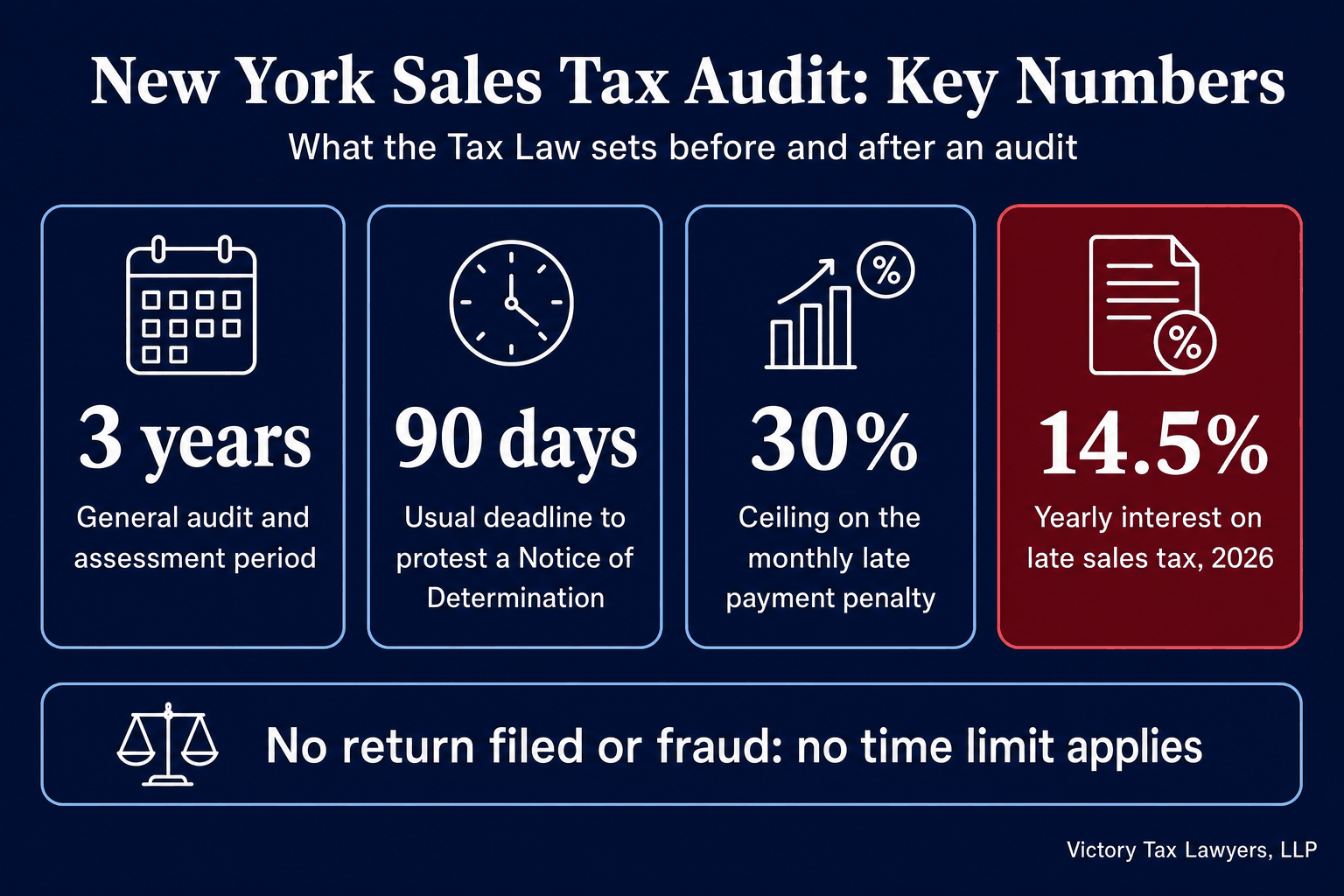
The three-year window is the general rule. Publication 130-F says New York generally places a three-year statute of limitations on tax audits, but it does not apply to any period for which no return was filed or a false or fraudulent return was filed to evade tax. It can also be extended by written agreement.
Penalties are set out in Tax Bulletin ST-805. Filing on time without paying costs 10% of the tax for the first month plus 1% a month after that, up to 30%. Omitting more than 25% of the tax required on a return adds a penalty of 10% of the unreported tax. Fraud carries a penalty of twice the unpaid tax. Failing to keep records costs up to $1,000 for the first quarter and up to $5,000 for each quarter after. Issuing a false or fraudulent resale or exemption certificate to evade tax costs $50 per document plus 100% of the tax that would have been due.
Interest adds up quickly. DTF's published interest rates put late payments and assessments of sales and use tax at 14.5% a year, compounded daily, for the third and fourth quarters of 2026. Interest keeps running while you protest. You are not required to pay while appealing a Notice of Determination, but paying stops further interest and penalties if you are later found liable.
Personal liability is what surprises most owners. Tax Bulletin ST-75 explains that the Tax Law makes responsible persons of a business personally liable for its sales and use tax. That group can include owners, officers, directors, employees, partners and members, and each can be liable for the full amount, even when the business is an LLC or corporation or an accountant handled the returns. When a balance becomes final, our tax levy, tax lien and back taxes pages explain what comes next.
What Is the Process for NY Sales Tax Audit Representation?

The steps below follow a typical audit from the first letter to a protest.
Step 1: Review the Audit Letter and Exposure
We read the audit letter, note the periods named, and check your filing history for any missing return that leaves an earlier period open.
Step 2: File Form POA-1 and Take Over Contact
We prepare Form POA-1 naming the individuals who will handle your case. From then on, the auditor contacts us and the appointment schedule is set with us.
Step 3: Reconcile the Records Before the Auditor Does
We compare your ST-100, ST-101 or ST-809 returns with bank deposits, POS reports and purchase records.
Step 4: Collect and Validate Exemption Certificates
We match every exempt sale to an ST-120 or other exemption certificate on file. Where one is missing, we work with you to obtain a properly completed replacement from the customer.
Step 5: The Opening Conference and the Audit Method
At the opening conference, the auditor explains the approach, the procedures and your protest rights. We discuss the audit method and review any test period or sampling agreement before you sign it.
Step 6: Fieldwork and Document Production
We produce what is requested, organized by period. Answers go back in writing so the record stays consistent.
Step 7: Respond to the Statement of Proposed Audit Changes
The auditor presents workpapers and a Statement of Proposed Audit Changes (Form AU-346 for sales and use tax). We test the math and the method, submit additional documentation, and request conferences with the auditor's supervisor when needed. If you agree, you sign. If you disagree, you mark that on the form and return it.
Step 8: Protest the Notice of Determination in Time
If the disagreement remains, DTF issues a Notice of Determination. Generally you have 90 days from the date of the notice to request a conciliation conference or file a petition with the Division of Tax Appeals. The notice itself states the deadline that applies to you.
How Can You Challenge a Notice of Determination?
New York offers two protest routes, described on DTF's protest page. You can request a conciliation conference with the Bureau of Conciliation and Mediation Services (BCMS), or you can petition the independent Division of Tax Appeals. A written protest is required even if you already objected to the Statement of Proposed Audit Changes. DTF says more than 98% of protests start as conciliation requests, and over 90% of those are resolved there.
A conference is requested on Form CMS-1-MN by the deadline on the notice. BCMS acknowledges the request in about 10 days and sends an appointment notice at least 30 days before the conference. Conferences are held by phone, by video or at department offices, and typically last under two hours. The conferee then sends a proposed resolution called a Consent. You have 15 days to sign it, and if you don't, the conferee issues a Conciliation Order that binds both sides unless you petition the Division of Tax Appeals.
The Division of Tax Appeals hears petitions filed on Form TA-100. An administrative law judge decides the case, and either side can ask the Tax Appeals Tribunal to review the determination. A Tribunal decision can be taken to court, generally within four months.
Representation rules tighten at this stage. Under DTF's POA-1 guidance, only New York-licensed attorneys, New York CPAs, IRS enrolled agents and New York public accountants may represent a taxpayer before BCMS or the Division of Tax Appeals. An attorney licensed in another state needs special permission to appear. Our attorneys are licensed in California, so where a conference or hearing requires it, we coordinate with New York-admitted counsel and keep building the record they present.
If the protest deadline has already passed, options narrow. DTF may grant a courtesy conference on a bill that followed a field audit when you have new information, as its page on disagreeing with a bill explains. Where tax remains due, an installment payment agreement may be available, and our guide to owing New York State taxes covers collection.
How Should You Prepare for a New York Sales Tax Audit?

Pull every sales tax return for the years the letter names, with the matching bank statements, POS exports, purchase invoices and federal returns, sorted by quarter.
Then check the certificate file. Each ST-120 should be complete and tied to specific sales, and every exempt sale without one is a likely adjustment.
Tell us about the problem quarter, the register that failed, or the supplier who never sent invoices. The problems that cost the most are the ones the auditor finds first.
Finally, stop informal contact with the department and route questions through your representative so answers stay consistent. Business owners in New York City, Buffalo and across the state can start with our New York tax attorney page, and our guide to the New York Department of Taxation and Finance explains how the agency is organized.
Ready to Talk About Your New York Sales Tax Audit?
An audit letter comes with response dates, and a Notice of Determination starts a fixed protest deadline. Early review leaves more room to shape the audit method and fix the certificate file. Victory Tax Lawyers is a tax controversy firm, and our audit representation practice handles state sales tax audits alongside IRS examinations.
Reach out to Victory Tax Lawyers today to discuss your New York sales tax audit.
Frequently Asked Questions
These are the questions New York business owners ask most often after a sales tax audit letter arrives. We have provided brief answers.
What Is NY Sales Tax Audit Representation?
It is representation during a sales and use tax audit by the New York State Department of Taxation and Finance. The individuals named on your Form POA-1 deal with the auditor, manage document production, and respond to proposed audit changes on your behalf.
How Far Back Can a New York Sales Tax Audit Go?
An audit generally covers three years, and New York generally applies a three-year statute of limitations. That limit does not apply to periods where no return was filed or a false or fraudulent return was filed to evade tax.
Can New York Estimate My Sales Tax in an Audit?
Yes, but only in limited cases. For sales and use taxes, the Tax Department may estimate additional tax only if you have no records or the records you provide are not adequate to determine the tax due.
Am I Personally Liable for My Business's Unpaid New York Sales Tax?
You can be if you are a responsible person, such as an owner, officer, director, partner, member or employee with that responsibility. A responsible person can be liable for the full amount, even if the business is a corporation or LLC.
How Long Do I Have to Challenge a Notice of Determination?
Generally 90 days from the date of the notice. You can request a conciliation conference with BCMS or file a petition with the Division of Tax Appeals. Check the notice itself for the exact deadline.
Legal Disclaimer: This page is for informational purposes only and does not constitute legal or tax advice. Reading it or contacting Victory Tax Lawyers does not create an attorney-client relationship. Victory Tax Lawyers' attorneys are licensed in California and do not hold New York bar admission. Tax outcomes depend on the specific facts of each matter, and past results do not guarantee future outcomes.