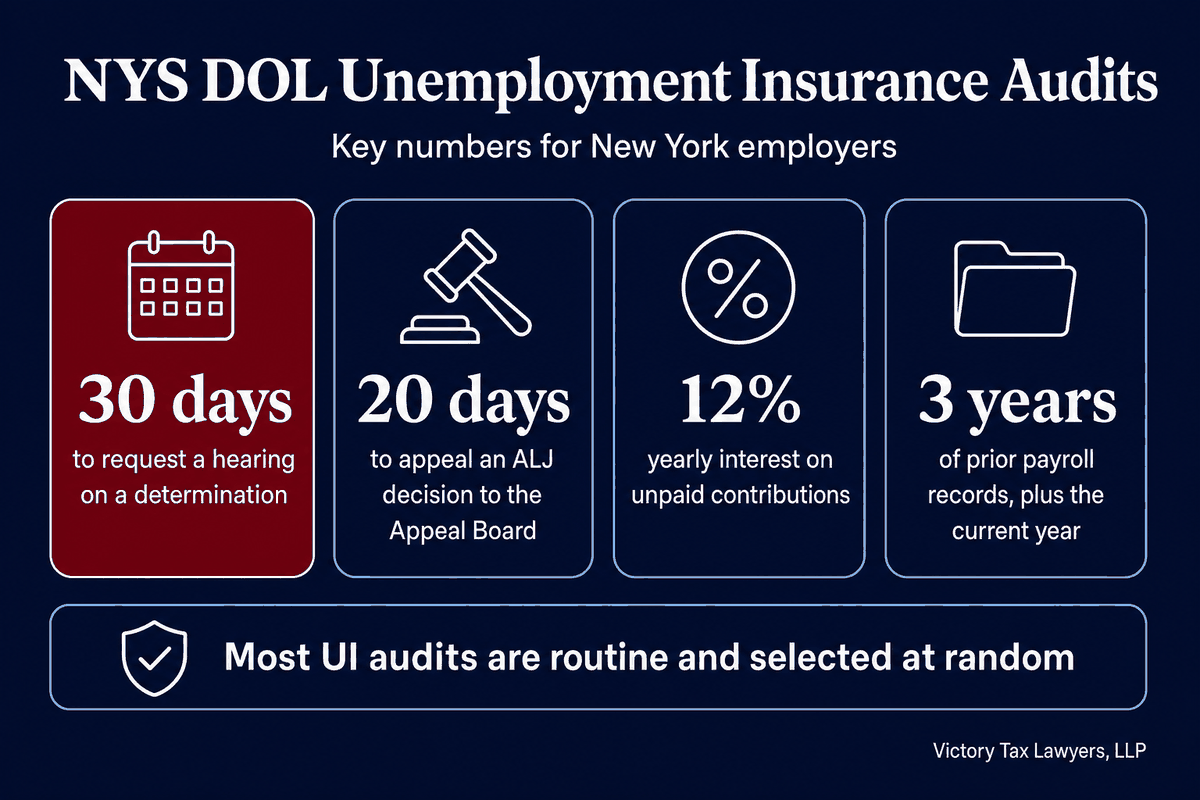
A New York State Department of Labor unemployment insurance audit checks whether your business reported every worker's wages and paid the right contributions. Most audits are routine and chosen at random, but the findings can mean back contributions, 12% annual interest, and a reclassification of workers you paid as contractors. You have 30 days from a determination to ask for a hearing. At Victory Tax Lawyers, our California-licensed attorneys and IRS enrolled agent help employers prepare for a NYS DOL audit, organize payroll and contractor records, and connect the state findings to the federal payroll-tax picture. Where a New York hearing calls for New York-admitted counsel, we coordinate with them.
Contact us today and let us help with your tax liability.
What Is a NYS DOL Unemployment Insurance Audit?

The Unemployment Insurance Division of the New York State Department of Labor collects the employer contributions that fund jobless benefits, reported each quarter on Form NYS-45. The audit checks that those contributions match the payroll that actually existed.
The Department's audit page for businesses explains that New York is required to audit a percentage of businesses each year as part of federal unemployment insurance standards, and most audits are routine, with businesses selected at random. Section 575 of the Labor Law requires every employer to keep a true and accurate record of each person employed, open to inspection.
Not every audit starts at random. The Department runs a 24-hour employer fraud hotline for anonymous reports of off-the-books pay, intentional misclassification, and SUTA dumping, which is shifting workers between payrolls to get a lower contribution rate. A worker paid as a contractor can also file for benefits and then request a hearing to challenge a finding that he or she was an independent contractor.
The notification letter gives the date, time, and place of the audit, the period it covers, and the records you must provide. Records can go in through the Department's E-Audit Portal, and the audit can be scheduled remotely. When the auditor finishes, the results are reviewed with you, which is the first chance to push back before any formal determination.
What Records Does a DOL Auditor Review?
The core of the audit is payroll. Under the Department's Employer's Guide to Unemployment Insurance, Wage Reporting, and Withholding Tax (NYS-50), every employer must keep a record for each person it employs showing the name and Social Security number, the beginning and ending dates of each payroll period, the days worked and earnings for each day, and all other payments such as vacation pay, bonuses, dismissal pay, tips, and the reasonable value of board and lodging. Those records must be kept for the current year and at least three preceding years.
The auditor compares that payroll against your quarterly NYS-45 returns. Because the question is who you paid, not only who sat on the payroll register, expect questions about 1099 recipients, cash disbursements, and vendor payments that look like pay for personal services. A general ledger with regular payments to individuals can be where a classification issue first surfaces.
Who Counts as an Employee Under New York Unemployment Insurance Law?
For many employers, this is the question the audit turns on. The Unemployment Insurance Law excludes independent contractors from coverage, but it does not define the term. According to the Department's independent contractor guidance, courts apply the common law tests and look at all the facts to decide whether the business supervises, directs, and controls the work, or has the right to.
Paperwork does not settle it. A worker can still be an employee if you issue a 1099 instead of a W-2, if the worker signs a statement claiming to be a contractor, waives employee rights, or obtains a dba at your request. An agreement by employees to waive their rights under the law is not valid. In general, a corporate officer who performs the usual management work is an employee, not a contractor.
The table below sets out the indicators the Department lists on each side.
| Factor | Points Toward an Employee | Points Toward an Independent Contractor |
|---|---|---|
| Control of the work | You decide when, where, and how the work is done, and supervise it directly | The worker is free from supervision, direction, and control |
| Hours and schedule | You set the hours and require prior permission for absences | The worker sets their own schedule and can refuse work offers |
| Tools and facilities | You provide facilities, equipment, tools, and supplies | The worker invests in their own place of business, equipment, and supplies |
| Pay and expenses | You set the pay rate, pay salary or hourly, or reimburse expenses | The worker sets their own rate, pays their own expenses, and bears profit or loss |
| Reporting and review | You require meetings, training, or reports, and evaluate performance | No meetings, training, or reports are required |
| Exclusivity | The worker cannot perform services for your competitors | The worker offers services to other businesses and the general public |
| Business presence | The worker has no business of their own | The worker has an established business, advertises, and carries insurance |
Some workers are employees by statute whatever the common law test shows, including certain commission delivery drivers, full-time salespeople soliciting orders for resale, and performing artists and professional models under defined conditions.
The Construction and Commercial Goods Transportation Fair Play Acts

Two industries face a stricter standard. The Construction Industry Fair Play Act took effect on October 26, 2010, and the Commercial Goods Transportation Industry Fair Play Act took effect on April 10, 2014 for drivers of commercial vehicles who transport goods. Under both, a worker is presumed to be an employee unless the worker is free from control and direction in performing the job, both under contract and in fact, performs services outside the usual course of the company's business, and is engaged in an independently established trade, occupation, or business similar to the service performed.
A business entity can fall outside the presumption by meeting every criterion of a separate business entity test, which has twelve parts in construction and eleven in commercial goods transportation. A willful failure to classify properly carries civil penalties of up to $2,500 per misclassified employee for a first violation and up to $5,000 per employee for a second violation within five years. The Construction Industry Fair Play Act and the Commercial Goods Transportation Industry Fair Play Act texts are posted on the Department's site.
If you are unsure how a group of workers should be treated, you can ask the Department's Liability and Determination Section for a formal determination before an audit ever starts.
What Happens If the Audit Finds Unreported Wages?
The Department assesses contributions on the wages that should have been reported. For 2026, total contribution rates run from 1.7% for the lowest-rated employers to 9.5% at the top, and the new employer rate is 4.1%, according to the Department's 2026 rate information. Contributions apply to each employee's pay up to the annual wage base, which is $17,600 for 2026.
Interest runs at 12% per year on unpaid contributions from the date the payment was originally due. The NYS-50 guide states that this interest may not be waived or reduced. Contributions paid more than 60 days after their due date are not credited to your experience rating account, so a late balance can also push your future rate higher. Where a failure to comply is found to be fraud with intent to avoid payment, a penalty of 50% of the deficiency may be added, and criminal penalties may apply.
Filing problems carry their own penalties. A missing or late NYS-45 draws a failure-to-file penalty of the greater of $1,000 or $50 times the number of employees on the last return, capped at $10,000 per quarter.
Unpaid balances move to collection. The Department's collections page lists warrants filed with the county clerk, levy and sale of assets, collection fees of up to 22% of the debt, blocked license renewals, and tax refund offsets. Our tax levy and tax lien pages explain the federal versions of those tools.
How Do You Challenge a DOL Audit Determination?
You have the right to a hearing when you disagree with a determination about your liability under the Unemployment Insurance Law. The Department's hearing request page requires the request within 30 days after the mailing or personal delivery of the determination, with specific grounds for the challenge. Under the Appeal Board's rules, a determination is presumed mailed on the date printed on it and received no later than five business days later, so read the date on the notice, not the date it reached your desk.
When the request is based on an audit or investigation, the Department first schedules an informal conference. You may bring your own representative, such as an accountant or attorney. The Department's representative explains the basis for the determination, and you can present information that may change it. If the conference does not resolve the matter, the case goes to a hearing before an Administrative Law Judge.
Interest keeps accruing at 12% per year during the dispute. You can pay the amount due to stop it, and the Department refunds amounts paid under protest if the outcome is in your favor.
The Administrative Law Judges work under the Unemployment Insurance Appeal Board, an independent body appointed by the governor. Contribution hearings are generally held at the location closest to your business address, or by telephone if you are far from a hearing site. The first hearing date can be postponed only for a previously scheduled legal proceeding, so treat it as fixed.
If the judge rules against you, you can appeal to the Appeal Board within 20 days of the decision, provided you appeared at the hearing. The Board decides most appeals on the hearing record, so the evidence has to be in the record at the hearing. A Board decision can then go to the Appellate Division, Third Department.
Who Can Represent an Employer at a UI Hearing?
The Department's hearing guide for employers says an employer can represent itself or have an attorney or other representative present. A representative is not required.
Fees are regulated. The Appeal Board's rules at 12 NYCRR Part 460 require Board approval for any fee charged to a claimant, and permit such fees only for lawyers and non-lawyer representatives registered with the Board. The Board's information for attorneys and representatives states that only an attorney licensed in New York or a representative registered with the Board may charge and receive a fee. The Board also keeps a list of agents who represent employers.
Here is where we fit. Victory Tax Lawyers' attorneys are licensed in California, and our team includes an IRS enrolled agent. We are not New York-admitted and do not appear as New York counsel. We can organize the records, test the classification of each worker group, prepare written responses and hearing exhibits, and handle the federal Form 940 and Form 941 exposure tied to the same facts. When a hearing calls for New York-admitted counsel, we coordinate with them so the record is built once.
How Does a DOL Audit Connect to Your Federal Payroll Taxes?
A reclassified worker is rarely only a state problem. Most employers pay both a federal and a state unemployment tax, and federal unemployment tax is reported annually on Form 940. Income tax withholding and Social Security and Medicare taxes on employee wages are reported quarterly on Form 941. New York's Re-employment Service Fund contribution of 0.075% cannot be taken as a credit on Form 940.
The IRS applies its own common law test, grouped into behavioral control, financial control, and type of relationship, per its worker classification guidance. A New York finding does not bind the IRS, but the facts gathered in a DOL audit are the same facts an IRS examiner would weigh.
If withheld taxes go unpaid, owners face personal exposure. The IRS can assess the Trust Fund Recovery Penalty against any responsible person who willfully fails to collect or pay withheld income and employment taxes. Our payroll tax practice handles these federal cases, including penalty abatement requests.
What Is the Process for NYS DOL Audit Representation?

The steps below show how we work a DOL audit from the notification letter onward.
Step 1: Review the Audit Notice
We read the notice for the audit period, the record list, and the date, then map what you have against what the auditor asked for.
Step 2: Reconcile Payroll to the NYS-45 Returns
We compare payroll, NYS-45 filings, and the general ledger for the audit period, so we find the gaps before the auditor does.
Step 3: Sort Every Worker Group
We test each group of people paid outside payroll against the common law factors and, where it applies, the Fair Play Act presumption. Some groups are defensible as contractors and some are not.
Step 4: Organize the Document Production
We assemble the required records with contracts, invoices, and proof of each contractor's independent business. Nothing goes out without a review.
Step 5: Support You Through Fieldwork
We prepare you for the auditor's questions, track follow-up requests, and test the math and classification calls when the results are reviewed with you.
Step 6: Request a Hearing Within 30 Days
If a determination gets the facts wrong, the hearing request goes in within 30 days with specific grounds, and we prepare exhibits for the informal conference.
Step 7: Build the Hearing Record
An unresolved case is decided by an Administrative Law Judge on the hearing record. We work with New York-admitted counsel where the hearing calls for it, so evidence and witnesses are ready on the first date.
Step 8: Close Out the Federal Side
We then review Forms 940 and 941 for the same workers and periods and address any federal exposure, including a Trust Fund Recovery Penalty proposal.
Ready to Talk About a New York DOL Audit?
The dates that matter are the audit date on your notice and the 30-day window after a determination. Bring the notice, your NYS-45 filings, your payroll records, and any contractor agreements to a free consultation. Our New York tax attorney page explains our federal work for New York businesses, and our NY DTF audit representation page covers Department of Taxation and Finance audits.
Reach Out to Us at Victory Tax Lawyers Today to Build a Strong Case.
Frequently Asked Questions
Short answers to the questions New York employers ask most after a DOL audit letter arrives.
What Triggers a New York DOL Unemployment Insurance Audit?
The Department of Labor must audit a percentage of employers each year under federal unemployment insurance standards, and most audits are routine with businesses selected at random. The Department also takes anonymous reports of off-the-books pay and worker misclassification through its employer fraud hotline.
What Records Does a NYS DOL Auditor Ask For?
The audit letter lists the records you must provide. Employers must keep, for each employee, the name, Social Security number, payroll period dates, days worked and daily earnings, and all other payments, for the current year and at least three preceding years.
How Long Do I Have to Request a Hearing After a DOL Audit Determination?
You must file the request within 30 days after the mailing or personal delivery of the determination. For audit cases, the Department holds an informal conference first, and unresolved cases go to an Administrative Law Judge. An appeal from the judge's decision to the Appeal Board is due within 20 days.
Does Paying Someone on a 1099 Make Them an Independent Contractor in New York?
No. New York looks at whether the business supervises, directs, and controls the work. A 1099, a signed contractor statement, or a required dba does not change the result if the facts show an employment relationship.
Can Victory Tax Lawyers Help With a New York DOL Audit?
Yes, within the limits of our licensing. Our attorneys are licensed in California and our team includes an IRS enrolled agent. We can organize records, analyze worker classification, prepare audit responses, and handle the federal payroll-tax side, and we coordinate with New York-admitted counsel when a hearing calls for it.
Legal Disclaimer: The information on this page is provided for general educational purposes and is not legal or tax advice. Victory Tax Lawyers' attorneys are licensed in California; the firm has no New York office and coordinates with New York-admitted counsel where a matter requires it. NYS DOL audit procedures, contribution rates, penalties, and appeal deadlines change over time and depend on the specific facts of each matter. Reading this page or contacting Victory Tax Lawyers does not create an attorney-client relationship, and past results do not guarantee future outcomes.