If you owe the Illinois Department of Revenue, the balance will not sit quietly. IDOR moves a final, unpaid bill into Collections, where it can file a lien, levy a bank account or wages, hold a professional or liquor license, and pass the account to an outside collection agency. It also offers payment plans and, through its Board of Appeals, a limited offer in compromise. Victory Tax Lawyers helps taxpayers work out which option fits, prepare the paperwork, and deal with the IRS side when there is one.
Contact us today and let us help with your Illinois tax balance.
Our attorneys are licensed in California and admitted to the United States Tax Court. They are not admitted in Illinois, and we coordinate with Illinois counsel for any Illinois hearing or court matter.
How Does an Illinois Tax Balance Reach Collections?
There are two ways in, according to IDOR’s own collections training. A balance due reaches Collections after the debt is final and the protest deadlines have passed. Unfiled returns “come straight to collections when they are past due.” IDOR’s FY2025 annual report counts over 131,000 individual non-filers, with $302.7 million in liability established in a single fiscal year.
The notices tend to arrive in order. IDOR’s letters page describes the Notice of Tax Due (IDOR-2-BILL) as the letter sent “when there is a balance due on your account.” IDOR’s collections page says the first bill contains “a detailed breakdown of the tax, penalty, and interest you owe,” and that if you do not pay by the date shown, “we will continue collection activity.”
After that, IDOR’s collections presentation lists the stages:
- An initial letter, the Notice Before Collection Action.
- Automated and manual calls and emails.
- Intent letters, warning of outside collection agencies, bank or wage levies, revocation of licenses or certificates, and assessment against a business owner.
Some actions can run at the same time as those stages, including federal and state refund offsets, a lien, and holds on license renewals. The same presentation warns that a collection fee is assessed if the balance is not resolved by the deadline, and that the deadline “is not extended by a pay plan or sending documentation.”
What Can IDOR Do If You Don’t Pay?
IDOR does not need to sue you first. Its collections page lists the tools.
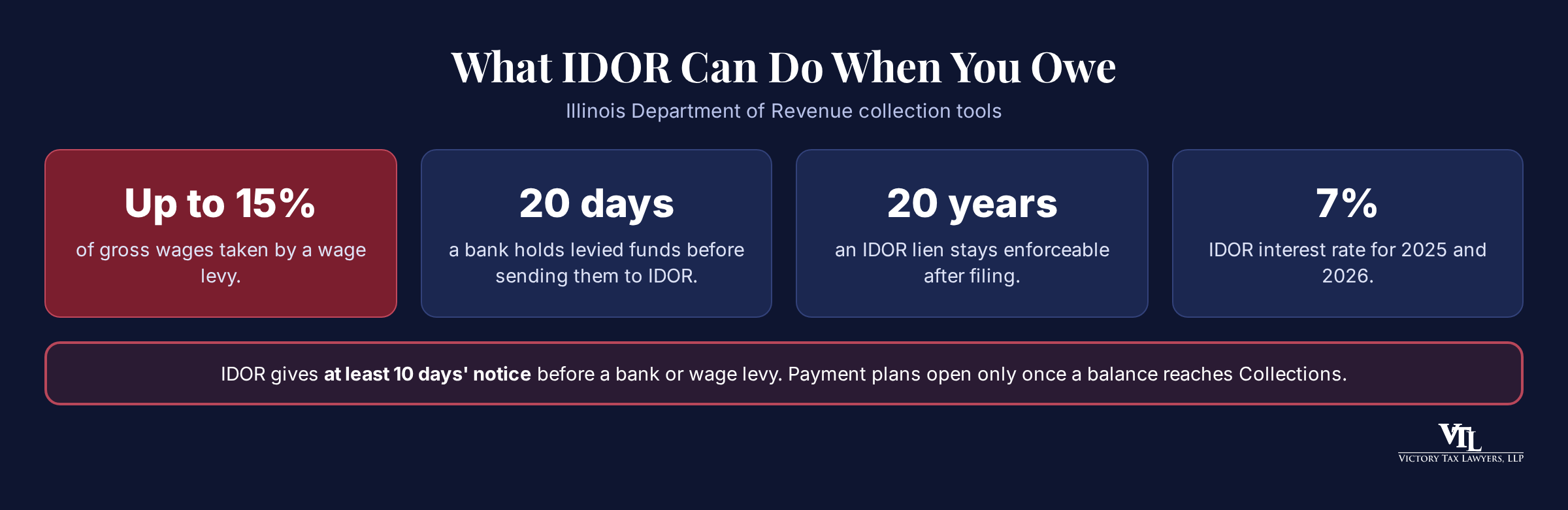
Liens. IDOR files liens in the statewide State Tax Lien Registry rather than county by county. Its collections page says the lien “is enforceable for 20 years,” and that in most cases you cannot sell or transfer the property until the past-due amount is paid.
Bank levies. IDOR says a bank levy requires the bank “to hold for 20 days all monies in your account up to the total past due tax, penalty, and interest,” and then send the money to IDOR. The same levy can reach certificates of deposit, rent owed to you, and other payments.
Wage levies. Your employer “must deduct up to 15 percent of the gross amount” of your pay, and the levy can stay in place until the debt is paid. Illinois caps wage deductions under 735 ILCS 5/12-803, which applies to IDOR levies too.
Notice first. IDOR says it will notify you of the amount owed at least 10 days before it sends a bank or wage levy.
Licenses. IDOR can ask licensing agencies to suspend or refuse to renew a professional or business license. For licenses issued by the Illinois Department of Financial and Professional Regulation, 20 ILCS 2105/2105-15 provides for suspension without a hearing once IDOR certifies the debt, with enforcement stayed for 60 days. Liquor licenses, lottery licenses, corporate charters, and sales tax certificates of registration are also at risk.
Offsets and agencies. The Illinois Comptroller can offset state payments owed to you, IDOR can ask the IRS to send it your federal refund, and unresolved accounts can go to outside collection agencies, with their fees added.
Personal liability. For unpaid sales and withholding taxes, IDOR can assess the business’s officers and others responsible for filing and paying. You have 60 days from the notice to protest.
How Long Can IDOR Keep Collecting?
Longer than most people assume. A lien lasts 20 years from filing under 35 ILCS 5/1104 unless released sooner. IDOR’s collections page says that once a liability is final, the period to use enforcement “varies from 2 years to 20 years or longer,” depending on whether a lien was filed, whether the Attorney General obtained a judgment, and whether personal penalty assessments were issued.
Interest keeps running the whole time. IDOR’s interest rate page sets the rate at the federal underpayment rate, reviewed each January 1 and July 1, and lists it at 7% for 2025 through 2026. The federal collection period is generally ten years, so an Illinois balance from the same year as an IRS debt can outlive it.
Can You Set Up a Payment Plan With IDOR?
Yes, once the balance is in Collections. IDOR’s payment page says plans “are not available until a balance reaches the Collections stage,” which you can tell from a notice with a Collection ID in the upper right corner.
There are two ways to ask.
The pre-approved plan on MyTax Illinois. IDOR says you “will be approved if you meet the terms presented.” Its collections presentation describes terms from 3 months to 2 years, with the first payment due within 15 days. You must have filed all tax returns, and every outstanding liability goes into the same plan.
Form CPP-1, Installment Payment Plan Request. This is for balances that do not fit the pre-approved terms. The CPP-1 instructions ask for a good-faith down payment with the form and say to return it within 10 days of the bill. If the agreement, including penalties and interest, is over $15,000, IDOR also requires a financial statement on Form EG-13-I for individuals or EG-13-B for businesses. “If our review finds that you can pay in full, then we will require you to do so.”
Four things to know before you sign:
- Interest and penalties keep accruing while you pay.
- IDOR “has the discretion to file a lien at any time,” plan or no plan.
- If you default, the whole balance is due immediately and levies can follow.
- No IDOR plan is available if the account is with an outside collection agency, covered by bankruptcy, or subject to an active wage levy. At an agency, the plan is arranged with the agency.
Can You Settle an Illinois Tax Debt for Less?
Sometimes, through the IDOR Board of Appeals, and the rules are narrower than the IRS’s. IDOR describes the Board as three members appointed by the Director who can “waive penalties and interest based on reasonable cause, and reduce a tax liability if it is likely the full debt cannot be collected.”
| Option | When it fits | What IDOR looks at |
|---|---|---|
| Pay in full | You can pay now | Stops interest; cash or certified funds are needed for an immediate lien release |
| Pre-approved plan (MyTax Illinois) | Balance in Collections, all returns filed | Terms of 3 months to 2 years |
| Form CPP-1 plan | Longer or larger plans | Down payment, and a financial statement over $15,000 |
| Board of Appeals offer in compromise | The full debt realistically cannot be collected | Returns, bank statements, and a financial statement on Form BOA-4 or BOA-5 |
| Penalty and interest waiver | Reasonable cause for the late filing or payment | Ordinary business care and prudence |
The offer in compromise has three limits that trip people up:
- Collectibility only. IDOR’s regulation, 86 Ill. Adm. Code 210.115, says “the only grounds for relief that may be propounded is uncertainty as to collectibility.” Illinois has no doubt-as-to-liability offer. If you disagree with the tax itself, that argument belongs in a protest or before the Independent Tax Tribunal, before the debt is final.
- Only after the debt is final. No petition may be filed before the assessment becomes final.
- No appeal. IDOR says Board decisions “are final and cannot be appealed,” and a petition with no action within 365 days is treated as denied.
The petition goes on Form BOA-1. For an offer, IDOR asks for your last three federal and state income tax returns, six months of bank and brokerage statements, and a current financial statement, which for individuals means two recent pay stubs and Form BOA-4. Businesses use Form BOA-5. All required returns must be filed. The petition must be signed by the taxpayer, not by a power of attorney. You can ask the Board to pause collection while it considers the petition, but IDOR says that is not guaranteed and does not stop liens or refund offsets.
What If You Never Filed the Returns?
Unfiled returns go straight to Collections, and IDOR can assess them with no time limit. IDOR’s Voluntary Disclosure Program offers a better route if you come forward first. IDOR says it limits the lookback period to four years and eliminates the penalties on the disclosed liability once all tax and interest are paid within 60 days of billing. The request goes to the Board of Appeals on Form BOA-2.
Can Penalties Be Removed?
Yes, where there was reasonable cause. Under 35 ILCS 735/3-8, the main late-filing, late-payment, and negligence penalties “shall not apply if the taxpayer shows that his failure to file a return or pay tax at the required time was due to reasonable cause.” That section covers penalties, not interest. The Board of Appeals can also consider waiving interest on its own grounds. IDOR’s regulation describes reasonable cause as ordinary business care and prudence that still could not prevent the delay.
How Does Victory Tax Lawyers Help With Illinois Tax Debt?
We start by pulling the account and matching it to your records, because the balance on a notice is not always the balance you owe. Then we look at the whole picture, including any IRS debt for the same years, since paying one agency in a way that starves the other rarely works out.
From there we help you choose the route and prepare it: a plan on MyTax Illinois or Form CPP-1, a reasonable cause request, a voluntary disclosure, or a Board of Appeals petition with the financial documents it needs. We work under Form IL-2848, and if any part of the case needs an Illinois-admitted attorney, we coordinate with Illinois counsel. For the federal side, see our pages on IRS installment agreements, offers in compromise, and tax levies.
Ready to Resolve Your Illinois Tax Balance?
The cheapest time to act is before the levy. IDOR’s collections presentation says no payment plan is available while a wage levy is active. Bring your most recent IDOR notice, your MyTax Illinois account details, and any IRS notices to a free consultation, and we can walk you through which options are open to you.
Contact us for a free consultation today.
Frequently Asked Questions
These are the questions Illinois taxpayers ask most often when they owe IDOR.
How Do I Know If I Owe the Illinois Department of Revenue?
IDOR sends a Notice of Tax Due when there is a balance on your account, and you can check balances and notices in MyTax Illinois. A notice with a Collection ID in the upper right corner means the balance has reached Collections.
Can IDOR Levy My Bank Account or Garnish My Wages?
Yes. A bank levy requires the bank to hold funds for 20 days before sending them to IDOR, and a wage levy can take up to 15% of gross pay. IDOR says it gives at least 10 days’ notice of the amount owed before either levy.
How Do I Set Up a Payment Plan With IDOR?
Once your balance is in Collections, you can use the pre-approved plan on MyTax Illinois or file Form CPP-1 with a down payment. All returns must be filed, and interest and penalties keep accruing while you pay.
Does Illinois Offer an Offer in Compromise?
Yes, through the IDOR Board of Appeals on Form BOA-1, but only after the liability is final and only on the ground that the full debt is unlikely to be collected. Board decisions are final and cannot be appealed.
How Long Does an Illinois Tax Lien Last?
An IDOR lien is enforceable for 20 years from filing unless it is released sooner. Liens are filed in the statewide State Tax Lien Registry, and an immediate release requires payment in guaranteed funds, such as a cashier’s check or money order.
Legal Disclaimer: The information on this page is provided for general educational purposes and is not legal or tax advice. Illinois collection procedures, payment plan terms, interest rates, and relief programs change over time and depend on the facts of each matter. Victory Tax Lawyers, LLP attorneys are licensed in California and admitted to the United States Tax Court; they are not admitted to practice law in Illinois. Reading this page does not create an attorney-client relationship. Past results do not guarantee future outcomes.