A New York State tax audit starts with a letter from the Department of Taxation and Finance asking you to support one or more returns, usually from the last three years. If the auditor still sees tax due after reviewing your records, the department proposes changes and then issues a Notice of Deficiency or Notice of Determination, which you generally have 90 days to protest. At Victory Tax Lawyers, we help individuals and businesses respond to DTF audits of income, corporation, and withholding tax returns. We deal with the auditor under Form POA-1 and keep the federal side consistent when the IRS is involved too.
Contact us today and let us help with your tax liability.
What Is NY DTF Audit Representation?
The New York State Department of Taxation and Finance, usually shortened to DTF or simply the Tax Department, audits returns to confirm that taxpayers paid the correct amount. Per its audit overview, an audit can end in a bill, a denied refund or credit, a proposed refund, or no change.
You have the right to a representative at any point in the audit, and you can pause a meeting or interview to get one. Anyone who acts for you needs written authority on Form POA-1, Power of Attorney. New York only accepts individuals on that form, not firms, so the POA names the specific people from our team who work your file. From then on, the auditor's requests come to us.
The appeal stage has stricter rules. Before the Bureau of Conciliation and Mediation Services (BCMS) and the Division of Tax Appeals, only a New York-licensed attorney, a New York CPA, an IRS enrolled agent, or a public accountant enrolled with the New York State Education Department may appear. An attorney licensed in another state needs special permission.
Our broader audit representation practice handles IRS and state examinations together. Many New York audits start from, or run alongside, a federal file.
What Does the New York Tax Department Audit?

The department administers personal income tax, corporation tax, withholding tax, and sales tax, among others. An income tax audit looks at the income, deductions, and credits on your return. Corporation and withholding audits test the figures a business reported.
Sales tax audits run on their own track. Our New York sales tax audit representation page covers them. Employers facing unemployment insurance questions should see our page on New York DOL audits.
The department's published reasons for selecting a return include:
- Failure to file a return, or to report income or sales
- Excessive credits or exclusions claimed on a return
- Incorrect or fraudulent refund claims
- Differences between your return and information from the IRS, banks, employers, and other businesses
- Results of prior audits
- Misuse of exemption certificates
An audit of one tax can also spill into another. The department's audit publications say findings that materially affect another tax may be referred to that tax specialty, and adjustments in one tax can be used to recalculate another.
How Does a New York State Tax Audit Start?
In most cases, the first contact is a letter asking for information. Less often, the department sets an appointment to review records at your home or business. The two formats have different rules.
Desk audits. Publication 130-D describes a desk audit as a review of returns, refund requests, or other documents you submitted. It can also rest on unfiled reports or on information from other sources, such as the IRS. The department's main letter asking for information about a return is Form DTF-948 or DTF-948-O, Request for Information. Answer by the date printed on the letter.
Field audits. Publication 130-F says field audits are usually scheduled at least 15 days in advance. If you need more time to gather records, you can usually ask for an extension of up to 30 days. Longer delays need a written request that explains why. The first meeting is the opening conference, where the auditor explains the approach, the procedures, and your protest rights.
Field auditors may test every transaction, use a test period, or use statistical sampling. A field audit generally covers three years and can take anywhere from several days to more than a year.
How Do New York Residency Audits Work?

In our experience, residency audits carry some of the largest New York income tax exposure. A resident pays New York tax on all income, wherever it is earned. A nonresident pays only on New York source income. When someone leaves New York for another state, an auditor can test whether the move really happened for tax purposes. There are two ways to be a New York resident.
Domicile. Your domicile is your permanent, primary home, the place you intend to return to. According to the department's residency guidance, a New York domicile does not change until you show by clear and convincing evidence that you abandoned it and set up a new one somewhere else.
The department's Nonresident Audit Guidelines (December 2021) tell auditors to weigh five primary factors: home, active business involvement, time, items "near and dear," and family connections. Where a taxpayer historically domiciled in New York claims a move, the burden of proof sits with the taxpayer.
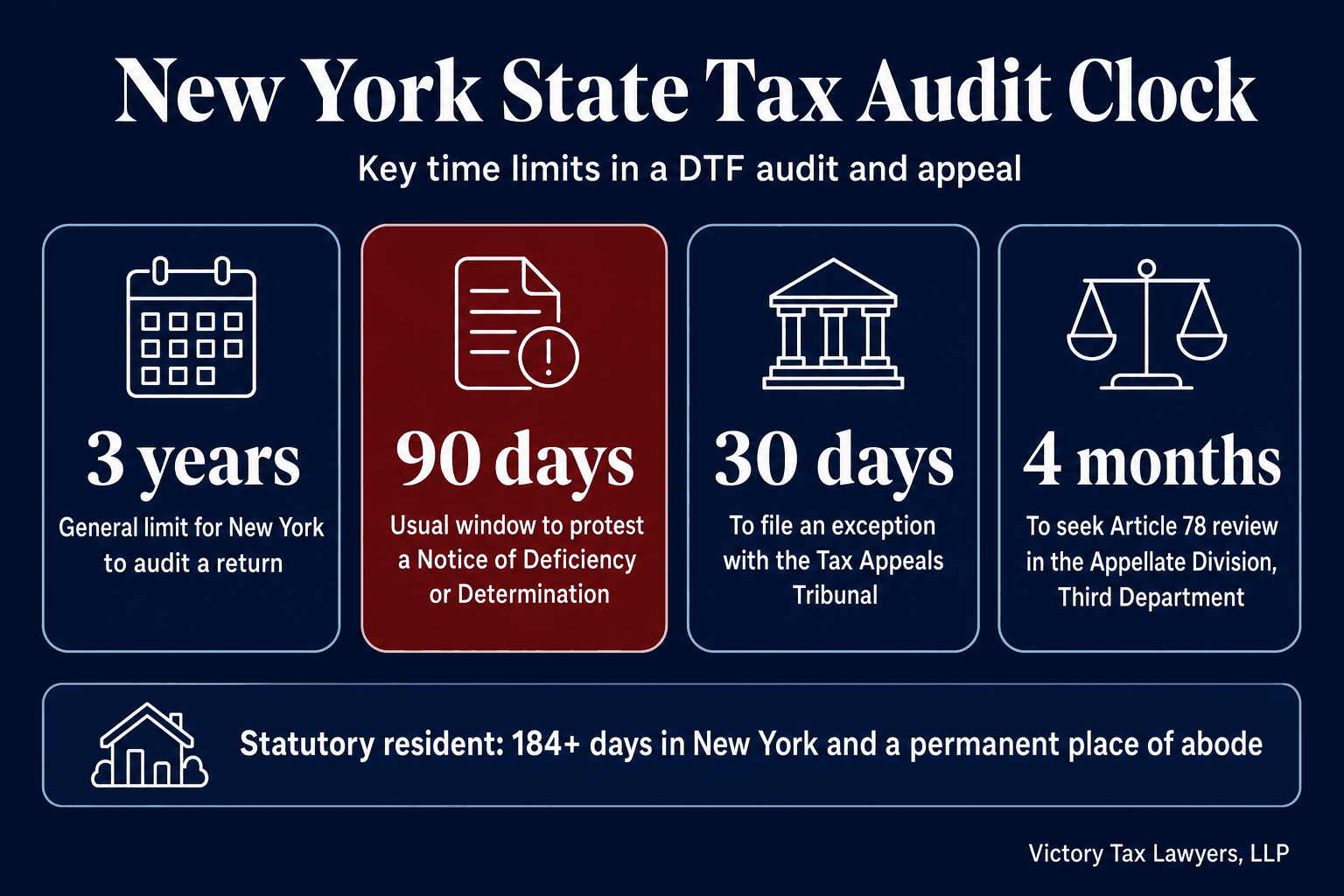
Statutory residency. Even with a domicile elsewhere, you are taxed as a New York resident if you maintain a permanent place of abode in the state for substantially all of the year and spend 184 days or more in New York. Any part of a day counts as a day, and you do not need to be at the abode for the day to count. Under Tax Bulletin TB-IT-690, a permanent place of abode is a dwelling suitable for year-round use that you maintain, whether or not you own it.
The guidelines add a timing rule. Beginning with tax year 2022, in a year when a taxpayer acquires or disposes of a residence, audit policy treats "substantially all of the year" as generally meaning more than 10 months.
Residency audits usually open with a questionnaire about domicile and days spent in New York. Those first answers matter a great deal. We build the day count from phone records, card statements, travel records, and calendars before anything is sent, so the questionnaire and the evidence tell the same story.
What Happens When the IRS Changes Your Federal Return?
New York starts from federal numbers, so an IRS adjustment usually changes the state return as well. The Form IT-201-X instructions require you to report IRS changes to New York on an amended return within 90 days of the IRS final determination. If you disagree with the IRS, you must still file the amended state return and say that you disagree.
Skipping that step is costly. The three-year audit limit does not apply to any period for which you failed to report federal changes. A bill that arises from a change the IRS made to your federal return also carries no protest or appeal rights at BCMS or the Division of Tax Appeals. The dispute has to be won on the federal side.
Information flows the other way as well. Publication 130-D notes that the Tax Law allows the department to share your tax information with the IRS and other government agencies. IRS work is our core practice. We handle IRS audits, appeals, and U.S. Tax Court petitions. A concession in an IRS audit can quickly become a New York adjustment.
How Long Does New York Have to Audit You?
New York State Tax Law generally sets a three-year statute of limitations on audits. After that, the department cannot audit without your written consent. The limit does not apply to any period in which you failed to file a return, failed to report federal changes, or filed a false or fraudulent return to evade tax.
Keep records that support every return for at least that long, and longer where one of the exceptions might apply.
Which Notices Follow a New York Audit, and What Are the Deadlines?
When the review is finished, the auditor either closes the file with no change or sends a Statement of Proposed Audit Changes (or a similar document) explaining the proposed tax. If you agree, you sign it and pay or set up an installment payment agreement. If not, you return it with your objections and support. If the auditor still sees tax due, the department issues a Notice of Deficiency or a Notice of Determination. That notice is what starts the formal protest clock.
The table below lists the documents you may receive and their time limits. The deadline printed on your own notice controls.
| Notice or Stage | What It Means | Time Limit |
|---|---|---|
| Request for Information (DTF-948 or DTF-948-O) | The department wants support for items on a return. | Respond by the date on the letter |
| Field audit appointment letter | Confirms the first meeting and lists the books and records to have ready. | Usually set at least 15 days out; extensions of up to 30 days are usually available |
| Statement of Proposed Audit Changes | The auditor's proposed findings, before any formal assessment. | Respond within the time the statement gives you |
| Notice of Deficiency or Notice of Determination | The formal assessment, with protest rights. | Generally 90 days from the date of the notice |
| BCMS Consent | The conferee's proposed resolution after the conference. | Sign and return within 15 days to accept |
| Conciliation Order | Issued if you reject the Consent; binds both sides unless you petition the Division of Tax Appeals. | Follow the time limit in the papers sent with the order |
| Administrative law judge determination | Decides the dispute unless a party asks the Tax Appeals Tribunal to review it. | 30 days to file an exception |
| Tax Appeals Tribunal decision | Final administrative decision. | 4 months to seek Article 78 review in the Appellate Division, Third Department |
A formal notice leaves you two choices. The first is a conciliation conference at BCMS, an independent bureau inside the department, requested on Form CMS-1-MN or online. The department reports that more than 98% of protests start as conciliation requests and that over 90% of those are resolved there. A conference typically lasts less than two hours.
The second choice is a petition on Form TA-100 to the Division of Tax Appeals, which is independent of the Tax Department. An administrative law judge hears the case in an adversarial hearing. The Division's FAQ notes that a petition disputing a personal income tax Notice of Deficiency must be filed within 90 days of the mailing date, or 150 days if the notice was addressed to someone outside the United States. Smaller cases can elect the small claims unit, but its determination cannot be appealed.
Under the Tribunal's Rules of Practice and Procedure, either side can file an exception to the ALJ's determination with the Tax Appeals Tribunal within 30 days. A Tribunal decision can then be challenged within four months under CPLR Article 78, and those appeals go directly to the Appellate Division, Third Department. Penalties and interest keep accruing during the protest, though you can pay at any time to stop the accrual and still continue.
"By the time a client calls us, the facts are usually already fixed. What is still open is how those facts get presented, and which deadline is protected," says Parham Khorsandi, Esq., Managing Attorney of Victory Tax Lawyers. "Early representation makes all the difference between a negotiation and a bill."
What Are the Steps in NY DTF Audit Representation?

This is how we run a New York audit file from the first letter. Each step narrows what the auditor can assess at the next one.
Step 1: Review the Letter and the Returns
In a free consultation, we read the audit letter, identify the tax type and the years under review, and compare them with your returns and records.
Step 2: File Form POA-1
We prepare Form POA-1 naming the individuals on our team who will handle the file. A business and its owner each need their own POA.
Step 3: Check the Federal File
We look at whether an IRS examination, a federal change, or an unreported adjustment sits behind the state audit.
Step 4: Build the Record
We gather and organize the documents the auditor will need. In a residency case, that means a day-by-day count and proof of each primary factor.
Step 5: Manage the Audit
We answer information requests on time, attend the opening conference and later meetings, and challenge sampling or test-period methods that do not fit the business.
Step 6: Respond to Proposed Audit Changes
When the Statement of Proposed Audit Changes arrives, we test the math, the legal basis, and the periods covered, then send a written response with support.
Step 7: Protect the Protest Deadline
If a Notice of Deficiency or Determination issues, we calendar the deadline the day it arrives and walk you through conciliation versus a Tax Appeals petition. New York limits who may appear at BCMS and the Division of Tax Appeals, so we coordinate with New York-admitted counsel when the case requires it.
Step 8: Resolve the Balance
Where tax is owed, we work on penalty relief, installment payment agreements, or a New York offer in compromise, alongside any federal offer in compromise or penalty abatement request. Our guide to owing New York State taxes covers the collection side.
Why Work With Victory Tax Lawyers on a New York Audit?
We are a tax controversy firm, and federal work is the center of our practice. Many New York audits trace back to an IRS adjustment or a federal return that does not match the state one. One team on both files avoids inconsistent answers to two agencies.
We are also clear about who does what. Our attorneys are licensed in California and admitted to the U.S. Tax Court, and our team includes an IRS enrolled agent. Anyone named on Form POA-1 can represent you through the audit itself. At the BCMS and Division of Tax Appeals stage, New York limits who may appear, and we coordinate with New York-admitted counsel where the matter needs it.
Our New York tax attorney page covers the federal practice for New Yorkers; see also our New York City tax attorney and Buffalo tax attorney pages. For background on the agency itself, see our guide to the New York Department of Taxation and Finance. If a final assessment turns into collection, we also handle levies, liens, and back taxes.
Ready to Talk About Your New York Audit Notice?
A formal New York notice carries a protest deadline the law does not extend. Send us the letter or notice and the return it refers to, and we can tell you where you stand.
Reach Out to Us at Victory Tax Lawyers Today to Build a Strong Case.
Frequently Asked Questions
These are the questions taxpayers ask us most often after a New York State audit letter arrives. We have provided brief answers.
What Is NY DTF Audit Representation?
NY DTF audit representation means a tax professional you appoint on Form POA-1 deals with the New York State Department of Taxation and Finance for you during the audit. The representative answers information requests, meets with the auditor, reviews proposed findings, and tracks every protest deadline.
How Long Does New York Have to Audit My Tax Return?
New York State Tax Law generally gives the department three years to audit, and it cannot go further back without your written consent. That limit does not apply to any period for which you failed to file a return, failed to report federal changes, or filed a false or fraudulent return to evade tax.
What Is the Deadline to Protest a New York Notice of Deficiency?
Generally, you must file your protest within 90 days of the date the Notice of Deficiency or Notice of Determination was issued. The notice itself states the exact deadline, and the Tax Law does not allow it to be extended, so check the date on your notice and file before it passes.
Who Can Represent Me at a BCMS Conciliation Conference?
With a properly completed Form POA-1, a New York-licensed attorney, a New York CPA, an IRS enrolled agent, or a public accountant enrolled with the New York State Education Department can represent you. An attorney or accountant licensed only in another state needs special permission to appear.
How Can I Schedule a Consultation About a New York State Tax Audit?
Call Victory Tax Lawyers at (800) 883-8301 or submit the form on our contact page. We can review your audit letter or notice in a free consultation and explain your options and deadlines before you commit to anything.
Legal Disclaimer: This page is for informational purposes only and does not constitute legal or tax advice. Reading it or contacting Victory Tax Lawyers does not create an attorney-client relationship. Tax outcomes depend on the specific facts of each matter, and past results do not guarantee future outcomes.