An IDOR audit is the Illinois Department of Revenue's review of whether you reported and paid the right amount of Illinois income tax, sales tax, or another state tax. It ends with either no change or a proposed bill, and every notice after that point carries a deadline, usually 60 days. Defending one means answering the auditor's requests accurately, keeping the audit inside the periods and issues it opened with, and using the review and protest routes Illinois gives you before an assessment becomes final. Victory Tax Lawyers helps individuals and businesses through the audit, the Informal Conference Board, and the path to a formal protest.
Contact us today and let us look at your IDOR notice.
A note on who we are, because it matters in a state matter. Victory Tax Lawyers, LLP is a California-licensed firm, and our attorneys are admitted in California and to the United States Tax Court. We are not admitted to practice law in Illinois. We work on the audit and review stages under an Illinois power of attorney, and a formal administrative hearing, an Illinois Independent Tax Tribunal case, or a circuit court case is handled with Illinois-admitted counsel.
What Is IDOR Audit Representation?
IDOR audit representation means a professional deals with the Illinois Department of Revenue auditor for you, from the first contact letter to the final notice. The auditor calls your representative, sends document requests to your representative, and hears the explanations from your representative. You stop answering questions on the fly.
It starts with a form. Illinois uses Form IL-2848, Power of Attorney, and IDOR's instructions say the form may be required for a representative to act for you "during certain proceedings before IDOR, such as an audit, certain collection actions, a settlement of tax liability, or a legal proceeding." IDOR's audit publication tells taxpayers to email the completed form to the Department and copy the auditor. Unless it is revoked, an IL-2848 expires 10 years after it is signed.
The goal is narrow. IDOR wants to establish the correct tax for the periods under review. Our job is to make sure that figure rests on complete records and a correct reading of Illinois law, not on the auditor's estimate of what your records probably show.
Why Does the Illinois Department of Revenue Audit Taxpayers?
Illinois taxes are self-assessed. You calculate what you owe and report it, and the audit program exists to check that. IDOR's audit information publication, PIO-60, says the Department selects taxpayers "using several methods, including random selection, referrals, nature of business, audit history, and tax issues."
In our experience, a few patterns account for most of the files we see.
- Residency. IDOR's FY2025 annual report says some taxpayers "are trying to avoid Illinois taxation by filing as residents of states with no income tax, such as Florida, while still maintaining residences in Illinois," and that the Audit Bureau receives referrals on these cases.
- Unreported federal changes. When the IRS changes your federal return, Illinois law gives you 120 days to report the change. The annual report says taxpayers "often fail to report federal changes," and the Audit Bureau follows up.
- Cash businesses. Bars, restaurants, liquor stores, convenience stores, and fuel stations appear in the same report as recurring problem areas for sales tax.
- Non-filers. The report counts over 131,000 individual non-filers, with $302.7 million in liability established in one fiscal year.
An audit notice is not an accusation of fraud. It means your return, your industry, or a data match put you on a list, and the next few weeks decide how big the problem gets.
What Does an IDOR Audit Examine?
That depends on the tax. For income tax, PIO-60 says IDOR's methods "include detailed reviews of federal or consolidated returns and associated schedules, in comparison to the returns and schedules filed for Illinois purposes." For sales and excise taxes, the auditor tests "source documents and general ledger accounts," and the Department "may require your records in samples or in detail."
Audits used to happen at your business or your representative's office. IDOR now accepts documents through its Virtual Audit Room or your MyTax Illinois account, which makes a remote audit practical. PIO-60 says an audit "may last from one day to many months."
Records carry their own risk. Failing to produce requested records can bring a penalty of up to $3,000 per filing period, according to PIO-60. That is one reason we never let a document request sit.
Which Notices Can You Receive After an IDOR Audit?
Illinois uses two layers of notices, and confusing them is the most common mistake we see. A proposed notice comes first. A statutory notice comes after, and it is the one that starts the formal protest clock.
| Notice | What it means | Your deadline and route |
|---|---|---|
| Notice of Proposed Deficiency or Notice of Proposed Liability | The auditor's unagreed adjustments, before any formal assessment | 60 days to ask the Informal Conference Board for review on Form ICB-1 |
| Notice of Deficiency (income tax) | IDOR's formal proposed assessment of tax and penalties | 60 days to protest on Form EAR-14 or petition the Independent Tax Tribunal |
| Notice of Tax Liability (sales, use, and excise taxes) | IDOR's formal claim of tax due plus penalty | 60 days to protest on Form AH-4 or petition the Tribunal; otherwise it becomes final |
| Notice of Penalty Liability | Personal liability of an officer or employee for unpaid trust taxes | Same protest routes as a Notice of Tax Liability |
| Final assessment | The protest window closed, or the protest was decided | Collection begins; relief moves to payment plans or the Board of Appeals |
The statute is blunt about the sales tax version. Under 35 ILCS 120/4, if no protest is filed within 60 days, the Notice of Tax Liability "shall become final without the necessity of a final assessment being issued." The same section makes IDOR's corrected return "prima facie correct," so the burden is on you to show it is wrong.
"By the time a client calls us, the facts are usually already fixed. What is still open is how those facts get presented, and which deadline is protected," says Parham Khorsandi, Esq., Managing Attorney of Victory Tax Lawyers. "Early representation makes all the difference between a negotiation and a bill."
How Far Back Can an IDOR Audit Go?
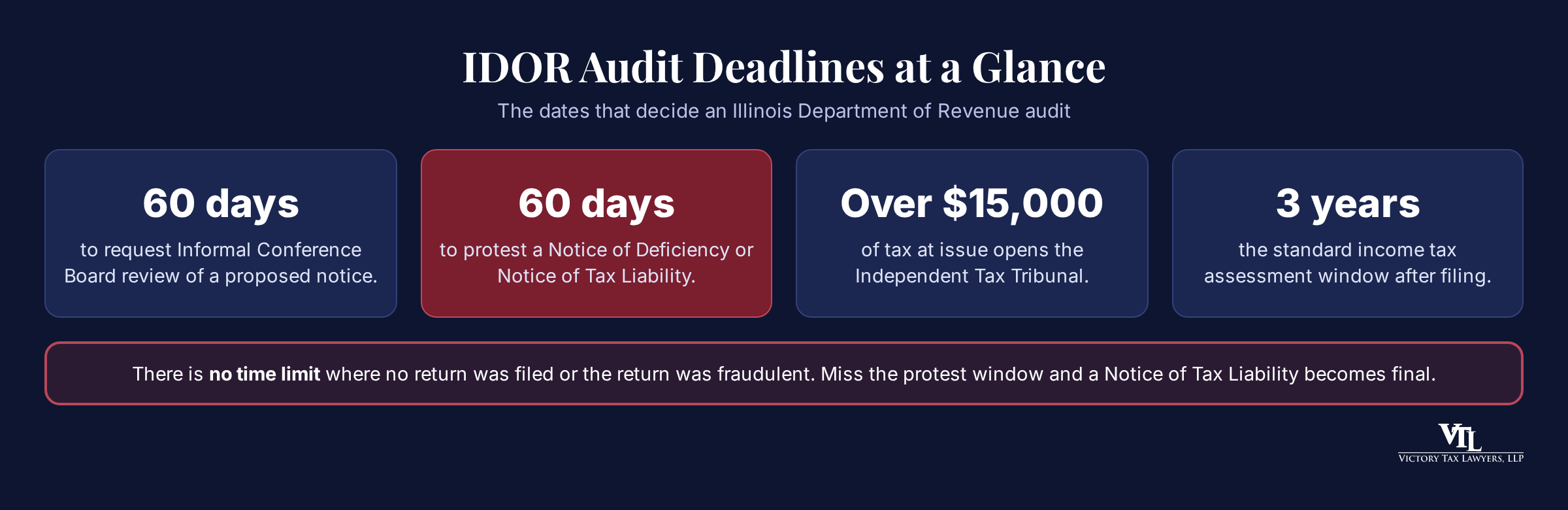
For income tax, 35 ILCS 5/905 says a Notice of Deficiency "shall be issued not later than 3 years after the date the return was filed." The window grows to 6 years if you left out more than 25% of the base income on the return. If no return was filed, or a fraudulent one was, there is no limit. An unreported federal change can also be assessed at any time, limited to the items the federal change touched.
Sales tax runs on a different calendar. The limit is counted back from each January 1 and July 1, and IDOR cannot issue a Notice of Tax Liability for receipts from more than 3 years before that date. IDOR's own regulation says there is no limitation period for a fraudulent return or for a return that was never filed.
The standard window can also be extended by written agreement, which matters for the next section. Requesting Informal Conference Board review requires you to sign a waiver that holds the audit period open.
What Are the Steps in IDOR Audit Representation?
This is the order we follow when we handle an Illinois audit from the start. Each step narrows what the next one can produce.
Step 1: Review the Notice and the Exposure
We start with the audit letter, the returns for the periods named, and the records you already have. You learn which taxes and periods are open, what the realistic exposure looks like, and which deadline is running.
Step 2: File Form IL-2848
The power of attorney goes to IDOR and a copy goes to the auditor. From that point, the Department contacts us, and the questions come to us rather than to your office staff.
Step 3: Reconcile Before the Auditor Does
For income tax, we compare the Illinois return with the federal return, line by line, including federal changes you may not have reported. For sales tax, we reconcile Form ST-1 filings against the general ledger, bank deposits, and point-of-sale reports. We want to know where the gaps are before anyone else finds them.
Step 4: Answer Document Requests on Time
Every response is complete, organized, and limited to what was asked. A late or partial response invites the auditor to estimate, and the records penalty can reach $3,000 per filing period.
Step 5: Work the Audit
We deal with the auditor directly, challenge sampling and projections that do not fit your business, and put reasonable cause arguments for penalties in writing. PIO-60 also describes Fast Track Resolution, where a facilitator tries to settle disputed issues while the case is still with the Audit Bureau.
Step 6: Read the Proposed Notice Carefully Before Signing Anything
PIO-60 warns that you waive Informal Conference Board review if you sign the auditor's report or a waiver of restrictions, or to the extent you pay the amount shown. We review the proposed adjustments before anything is signed or paid.
Step 7: Request Informal Conference Board Review
If the adjustments are wrong and the facts or law are genuinely uncertain, we file Form ICB-1 within 60 days of the proposed notice and present the case to the Board.
Step 8: Protect the Protest Deadline
If a Notice of Deficiency or Notice of Tax Liability issues, the 60-day clock starts again. Where the case needs a formal hearing or a Tribunal petition, we bring in Illinois-admitted counsel early enough that the petition is prepared properly, and we stay on the file.
What Is the Informal Conference Board, and Should You Use It?
The Informal Conference Board reviews unagreed audit adjustments before IDOR issues a statutory notice. IDOR's ICB publication, PIO-58, says the Board exists to review those adjustments "before the issuance of any statutory notice that would require a formal administrative hearing, circuit court review, or petition to the Illinois Independent Tax Tribunal."
The mechanics are specific:
- Form ICB-1 is due within 60 days of the proposed notice.
- Step 5 of the form includes a waiver of the statute of limitations. If you do not sign it, the request is denied.
- Interest may keep running while the Board reviews the case.
- The Board may accept an offer of disposition, filed on Form ICB-2, where "there is legitimate uncertainty regarding the proposed audit adjustments."
- ICB review does not affect your formal protest rights on any later statutory notice.
Under 20 ILCS 2505/2505-510, a taxpayer "may be represented by a party of his or her choice" at this stage "and need not be represented by an attorney." ICB is not the place to argue that you cannot pay. PIO-58 points those requests to the Board of Appeals after the final assessment.
Is it worth it? In our view, usually yes when the dispute is about facts or a debatable reading of the law, because it is the cheapest place to fix an adjustment. It is less useful when the only issue is money, or when extending the limitation period would open more exposure than it resolves.
How Do You Appeal an IDOR Assessment?
Once a statutory notice issues, you have 60 days to choose a route. IDOR's dispute page lists them.
A protest to IDOR's Office of Administrative Hearings. Income tax protests use Form EAR-14. Sales, use, and excise tax protests use Form AH-4. The hearing is a formal proceeding before an administrative law judge, with an attorney representing IDOR.
A petition to the Illinois Independent Tax Tribunal. The Tribunal is, by statute, "separate from the authority of the Director of Revenue and the Department of Revenue." It hears Notices of Deficiency, Notices of Tax Liability, Notices of Claim Denial, and Notices of Penalty Liability where the amount at issue exceeds $15,000, not counting penalties and interest. The filing fee is $500, which the Tribunal may waive for hardship. Petitions are expected to look like circuit court complaints, and they are public. Final Tribunal decisions are reviewed by the Illinois Appellate Court.
Payment under protest. You can pay on Form RR-374 and file a circuit court complaint within 30 days of the protest payment.
IDOR's IL-2848 instructions say an attorney must be the representative at an administrative hearing or before the Tribunal. Because our attorneys are not admitted in Illinois, this is the stage where Illinois counsel appears, and we coordinate the handoff so nothing learned in the audit is lost.
What Penalties Can an IDOR Audit Add?
Penalties come from the Uniform Penalty and Interest Act, and IDOR summarizes them in Publication 103. For returns due on or after January 1, 2024, tax first paid after an audit begins carries a 20% late-payment penalty. That drops to 15% if the full amount is paid within 30 days after IDOR provides the audit-prepared amended return or the income tax waiver form.
A negligence penalty of 20% of the deficiency can apply, but the statute says no penalty is imposed where the failure was due to reasonable cause. A fraud penalty is 50% of the deficiency. Interest runs on top, at a rate IDOR resets every January 1 and July 1.
For businesses, one more exposure sits outside the business itself. Under the trust tax rule in 35 ILCS 735/3-7, an officer or employee responsible for filing and paying who wilfully fails to do so can be held personally liable for the unpaid tax, interest, and penalties. That liability survives the dissolution of the company.
Why Work With Victory Tax Lawyers on an IDOR Audit?
Illinois audits often sit next to federal ones. A residency case can involve an IRS exam of the same year. A federal change reported late can produce a Notice of Deficiency years after the IRS file closed. We handle the federal side as our core practice, which is useful when both files are open. Our Illinois tax attorney page explains how we divide state and federal work, and our audit representation page covers IRS audits.
We are direct about scope. We work the audit, the document response, reasonable cause arguments, and Informal Conference Board review under Form IL-2848. For a formal hearing, a Tribunal petition, or court, Illinois-admitted counsel appears, and we stay involved. If the audit has already produced a final bill, our guide to owing the Illinois Department of Revenue covers liens, levies, payment plans, and the Board of Appeals.
Ready to Talk About Your IDOR Audit?
Two dates matter most. The 60-day window to request ICB review of a proposed notice, and the 60-day window to protest a Notice of Deficiency or Notice of Tax Liability. Bring the notice, the returns it covers, and any records the auditor has asked for to a free consultation, and we can walk you through where you stand and what we can and cannot do for you in Illinois.
Reach out to Victory Tax Lawyers today to review your IDOR notice.
Frequently Asked Questions
These are the questions Illinois taxpayers ask most often after an IDOR audit letter arrives.
What Is an IDOR Audit?
It is a review by the Illinois Department of Revenue of whether you reported and paid the correct Illinois tax. IDOR selects audits through random selection, referrals, the nature of the business, audit history, and specific tax issues, and it may review records in samples or in detail.
How Far Back Can the Illinois Department of Revenue Audit?
For income tax, generally 3 years from the date the return was filed, or 6 years if more than 25% of base income was omitted. There is no limit if no return was filed or the return was fraudulent. Sales tax is also generally limited to 3 years, counted back from each January 1 and July 1.
What Is the Informal Conference Board?
It is an IDOR review of unagreed audit adjustments before a formal notice issues. You request it on Form ICB-1 within 60 days of the proposed notice and must sign a waiver that extends the statute of limitations.
How Long Do I Have to Protest an IDOR Notice of Deficiency?
60 days from the notice for most taxes. You can file a protest with IDOR's Office of Administrative Hearings, or petition the Illinois Independent Tax Tribunal if more than $15,000 of tax is at issue, not counting penalties and interest.
Can Victory Tax Lawyers Represent Me in an Illinois Audit?
We can act for you during the audit and Informal Conference Board review under Form IL-2848. Our attorneys are licensed in California, not Illinois, so formal hearings, Tribunal cases, and court cases are handled with Illinois-admitted counsel.
Legal Disclaimer: The information on this page is provided for general educational purposes and is not legal or tax advice. Illinois Department of Revenue procedures, limitation periods, penalty rates, and appeal deadlines depend on the facts of each matter and change over time. Victory Tax Lawyers, LLP attorneys are licensed in California and admitted to the United States Tax Court; they are not admitted to practice law in Illinois, and matters that require an Illinois-admitted attorney are handled with Illinois counsel. Reading this page does not create an attorney-client relationship. Past results do not guarantee future outcomes.