An Illinois sales tax audit is an Illinois Department of Revenue review of whether your business reported and paid the right amount of Retailers' Occupation Tax and related taxes. The auditor compares your returns with your sales records, your purchase records, and the exemption paperwork behind every untaxed sale. It ends with no change or a proposed liability, and the formal notice that follows gives you 60 days to protest before it becomes final. Victory Tax Lawyers helps Illinois retailers, restaurants, and service businesses prepare the records, work the audit, and use the review routes Illinois offers.
Contact us today and let us review your sales tax audit letter.
Victory Tax Lawyers, LLP is a California-licensed firm, and our attorneys are admitted in California and to the United States Tax Court, not in Illinois. We work the audit and the Informal Conference Board stage under an Illinois power of attorney. Formal hearings, Independent Tax Tribunal petitions, and court cases are handled with Illinois-admitted counsel.
What Is Illinois Sales Tax, and Who Administers It?
Illinois does not have a tax called "sales tax" on the statute books. IDOR explains on its Retailers' Occupation Tax page that there are "two separate but complementary taxes." The Retailers' Occupation Tax is imposed on the business of selling tangible personal property at retail. The Use Tax is imposed on the privilege of using that property in Illinois. Together, IDOR says, they "comprise what is commonly known as 'sales tax' in Illinois."
Two more taxes cover businesses that transfer property as part of a service. Those are the Service Occupation Tax and the Service Use Tax. All four are administered by the Illinois Department of Revenue, the same agency that handles Illinois income tax. There is no separate sales tax agency in Illinois the way California has the CDTFA.
A few current rules shape most audits:
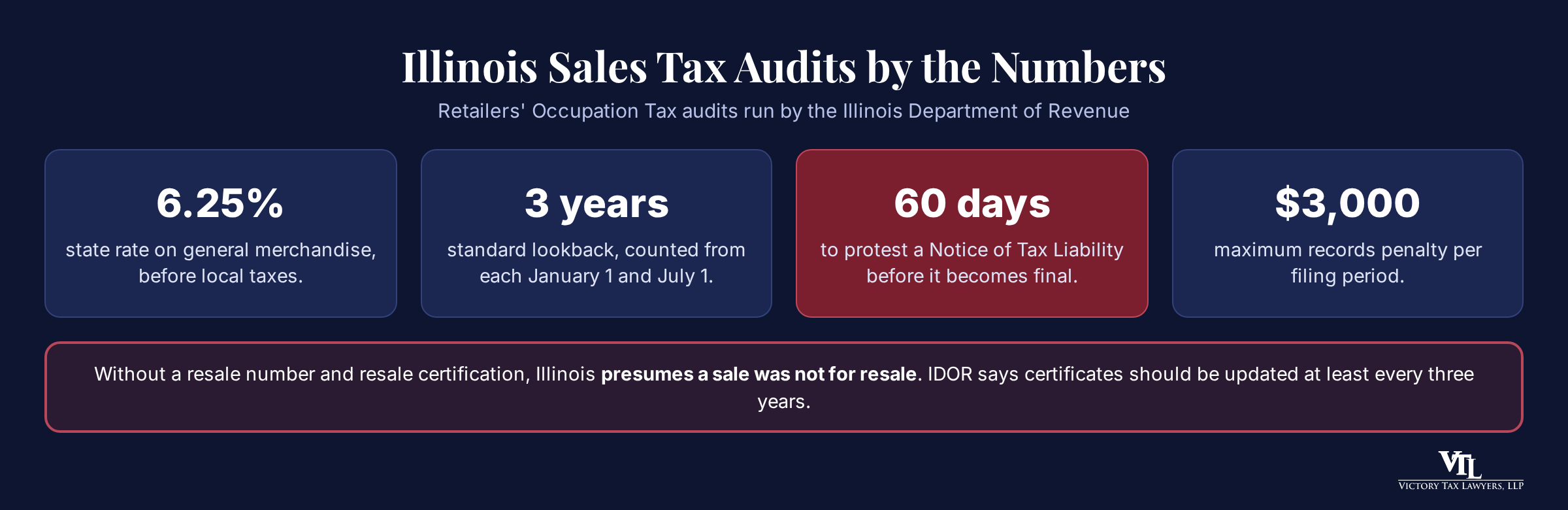
- The state rate is 6.25% of gross receipts under 35 ILCS 120/2-10, with local taxes added on top depending on where the sale takes place.
- Medicines, drugs, and medical appliances are taxed at 1%.
- The state's 1% tax on groceries ended on January 1, 2026. IDOR's Compliance Alert CA-2026-01 says municipalities and counties may now impose their own 1% grocery tax by ordinance.
- Remote retailers moved to destination-based ROT on January 1, 2025, replacing the Use Tax they collected before.
Retailers report on Form ST-1, the Sales and Use Tax and E911 Surcharge Return. Monthly filers owe it by the 20th of the following month.
What Does an Illinois Sales Tax Audit Examine?
IDOR's audit publication, PIO-60, says auditing methods for sales and excise taxes "include testing and detailed reviews of source documents and general ledger accounts," and that the Department "may require your records in samples or in detail." In practice the auditor is asking three questions.
Do reported gross receipts match the business? Returns are compared with the general ledger, bank deposits, point-of-sale data, and federal returns.
Is every untaxed sale supported? Resale sales, exempt sales to charities or government bodies, and out-of-state shipments all need paperwork.
Did you pay tax on what you bought? If a vendor did not charge Illinois tax on equipment or supplies you used yourself, Use Tax may be owed on those purchases.
The recordkeeping rule is broad. IDOR's regulation at 86 Ill. Adm. Code 130.801 requires retailers to keep records of all sales and purchases, including invoices, purchase orders, inventory records, credit and debit memos, and shipping records, "whether or not the retailer believes them to be taxable." Failing to produce requested records can bring a penalty of up to $3,000 per filing period.
Which Businesses Get Audited Most Often?
IDOR does not publish a formula, but its FY2025 annual report lists the problems its auditors keep finding. In our experience, those are also the files that come to us.
| Recurring audit finding (IDOR FY2025 report) | Who it affects | Records that answer it |
|---|---|---|
| Cash businesses failing to keep or produce records | Bars, restaurants, liquor and tobacco stores, grocery and convenience stores, fuel stations | Daily register tapes or POS reports, deposit records, purchase invoices |
| High-rate sales reported at the low rate | Stores selling both general merchandise and low-rate items | Item-level sales reports showing how each product was coded |
| Missing exemption documentation | Wholesalers, distributors, and sellers to farms, contractors, charities, or government | Resale certificates, farm machinery and building materials certificates, exemption numbers |
| Unverifiable sale locations | Remote retailers and marketplace facilitators | Shipping addresses and sourcing records for each sale |
Why Do Resale Certificates Decide So Many Audits?
Because Illinois presumes the sale was taxable until you prove otherwise. IDOR's ROT page says that failing to present an active registration or resale number, with a certification that the purchase is for resale, "creates a presumption that a purchase is not for resale." It also puts the burden on the seller "to verify that the purchaser's Illinois account ID... is valid and active."
The regulation at 86 Ill. Adm. Code 130.1405 is just as direct. "Mere statements by sellers that property was sold for resale will not be accepted by the Department without corroborative evidence." A proper Certificate of Resale, on the other hand, is accepted as prima facie proof. Buyers can use Form CRT-61 or their own certificate, and IDOR says certificates "should be updated at least every three years."
A distributor with 400 customers and 40 expired certificates has a problem the auditor can find in an afternoon. Collecting and updating certificates before the audit starts is the cheapest defense there is.
"An audit is a documentation contest, not an argument about intent," says Parham Khorsandi, Esq., Managing Attorney of Victory Tax Lawyers. "The businesses that come out clean are the ones whose resale and exemption certificates were already in order. Most audits are won in the file cabinet, before anyone meets the auditor."
How Far Back Can an Illinois Sales Tax Audit Go?
Illinois uses a rolling calendar for sales tax. Under 35 ILCS 120/4, no Notice of Tax Liability can be issued on or after each January 1 and July 1 covering receipts from more than 3 years before that date. The period can be extended with your written consent.
Two exceptions remove the limit entirely. IDOR's regulation at 86 Ill. Adm. Code 130.815 says there is no statute of limitations for a fraudulent return or where a return was never filed. That is why an unregistered business that has been selling taxable goods for years faces far more exposure than a registered one that filed and made mistakes.
What Are the Steps in Illinois Sales Tax Audit Representation?
This is how we run a sales tax audit when we are involved from the first letter.
Step 1: Assess the Exposure
We review the audit letter, the periods named, and a sample of your returns and sales data. You get an honest picture of where the risk sits before any records go to IDOR.
Step 2: File Form IL-2848
The Illinois power of attorney is filed and copied to the auditor, so requests and scheduling run through us.
Step 3: Reconcile Returns to the Books
We tie your ST-1 filings to the general ledger, bank deposits, and POS reports. Differences are explained in writing, with support, before the auditor builds a projection on them.
Step 4: Collect and Repair Exemption Paperwork
We identify every untaxed sale in the test period and gather the certificates that support it. Where a certificate is missing, we look for other evidence the sale was genuinely for resale or exempt.
Step 5: Control the Sample
If IDOR proposes to test a sample period and project the result, we check that the period is representative of your business. A holiday month or a one-time equipment sale can distort a projection across three years.
Step 6: Review the Proposed Liability
Before signing the auditor's report or paying anything, we review the adjustments. IDOR's audit publication says signing the report or paying the amount can waive your right to Informal Conference Board review.
Step 7: Informal Conference Board and Protest
If the adjustments are wrong, we request ICB review on Form ICB-1 within 60 days of the Notice of Proposed Liability. If a Notice of Tax Liability issues, the 60-day protest window follows. For a formal hearing or a Tribunal petition, Illinois-admitted counsel appears, and we stay on the file.
Step 8: Fix the Process Going Forward
The same coding error in the POS system will produce the same finding next time. We close the audit by fixing the rate setup, the certificate process, and the Use Tax accrual on purchases.
What Happens After a Notice of Tax Liability?
The Notice of Tax Liability is IDOR's formal claim of tax due. Under 35 ILCS 120/4, IDOR's corrected return is "prima facie correct," and if no protest is filed within 60 days, the notice "shall become final without the necessity of a final assessment being issued."
Within those 60 days, IDOR's dispute page lists the routes. You can protest on Form AH-4 and request a hearing before IDOR's Office of Administrative Hearings. If more than $15,000 of tax is at issue, not counting penalties and interest, you can petition the Illinois Independent Tax Tribunal instead. You can also pay under protest and go to circuit court. IDOR's power of attorney instructions say an attorney must represent you at an administrative hearing or before the Tribunal.
What Penalties Apply in an Illinois Sales Tax Audit?
Penalties come from the Uniform Penalty and Interest Act and are summarized in IDOR's Publication 103.
- Late payment after an audit starts: 20%, reduced to 15% if the full amount is paid within 30 days after IDOR provides the audit-prepared amended return (for returns due on or after January 1, 2024).
- Negligence: 20% of the deficiency, unless the failure was due to reasonable cause.
- Fraud: 50% of the deficiency.
- Interest: simple interest at the federal underpayment rate, which IDOR lists as 7% for 2025 and 2026.
Sales tax is also a trust tax, and that reaches past the business. Under 35 ILCS 735/3-7, an officer or employee responsible for filing and paying who wilfully fails to do so is personally liable for the unpaid tax, interest, and penalties. The liability survives if the company is dissolved, and it is assessed on a separate Notice of Penalty Liability.
Why Work With Victory Tax Lawyers on an Illinois Sales Tax Audit?
A sales tax audit rarely stays a sales tax problem. Unreported cash sales can show up in the federal return. An unpaid assessment against a closed business can turn into a personal bill for the owner. We handle the federal side of those cases as our core practice, which matters when the IRS and IDOR are looking at the same records.
We are also clear about where our work stops. We run the audit, the records work, reasonable cause arguments, and ICB review under Form IL-2848. Formal hearings, Tribunal cases, and court cases in Illinois need an Illinois-admitted attorney, and we coordinate with Illinois counsel for that stage. Our IDOR audit representation page covers income tax audits, and our Illinois tax attorney page explains how we divide state and federal work.
Ready to Talk About Your Illinois Sales Tax Audit?
Bring the audit letter, three years of ST-1 returns, and whatever sales and purchase records you have. We can walk you through where the exposure is, what the auditor is likely to test first, and which records to gather now.
Reach out to Victory Tax Lawyers today to prepare for your sales tax audit.
Frequently Asked Questions
These are the questions Illinois business owners ask most often when a sales tax audit letter arrives.
What Is the Illinois Retailers' Occupation Tax?
It is the tax on the business of selling tangible personal property at retail in Illinois. Together with the Use Tax, it makes up what most people call Illinois sales tax, and both are administered by the Illinois Department of Revenue.
What Does an Illinois Sales Tax Audit Look At?
The auditor tests your source documents and general ledger against your ST-1 returns, reviews support for every untaxed sale, and checks whether Use Tax was paid on purchases. IDOR may ask for records in samples or in detail.
Do I Need Resale Certificates for Every Sale for Resale?
You need support for each one. Without an active registration or resale number and a resale certification, Illinois presumes the sale was not for resale. IDOR accepts Form CRT-61 or an equivalent certificate and says certificates should be updated at least every three years.
How Far Back Can IDOR Audit Sales Tax?
Generally 3 years, counted back from each January 1 and July 1. There is no limit where a return was fraudulent or never filed, and the period can be extended with your written consent.
How Long Do I Have to Protest a Notice of Tax Liability?
60 days. If you do not protest within that time, the notice becomes final without a separate assessment. You can protest to IDOR's Office of Administrative Hearings, or petition the Independent Tax Tribunal if more than $15,000 of tax is at issue.
Legal Disclaimer: The information on this page is provided for general educational purposes and is not legal or tax advice. Illinois sales and use tax rates, exemptions, audit procedures, penalty rates, and appeal deadlines change over time and depend on the facts of each matter. Victory Tax Lawyers, LLP attorneys are licensed in California and admitted to the United States Tax Court; they are not admitted to practice law in Illinois, and matters that require an Illinois-admitted attorney are handled with Illinois counsel. Reading this page does not create an attorney-client relationship. Past results do not guarantee future outcomes.