An IRS lock-in letter means the IRS requires an employer to withhold income tax at a specified rate. The IRS sends this letter when an employee lacks enough withholding, has unpaid taxes, or has missing returns. The letter often requires more withholding, uses zero allowances, and overrides the employee’s current withholding status. Employers must apply the instructions effective immediately using withholding tables, payroll systems, and the employer’s withholding worksheet.
At Victory Tax Lawyers, our seasoned tax professionals help clients who have received an IRS lock-in letter. Schedule a free tax attorney consultation today.
In this comprehensive guide, you will learn what an IRS lock-in letter implies for both employers and employees and how to find your way around it.
What Is a Lock-In Letter From the IRS?
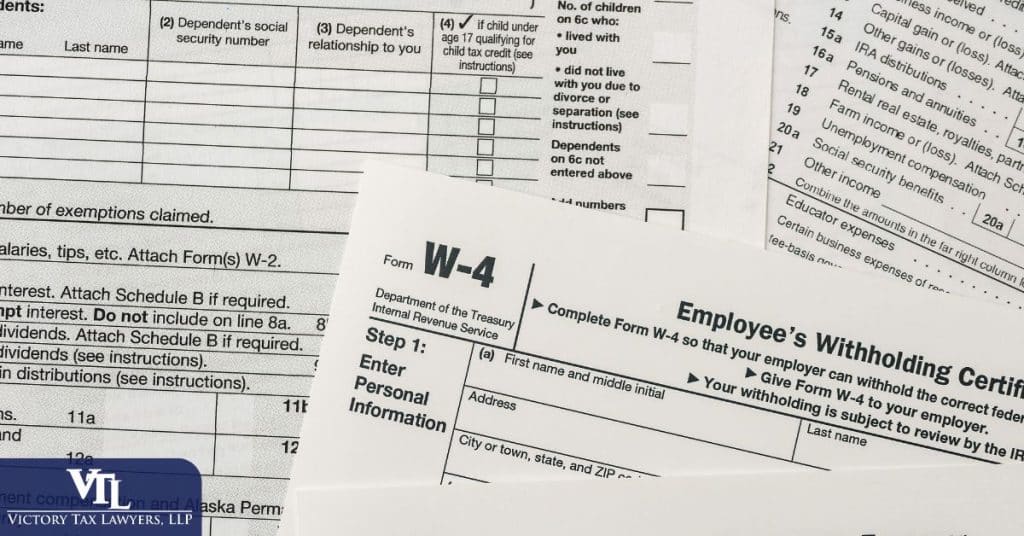
An IRS lock-in letter is an IRS notice sent to an employer to tell them to withhold federal income tax from an employee’s wages at a higher rate. The IRS issues this notice when it determines that the employee is under-withholding taxes, meaning their paycheck does not have the right amount of tax taken out. The lock-in letter spells out the withholding allowances the employer must use, and it often overrides the employee’s Form W-4.
Lock-in letters from the IRS make sure that the federal income tax withholding from an employee’s wages is enough to avoid underpayment. If you receive a lock-in letter from the IRS, you typically have a limited time, usually 60 days, to respond or contest the decision with the IRS before the withholding change begins to apply.
According to the IRS Data Book, in Fiscal Year 2025, the IRS issued 116.9 million individual refunds totaling $516.4 billion, while individual income tax withholding and payments generated nearly $2.9 trillion before refunds. These figures highlight why the IRS closely monitors chronic under-withholding through its Withholding Compliance Program.
How Does an IRS Lock-In Letter Affect Employees and Employers?
An IRS lock-in letter requires an employer to withhold federal income tax from an employee’s wages at a rate specified by the IRS. The IRS issues Letter 2801C to the employee and Letter 2802C to the employer through its Withholding Compliance Program when it determines that an employee is not having enough tax withheld.
Once a lock-in letter takes effect, it overrides the employee’s existing Form W-4 and prevents the employee from reducing withholding by submitting a new W-4 directly to the employer. The IRS generally requires withholding at a higher rate, often equivalent to single filing status with no adjustments under prior rules or the comparable rate under the current Form W-4 system. Employees seeking to change their withholding during the lock-in period must submit a corrected Form W-4 directly to the IRS and obtain IRS approval.
For employees, a lock-in letter increases federal income tax withholding, which reduces take-home pay. If the amount withheld exceeds the employee’s actual tax liability, the excess is refunded when the annual tax return is filed. Making false statements on Form W-4, such as improperly claiming exempt status, may result in a $500 penalty under IRC § 6682.
Employers must implement the withholding rate specified in Letter 2802C within 60 days of receiving the notice, provide the employee with a copy of the letter, and disregard any subsequent Form W-4 submitted directly by the employee unless the IRS authorizes a change. Failure to comply may leave the employer liable for the tax that should have been withheld.
The IRS generally issues lock-in letters when taxpayers repeatedly underwithhold taxes, improperly claim exempt status, fail to file tax returns, or consistently owe significant balances due at the time of filing. The IRS identifies these patterns by comparing wage information reported on Forms W-2 with prior tax returns and withholding elections.
A lock-in letter is not a wage garnishment. It increases future payroll withholding to ensure adequate tax payments during the year, but does not seize wages to collect an existing tax debt. The table below sets out the differences between an IRS lock-in letter and a routine Form W-4 adjustment to make the override mechanics clear at a glance.
| Feature | IRS Lock-In Letter | Employee Form W-4 |
|---|---|---|
| Authority | IRS directive issued under federal tax law and binding on both the employee and employer | Employee election used to determine federal income tax withholding |
| Effect on Withholding | Requires withholding at a rate specified by the IRS, overriding the employee’s prior withholding elections | Allows the employee to adjust withholding based on filing status, dependents, additional income, deductions, and extra withholding amounts |
| Duration | Remains in effect until the IRS modifies or releases the lock-in requirement | Remains in effect until the employee submits a new Form W-4 to the employer |
| Employer Obligations | Must implement the IRS-specified withholding rate within 60 days of receiving Letter 2802C, provide a copy to the employee, and disregard any subsequent Form W-4 submitted directly by the employee unless authorized by the IRS. | Must withhold based on the most recent valid Form W-4 on file and retain withholding records as required by law |
| Employee Options | May submit a corrected Form W-4 directly to the IRS, request a modification based on changed circumstances, or respond within the timeframe stated in the IRS notice. | May submit a new Form W-4 to the employer at any time to increase or decrease withholding |
The table makes the distinction plain. A lock-in letter is not a routine W-4 adjustment; it removes the employee’s direct authority over their own withholding until the IRS releases it.
How Long Does an IRS Lock-In Letter Last?
An IRS lock-in letter lasts indefinitely without intervention. It stays in effect until the IRS Withholding Compliance Unit releases it through a formal notice. There is no automatic expiration based on time alone. The IRS generally looks for sustained compliance before releasing a lock-in, often described as three consecutive years of accurate filing and full payment.
Release decisions are fact-dependent under IRM 5.19.11, so the three-year reference is a working guideline rather than a fixed statutory threshold. The IRS determines whether the record supports release based on filing accuracy, payment history, and the current W-4 election. Ignoring the appeal window can lead to a locked-in status that lasts indefinitely if no compliance work follows.
A modification can be requested within three years if your situation changes. Marriage, divorce, additional dependents, or a significant change in income can reduce the appropriateness of the IRS-determined rate. A revised Form W-4 submitted with a modification letter request to the Withholding Compliance Unit asks the IRS to apply a lower rate that reflects the new facts. Marital status changes are a common reason to file a modification.
Release is communicated through CP2813, releasing a previous withholding lock-in and emphasizing the need for adequate withholding going forward. Falling back into under-withholding after release can trigger a reinstated lock-in. The IRS website publishes Form W-4 guidance and the official taxpayer information about the Withholding Compliance Program. The Withholding Compliance Unit also accepts written modification requests through the address provided in Letter 2801C.
In our experience, when clients come to us a year or more into a lock-in, the case usually centers on documenting the compliance record and timing the release request. A free consultation lets our team review Letter 2801C, the prior-year returns, and the withholding history before recommending a path.
What Triggers an IRS Lock-In Letter?

Your employer is likely to receive an IRS lock-in letter when the IRS believes that you are not having enough federal income tax withheld from your paycheck. According to the IRS, the lock-in letter states the maximum number of withholding allowances the employee is allowed to claim. Employers have to withhold taxes in the exact way it was spelled out to them in the lock-in letter and by the deadline given, unless the IRS says otherwise. The date is usually 60 days from when the letter is issued. Once the lock-in rate is set in motion, an employer cannot reduce the withholding unless the IRS approves it.
Employees are typically required to fill out Form W-4 to determine how much tax should be withheld from their paychecks. Now, if you claim too many allowances, such as listing multiple dependents or choosing a higher withholding exemption than you actually qualify for, you may end up with too little tax being withheld. Over time, when the IRS notices this and sees that you are constantly owing taxes when filing, they may target you for a lock-in letter to correct the withholding rate. The idea is to make sure that the correct amount gets taken from your paycheck in the future.
Another thing that could lead to you being issued a lock-in letter is years of unpaid federal income taxes. If you have back taxes from previous years, the IRS will try to correct this by making sure it takes enough money from your future wages to cover the debt. They will achieve this by issuing a lock-in letter to increase the withholding tax amount from your wages. That way, your future withholdings are sufficient not only for the current year’s taxes, but also to help repay any back taxes owed.
Note that the IRS takes tax fraud and evasion seriously. If you intentionally provide incorrect information on your Form W-4 to reduce your tax liability, the IRS may just issue you a lock-in letter. An example is when you attempt to claim exemptions you are not entitled to or deliberately underestimate your income.
If the IRS reviews your tax history and detects any suspicious or fraudulent activity, it will take action. In such cases, the lock-in letter is issued to prevent you from further manipulating your withholdings and underpaying taxes. Even if you didn’t mean to commit fraud, the IRS could still send this letter if they spot mistakes in your returns or withholding details. It serves as a warning to encourage you to be more careful and accurate next time.
How Long Does a Federal Income Tax IRS Lock-in Letter Last?
When an employer receives an IRS lock-in letter for federal income tax, the letter remains effective indefinitely until the IRS officially cancels it. This simply means that the employer has to stick to the federal tax withholding guidelines laid out in the letter for as long as the letter is still in effect. However, the employee who is affected by the new withholding rate can appeal to the IRS to lift or modify the lock-in letter. Although an appeal to have the lock-in letter modified only stands if the employee has shown compliance with the lock-in letter.
Is an IRS Lock-in Letter Bad?
No, an IRS lock-in letter is not necessarily bad. However, it is a sign that there is an issue with your federal income tax withheld. And while it is not to be looked at as a penalty, it is an indicator that you have a potential tax issue to address. That’s why you want to address it as soon as it lands on your desk.
For instance, if you leave it unanswered, the IRS-mandated income tax withholding might take a larger chunk out of your paycheck, leaving you with less money to spend. It is also the IRS’s way of helping you avoid harsher tax penalties in the future. So if you have received one, be grateful that you get the opportunity to correct any mistakes you may have in your withholding before they become bigger problems.
How a Lock-In Letter Can Affect Take-Home Pay
A client we worked with, earning $85,000 annually, claimed withholding amounts that substantially reduced federal tax withholding. Over several years, the client repeatedly owed more than $8,000 when filing returns. After reviewing prior returns and wage information, the IRS issued Letter 2801C to the employee and Letter 2802C to the employer, requiring withholding at a higher rate.
The employee’s net paycheck decreased by approximately $275 per pay period. After filing all outstanding returns, maintaining compliance for several years, and submitting a corrected Form W-4 to the IRS Withholding Compliance Unit, the taxpayer later obtained a release from the lock-in requirement. Every case is different, but this example illustrates how the IRS uses lock-in letters to correct chronic under-withholding.
The L.O.C.K. Method for Removing an IRS Lock-In Letter
In our experience assisting taxpayers with IRS withholding disputes, successful lock-in letter releases usually follow the same pattern. People who resolve these cases most efficiently tend to identify the underlying issue early, establish a record of compliance, and submit a well-documented release request to the IRS. To simplify the process, we use the L.O.C.K. Method, a four-step framework designed to help taxpayers understand what the IRS expects before considering a release of a lock-in letter.
- L – Locate the Cause: Review Letter 2801C, prior tax returns, and withholding elections to determine why the IRS imposed the lock-in requirement.
- O – Obtain Compliance: File any unfiled returns, resolve outstanding tax liabilities, and establish a history of timely filing and payment.
- C – Correct Withholding: Submit an updated Form W-4 directly to the IRS Withholding Compliance Unit, along with supporting documentation demonstrating that the withholding issue has been addressed.
- K – Keep Records: Maintain copies of tax returns, IRS correspondence, modification requests, and release notices, including CP2813, to document compliance and support future requests if needed.
Following these steps helps taxpayers present a complete, organized case when seeking a modification or release of an IRS lock-in letter. “In our experience, taxpayers often assume a lock-in letter automatically disappears after a certain period. It does not,” says Parham Khorsandi. “The IRS generally expects taxpayers to demonstrate a sustained pattern of compliance before considering release.”
How Do I Get Out of an IRS Lock-In Letter?
Release takes a documented compliance record and a formal request. There is no automatic expiration of a lock-in letter, so the work has to be done.
Step 1 – Establish a Sustained Compliance Record
File all missing tax returns first, because unfiled returns are a barrier to release. Then maintain accurate filing and full payment for an extended period, typically three consecutive years. We have found that clients who get a faster release are the ones who can hand the IRS a clean compliance file on the first request. Documenting past returns and current employee returns side by side helps show the pattern has shifted.
Step 2 – Submit a Corrected Form W-4 Directly to the IRS
Once compliance is in place, submit the corrected W-4 to the Withholding Compliance Unit, not to the employer. The employer cannot release the lock-in unilaterally. Include documentation showing the under-withholding pattern has been corrected. If you have a new employer because you change jobs after the lock-in, send the corrected W-4 to the IRS, and the new employer will receive the IRS directive separately.
Step 3 – File the Release Request
The taxpayer, or an authorized representative under Form 2848 Power of Attorney, contacts the Withholding Compliance Unit in writing and asks for release of the lock-in. Reference the case file using the identifiers on Letter 2801C. We typically attach the corrected W-4 and the supporting record in the same submission so the file is complete on first review.
Step 4 – Watch for CP2813
If the IRS grants a release, CP2813 is issued to formalize the lock-in removal. The notice emphasizes the need for adequate withholding going forward, and under-withholding after release can trigger a reinstated lock-in. Keep the CP2813 with the case file; if a new employer later asks why the prior IRS-specified rate is no longer in effect, the notice is the documentation.
Step 5 – Appeal if Release Is Denied or if the Original Lock-in Is Contested
Before the lock-in takes effect, Letter 2801C generally provides a defined response period, commonly around 60 days, for the employee to dispute the proposed rate before the employer is directed to apply it. After the lock-in takes effect, you have 30 days to appeal the lock-in letter, and the appeal goes to the Withholding Compliance Unit with supporting documentation.
For complex cases or denied release requests, working with a tax attorney or enrolled agent strengthens the appeal. An experienced practitioner can present the case to IRS Appeals if the first request is denied. Speak with our team if a lock-in letter has been in place for more than a year and you want a clear path to release. Free consultation; no obligation.
How to Respond to an IRS Lock-In Letter?

For employees, the first step is to review the IRS letter and identify why the withholding change was issued. Next, evaluate your Form W-4 against your current withholding arrangement and IRS account data used to determine the adjustment.
If the IRS changes appear incorrect, gather supporting documents and records that reflect your correct withholding arrangement. Married employees filing jointly may qualify for less withholding depending on income structure, filing status, and input values on Form W-4. If necessary, submit a revised W-4 that reflects your current financial situation.
You may contact the IRS directly within the response deadline to challenge the IRS letter and submit supporting documentation. The IRS reviews employee results and determines whether to modify the withholding arrangement or maintain the same set of instructions. If approved, the withholding arrangement is updated; otherwise, the original directive remains in effect.
The IRS letter overrides the employee’s Form W-4 and must be implemented through automated payroll systems using IRS percentage method tables or wage bracket tables, depending on instructions. Employers must apply correct input values and ensure payroll reflects the required withholding arrangement by the deadline. Even if the employee disputes the adjustment or submits a new W-4, the employer must continue using the IRS-directed system until the IRS issues updated instructions.
Need Help From a Tax Lawyer?
Many articles simply explain what a lock-in letter is. This guide goes further by outlining the release process, discussing modification requests, comparing lock-in letters with Form W-4 elections, identifying common triggers, and providing practical strategies developed from representing taxpayers dealing with withholding compliance issues.
With over $72 million saved for clients since 2017, Victory Tax Lawyers, a Los Angeles-based tax firm, delivers experienced legal help you can count on to get real IRS solutions. Get the honest, effective tax relief you deserve. Contact us for a free consultation today!
Frequently Asked Questions
The questions below cover the points clients most often raise about IRS lock-in letters — release, timing, and the practical impact on payroll.
How Do You Get Out of an IRS Lock-In Letter?
Release requires a sustained compliance record, a corrected Form W-4 sent directly to the IRS Withholding Compliance Unit, and a formal release request. Work with a tax attorney to prepare the request and represent you through any appeal.
How Long Does an IRS Lock-In Letter Last?
A lock-in lasts indefinitely without intervention, and the IRS may release it after sustained compliance, often described as three consecutive years of accurate filing and full payment. Modification requests can be filed earlier if circumstances change.
How Long Does the Process Take to Remove a Lock-In Letter?
Release commonly runs 30 to 90 days after submission, once the compliance record supports the request. Complex cases or those that require an appeal can extend the timeline.
Is an IRS Lock-In Letter Bad for Employees?
The lock-in reduces net pay by mandating higher withholding, but it does not directly affect credit, employment status, or other financial accounts. The over-withholding can produce a refund at year-end if the IRS rate exceeds the actual liability.
How Long Does the IRS Lock Your Account?
There is no account lock-in in the consumer-banking sense. The IRS lock-in directs the employer to withhold at the IRS-specified rate. The directive applies only to payroll withholding through the named employer.
Legal Disclaimer: The information provided on this blog is for general informational purposes only and does not constitute legal advice. Reading this content does not create an attorney-client relationship. Laws and regulations vary by jurisdiction and may change over time, so you should consult a qualified tax attorney for advice regarding your specific situation. Past examples, case studies, or hypothetical scenarios are illustrative only and do not guarantee similar results.