
If you owe the IRS, your IRS account will show an outstanding balance for the applicable tax year. Back taxes are unpaid taxes from previous years, and ignoring them can lead to liens or levies. If you cannot pay in full, you may qualify for an installment plan or hardship extension, which requires proof of financial difficulty. It is in your best interest to pay what you can or arrange a payment plan before additional interest and penalties accrue.
At Victory Tax Lawyers, we help taxpayers nationwide resolve IRS disputes and tax debt matters. Our attorneys bring more than 10 years of experience handling tax controversy, resolution, and litigation matters, have secured over $100 million in tax relief for clients, and have assisted more than 10,000 taxpayers across all 50 states. Our results include reducing a $1 million tax liability to $16,194 through an Offer in Compromise and converting six-figure tax debts into affordable monthly payment plans as low as $25 per month. If you are facing IRS issues, contact us today for a free consultation.
This blog explains what happens when you owe the IRS, including collection notices, payment options, back taxes, penalties, interest, and hardship relief.
What Are IRS Payment Plans and How Do They Work?
An IRS payment plan is a formal agreement to pay your tax liability over time when you cannot pay the full amount by the due date. The IRS offers two forms. A short-term payment plan gives you extra days to pay in full. A long-term payment plan, known as an installment agreement, spreads the balance across monthly payments.
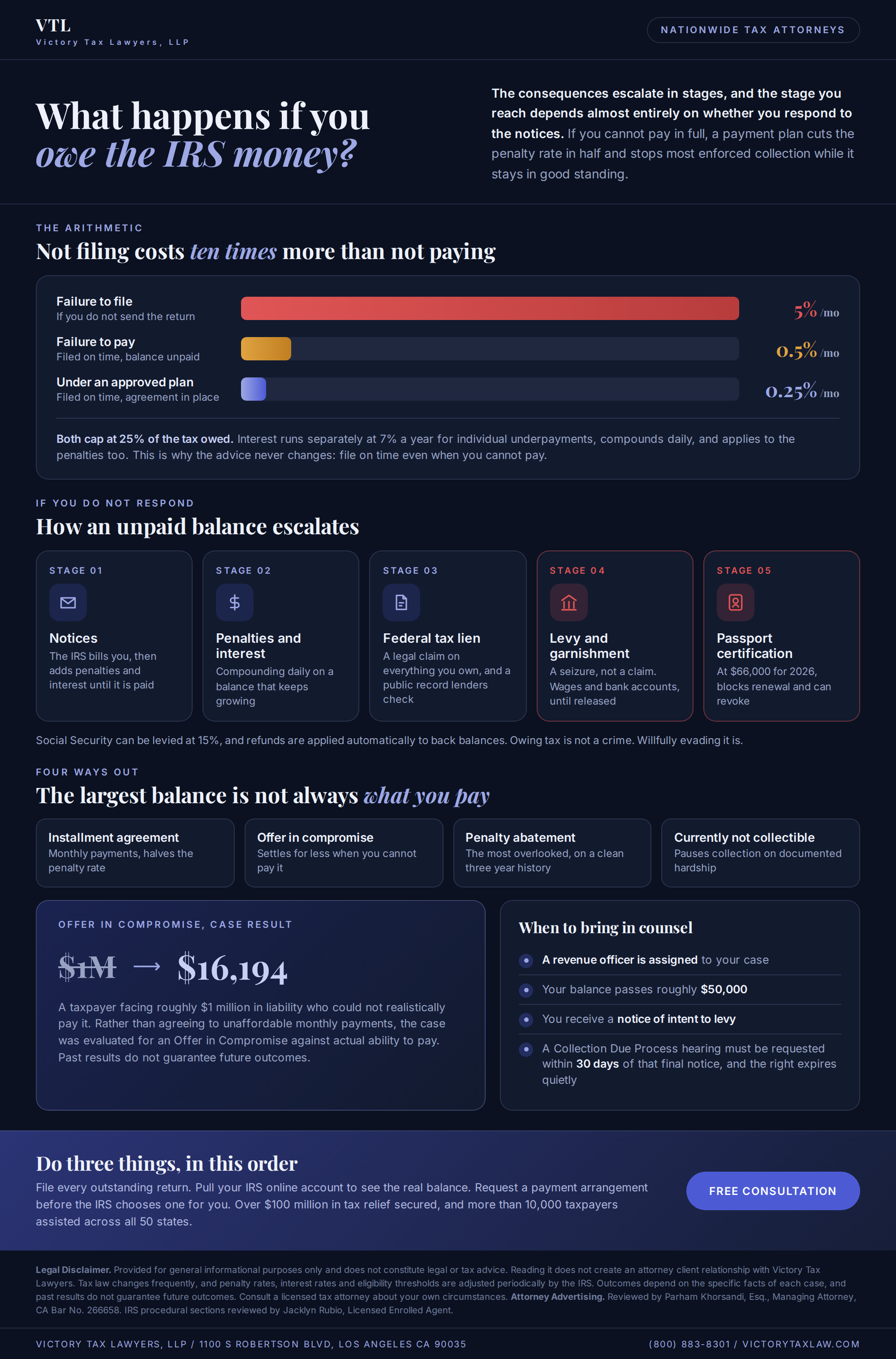
Payment plans matter because they change the arithmetic. The failure-to-pay penalty runs at 0.5% of the unpaid tax per month. Under an approved installment agreement, that rate drops to 0.25% per month for individuals who filed the return on time. Interest keeps accruing either way, but you cut the penalty rate in half.
An active agreement also stops most enforced collection. While the IRS reviews a pending installment agreement request, and while an approved agreement stays in good standing, the IRS generally will not levy. Timely payments keep that protection in place, which is why you should file early and set the amount honestly.
What Is a Short-Term Payment Plan?
A short-term payment plan gives you up to 180 days to pay the full tax bill. There is no setup fee. You may apply online if your combined tax, penalties, and interest come to less than $100,000.
This option suits a temporary delay rather than a structural problem. A bonus arriving in two months, a property sale closing in spring, an inheritance in probate. You still pay interest and the late payment penalty for the whole period the unpaid balance is open. Every extra month adds interest, so the shorter the window to pay in full, the cheaper the outcome.
What Is a Long-Term Payment Plan?
A long-term payment plan lets you pay your tax debt monthly over several years. You may apply online if you owe $50,000 or less in combined tax, penalties, and interest, and you have filed every required tax return. The setup fee is $29 when you apply online and pay by direct debit. It rises to $69 online without direct debit, and to $107 or $178 by phone, mail, or in person. The IRS waives the fee for low-income taxpayers.
Direct debit is not only cheaper. Agreements paid by direct debit default far less often, because the payment never depends on remembering it. The IRS now groups these arrangements under the label simple payment plans, so do not be thrown off if the wording on the IRS website differs from an older notice. If you owe more than $50,000, you can still get an installment agreement, but you file Form 9465 with a collection information statement instead of applying online.
Who Qualifies for an IRS Payment Plan?
In our experience, your unpaid balance and filing compliance determine eligibility. Filing compliance is the one that trips people. You must have filed all required returns before the IRS will approve any payment arrangements, even if you could not pay a cent of what those returns show. Income is not an eligibility test for a standard agreement, but it does change the terms.
Low-income taxpayers, defined as those at or below 250% of the federal poverty guidelines, can have the setup fee waived or reimbursed. Income and expenses matter far more once your balance passes $50,000. The IRS then reviews a collection information statement on Form 433-F or Form 433-A. It measures your proposed monthly payment against your basic living expenses. The table below compares the two plan types on the terms that decide which one fits your tax situation.
| Feature | Short-Term Payment Plan | Long-Term Payment Plan |
|---|---|---|
| Payment period | Up to 180 days | Monthly payments, generally up to 72 months |
| Balance limit to apply online | Under $100,000 combined | $50,000 or less combined |
| Setup fee | None | $29 online with direct debit; $69 online without direct debit; $107–$178 by phone or mail |
| Failure-to-pay penalty | 0.5% per month | 0.25% per month once approved |
| Payment options | Direct debit, bank account, credit or debit card, money order | Direct debit, payroll deduction, bank account, credit or debit card |
| Best for | A temporary cash-flow problem | A tax balance you cannot pay off within a year |
Low income taxpayers, those at or below 250% of the federal poverty guidelines, have the setup fee waived entirely on a direct debit agreement rather than reduced. Ignoring IRS notices can increase the likelihood of enforced collection actions, making it important to address the balance promptly.
IRS Tax Debt Case Study: How a $1 Million Liability Was Reduced to $16,194
Consider a taxpayer facing approximately $1 million in IRS tax liability who could not realistically pay the full balance. Rather than attempting to make unaffordable monthly payments, the case was evaluated for an Offer in Compromise based on the taxpayer’s financial circumstances and ability to pay. The result reduced the liability to $16,194, showing why taxpayers should evaluate their collection options before agreeing to payments they cannot sustain.
The lesson is straightforward: the largest IRS balance is not always the amount a taxpayer ultimately has to pay. The appropriate resolution depends on income, assets, expenses, filing history, and the taxpayer’s ability to satisfy the liability under the available IRS programs.
How Do You Apply for an IRS Payment Plan?

Applying for an IRS payment plan generally involves confirming your tax filings are current, choosing a payment amount and method, and submitting your installment agreement request online or by paper. Although paying the full balance immediately is generally in your best interest because unpaid taxes continue to accrue additional interest and penalties, an installment plan can provide relief when full payment is not feasible.
Step 1 - File every outstanding tax return. An application from a taxpayer with unfiled returns gets rejected, and that rejection wastes weeks you don't have.
Step 2 - Decide what you can genuinely pay monthly. Set the figure against your real budget, not an optimistic one. A defaulted agreement is treated worse than no agreement, because the IRS has already seen your proposal fail.
Step 3 - Apply. Use the IRS Online Payment Agreement tool for the fastest approval, or mail Form 9465 with your payment details if your balance or circumstances rule out the online route. The IRS approves most straightforward requests within thirty days.
Three benefits stand out: a lower penalty rate, protection from enforced collection, and a fixed number you can plan around. The penalty reduction alone is worth the setup fee many times over on a mid-sized balance. Protection from levy keeps your paycheck and your bank accounts intact while you pay. The third benefit is the one clients mention most. A known monthly figure turns an open-ended threat into a line item, and that makes the rest of your financial planning possible again.
What Are the Consequences of Owing Money to the IRS?

The consequences of owing money to the IRS escalate in stages, from interest and penalties to liens to seizure of assets. The taxes owed keep growing at every stage, because the balance continues to accrue interest until it is paid. The stage you reach depends almost entirely on whether you respond to the notices.
The IRS charges a 0.5% failure-to-pay penalty per month on unpaid taxes, capped at 25% of the tax owed. Interest accrues on top of it and compounds daily. Interest on unpaid tax is set quarterly at the federal short-term rate plus three percentage points. It stands at 7% per year for individual underpayments, including the quarter beginning October 1, 2026, and applies to both penalties and tax. Together they can add a meaningful share of the original tax bill within a year.
If you also failed to file, the failure-to-file penalty charges 5% of the unpaid taxes per month, capping at 25%, which is ten times the failure-to-pay rate. This is why we tell every client the same thing: file the tax return on time even when you cannot pay it. In our experience, filing without paying is expensive, but not filing is much more expensive.
We have found that credit scores are the part most articles get wrong. Since 2018, the three national credit bureaus no longer include federal tax liens on consumer credit reports, so an IRS balance does not directly lower your score. It still shows up where it matters. A recorded lien is a public record, and mortgage underwriters, commercial lenders, and licensing boards check for it.
What Are the Long-Term Consequences of Unpaid Taxes?

Left alone, an IRS balance turns into a federal tax lien and then a levy. The IRS can file a federal tax lien after several months of non-payment. A lien is a legal claim against everything you own, which is why refinancing or selling property becomes difficult once one is recorded.
A levy is the next step, and it is a seizure, not a claim. The IRS can seize assets like wages or bank accounts for unpaid taxes. Wage garnishment continues every pay period until the debt is satisfied or the levy is released. The IRS can levy Social Security benefits at 15% under the Federal Payment Levy Program, so retirement income is not automatically out of reach. Current refunds are applied automatically to back tax balances.
Under Internal Revenue Code section 6502, the IRS has 10 years to collect unpaid taxes after assessment a deadline called the collection statute expiration date. Waiting out the collection statute is not a strategy, though. Several actions, including a pending offer, suspend and extend the clock.
Can the IRS Take Legal Action Against You?
Yes. Most enforcement is administrative, meaning the IRS acts without going to court. The agency can also sue to reduce a tax liability to judgment or to foreclose a lien. Severe delinquency can trigger a passport certification to the State Department, which blocks renewal and can lead to revocation. The threshold is $66,000 in assessed tax, penalties, and interest for 2026, adjusted yearly for inflation. That is how an unpaid balance ends up costing someone a passport.
Criminal exposure is narrower than the headlines suggest. Owing taxes is not a crime. Willfully evading them is. The line matters, and it is one reason to bring in counsel before you start explaining your finances to a revenue officer.
You also have appeal rights that expire quietly. You must request a Collection Due Process hearing within 30 days of a final notice of intent to levy. Victory Tax Lawyers files those requests, represents clients at the hearing, and takes the matter to Tax Court when the determination is wrong.
What Are the Benefits of Paying Taxes on Time?
Paying taxes on time removes the penalty and the interest entirely, which is the cheapest tax planning available to anyone. Every month of delay costs you the late payment penalty plus the interest charges on the growing balance. Since interest compounds daily and applies to penalties too, the cost curve steepens the longer the balance sits. When you pay taxes by the due date, both charges are simply zero.
Paying in full also keeps your record clean where it counts. No lien means no public filing, and no public filing means nothing for an underwriter to find when you apply for a mortgage or a business line of credit. On-time payments build financial health by removing the single most aggressive creditor you will ever have. No commercial lender has the collection powers the IRS holds.
The practical fixes are unglamorous. Adjust your withholding when your income changes. Pay quarterly estimated taxes if you are self-employed. Use the Electronic Federal Tax Payment System to schedule tax payments ahead of the due date so you don't rely on memory. Treat the tax as money that was never yours, and the annual surprise disappears.
What Strategies Can Reduce Your Tax Debt?
Four strategies reduce tax debt in practice: an installment agreement, an offer in compromise, penalty abatement, and currently not collectible status. Which one fits depends on your financial situation, not your preference.
An offer in compromise lets qualifying taxpayers resolve a liability for less than the full amount owed when their income and assets show they cannot pay it. The IRS calculates reasonable collection potential from your equity and your future income after allowable living expenses, and it accepts offers that meet or beat that figure. The application requires Form 656 and Form 433-A (OIC) plus a $205 fee, which is waived for taxpayers who certify as low income. You may qualify. Nobody can promise you will.
An installment agreement is the more common and predictable outcome. Penalty abatement is the most overlooked. First-time abatement removes failure-to-file and failure-to-pay penalties for taxpayers with a clean three-year history. Reasonable cause relief covers illness, disaster, and similar circumstances. If you have no ability to pay at all, currently not collectible status pauses collection entirely where you can document genuine economic hardship. Interest continues to accrue while the account sits in that status.
When Should You Hire a Tax Professional?
Hire a tax professional once a revenue officer is assigned, once your balance passes roughly $50,000, or the moment you receive a notice of intent to levy. Those three markers shift the case from paperwork to negotiation.
A simple balance under $10,000 with current filings usually does not need counsel. The online payment agreement tool handles it. Representation earns its cost where discretion exists. Which allowable expenses the IRS accepts. Whether an offer is credible. Whether a penalty abatement argument holds. Whether you should be talking to the IRS directly at all. Under a Form 2848 power of attorney, we handle that contact so you don't have to.
What Practical Steps Lower a Tax Bill?
Start by budgeting the tax as a fixed monthly expense rather than a windfall you hope to have. Set the amount aside in a separate account so making payments is mechanical.
Then compare your borrowing costs honestly. If a personal loan or a credit card carries a lower rate than the combined IRS penalty and interest, it can be in your best interest to clear the taxes you owe up front and repay the lender instead. Run the numbers first. Consumer credit card rates usually run well above the IRS rate, so this works far more often with a personal loan than with a card.
Afterward, check whether you overpaid in the first place. Missed tax credits and deductions are common on self-prepared returns, and an amended return can reduce the underlying liability that everything else is calculated from. Refundable credits reduce the tax itself rather than your taxable income, so it's worth checking them first. Filing an amended return is often the highest-value hour in a tax debt case.
The Three-Step Tax Debt Resolution Framework
Our approach starts with three questions: Is everything filed? What does the IRS actually say you owe? And what resolution can you realistically afford? This sequence prevents taxpayers from choosing a payment arrangement before they know whether the underlying balance is accurate or whether a better resolution may be available.
Do three things, in order. File every outstanding return, pull your IRS online account to see the real balance, and request a payment arrangement before the IRS chooses one for you. Payment plans reduce the penalty rate and stop enforcement. Offers in compromise resolve liabilities you genuinely cannot pay. Penalty abatement removes charges that should never have applied. Each option depends on acting while you still have options.
Do You Need a Tax Lawyer to Help You Resolve Your Tax Debt?
We focus on resolving tax problems, not just explaining them. Our attorneys can communicate directly with the IRS, evaluate whether an installment agreement, OIC, penalty relief, or hardship status fits the taxpayer’s circumstances. They can also handle negotiation on the client’s behalf. That combination of tax-resolution strategy and direct representation is valuable when an IRS balance has moved beyond a payment question and into collection.
With over $100 million saved for clients since 2017, Victory Tax Lawyers, a Los Angeles-based tax firm, delivers experienced legal help you can count on to get real tax solutions. Get the honest, effective tax assistance you deserve. Contact us for a free consultation today!
Below are answers to some of the most common questions clients ask when they first call us about an IRS balance.
Frequently Asked Questions
What Happens If I Owe the IRS Money?
The IRS bills you, then adds penalties and interest until the balance is paid. If you do not respond, it can file a tax lien, garnish your wages or seize funds from your bank accounts.
Can the IRS Put a Lien on My Property If I Owe Them Money?
Yes, the IRS can file a federal tax lien against your property once a balance goes unpaid after demand. A recorded lien makes it much harder to sell or refinance that property.
What Should I Do If I Owe the IRS Money and Cannot Pay?
File the return anyway and contact the IRS to set up a payment plan. If you cannot pay anything, ask about currently not collectible status or an offer in compromise.
How Can a Tax Lawyer Help Me If I Owe the IRS Money?
A tax lawyer deals with the IRS directly under a power of attorney and argues for the resolution your finances support. That can mean an installment agreement, penalty relief, a levy release, or an offer in compromise.
What Are the Consequences of Not Paying What I Owe the IRS?
Penalties and interest keep building, and the IRS can move to liens, wage garnishment, and asset seizure. Severe delinquency can also lead to passport restrictions. Legal Disclaimer: This article is provided for general informational purposes only and does not constitute legal or tax advice. Reading it does not create an attorney-client relationship with Victory Tax Lawyers. Tax law changes frequently, and penalty rates, interest rates, and eligibility thresholds are adjusted periodically by the IRS. Outcomes depend on the specific facts of each case, and past results do not guarantee future outcomes. Consult a licensed tax attorney or qualified tax professional about your own circumstances before acting on anything described here. Attorney Advertising. Victory Tax Lawyers, 1100 S Robertson Blvd, Los Angeles, CA 90035. (800) 883-8301. Reviewed by: Parham Khorsandi, Esq., Managing Attorney (CA Bar No. 266658). IRS procedural sections reviewed by Jacklyn Rubio, Licensed Enrolled Agent.