The Internal Revenue Service (IRS) Withholding Compliance Program (WCP) ensures that taxpayers have the correct amount of federal income tax withheld from their wages. It applies to individuals who have been underpaying taxes or submitting inaccurate withholding information, helping prevent large tax debts, interest, and penalties. To request a release from the WCP, taxpayers must show full compliance with their filing and payment obligations and follow the IRS’s instructions carefully. If a release is denied, employee appeals can be filed to challenge the decision and regain control over withholding.
At Victory Tax Lawyers, our seasoned tax professionals can help with the IRS Withholding Compliance Program. Schedule a free tax attorney consultation today.
This article covers what you need to know about the program, what it is, and how to get a release if you're caught up in it.
What Is the IRS Withholding Compliance Program?
The Internal Revenue Service Withholding Compliance Program ensures taxpayers have enough federal income tax withheld to cover their actual tax liability. When the IRS reviews your IRS account and finds under-withholding, unfiled tax returns, or issues from past returns, it may send IRS notices or an IRS letter requiring corrections.
A key enforcement tool is the lock-in letter. If you’re wondering what a lock-in letter means, it directs your employer to withhold tax at a set rate, overriding your Form W-4, and is typically effective immediately. The IRS sends this when taxpayers, including those who are self-employed or have inaccurate employee returns, are not having enough withheld.
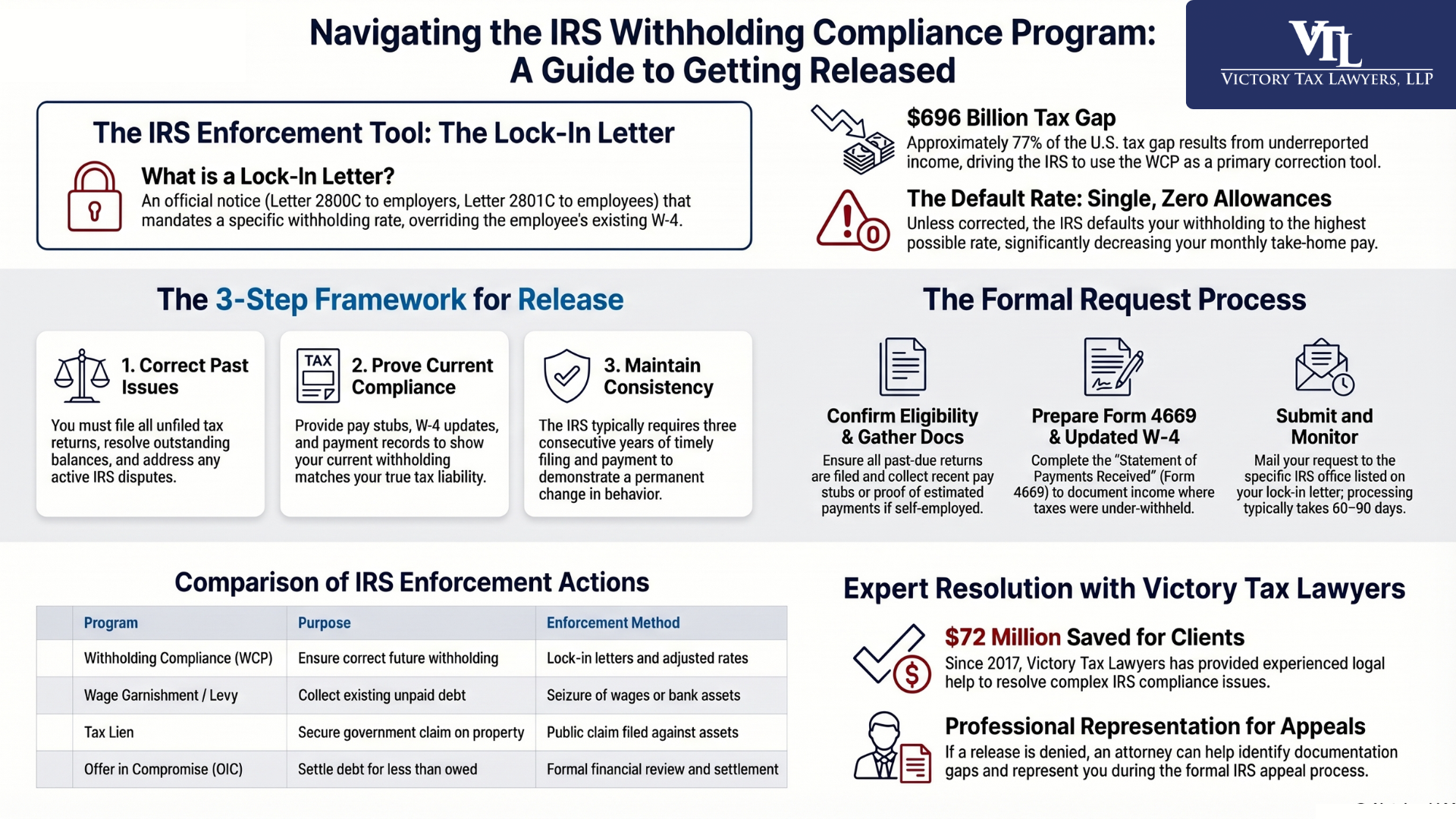
According to IRS data, the U.S. tax gap reached nearly $696 billion, with 77% of this gap coming from underreported income. Being in the program can reduce take-home pay and may lead to wage garnishment. If you change jobs or get a new employer, the IRS may issue another IRS letter to maintain compliance.
To make changes, you need IRS approval, often by filing unfiled tax returns and correcting past returns. The IRS may then issue a modification letter or release. Seeking professional help or a free consultation can help resolve issues and restore your IRS account.
What Is a Lock-In Letter?

A lock-in letter is an official IRS notice given to employers instructing them to withhold federal income tax from an employee's wages. This letter is issued when the Internal Revenue Service believes the employer has not withheld enough taxes, often due to the employee submitting multiple incorrect W-4 forms or claiming too many withholding allowances.
“A lock-in letter is one of the IRS’s strongest tools for correcting under-withholding, and most taxpayers don’t realize how difficult it can be to reverse without demonstrating consistent compliance over time,” says Parham Khorsandi, Founder, Victory Tax Lawyers.
The IRS doesn't issue a lock-in letter randomly. Usually, the employee in question must have been on their radar for a while. Ideally, they send two different notices: Letter 2800C and Letter 2801C. The first letter, which is Letter 2800C, is sent to the employer and mandates them to disregard any prior W-4 the employee has submitted and instead apply the specific withholding rate and filing status outlined in the lock-in letter to the employee's pay going forward.
After the employer receives the first notice, the self-correcting letter is sent to the employee to inform them that their employer has been instructed to enforce the new withholding rate. This letter emphasizes that the lock-in order can be canceled if a new W-4 leads to more tax being withheld than the lock-in letter specifies. The purpose of this process is to correct under-withholding and ensure the employee pays the true tax liability.
The IRS issues a lock-in letter when it believes an employee has not withheld enough taxes, often due to incorrect W-4 forms or excessive withholding allowances. The default lock-in withholding rate is “single, zero allowances,” which assumes the employee has a single filing status with no allowances, significantly increasing the amount of tax withheld and reducing take-home pay. Ignoring a lock-in letter does not stop the new withholding; the employer is still required to follow the IRS’s instructions.
Employers have 60 days to implement the lock-in rate once they receive the letter, and employees have 30 days to contest the IRS decision. To appeal, employees must submit a revised W-4 along with supporting documentation directly to the IRS. The IRS will review the appeal and determine whether to approve the new withholding rate or maintain the original lock-in.
A lock-in letter remains in effect until the IRS issues a modification or release, which typically requires three consecutive years of full compliance with filing and payment obligations. To be released from the IRS Withholding Compliance Program, you must continue to file returns, pay taxes due, and demonstrate consistent and accurate withholding. Professional help from tax attorneys can assist in navigating these requirements and ensuring proper compliance.
Real Example: How a Taxpayer Got Released from the WCP
For example, one employee was placed in the IRS Withholding Compliance Program after several years of under-withholding and unfiled tax returns. After receiving a lock-in letter, their withholding rate was changed to single, zero allowances, significantly reducing their take-home pay.
To resolve the issue, the taxpayer filed all past returns, updated their Form W-4, and provided documentation showing their withholding now covered their true tax liability. Within approximately 60 days of submitting a complete request, the IRS approved a modification and later granted a full release after consistent compliance. This example shows that while the process can be strict, following IRS requirements and maintaining accurate withholding can lead to a successful outcome.
The 3-Step Framework for Getting Released from the WCP

It can be difficult to understand how to be released from the IRS Withholding Compliance Program, particularly if you don't know what the IRS is looking for. It is easier to determine the necessary steps, steer clear of typical pitfalls, and increase your chances of approval when the process is broken down into a straightforward framework. To simplify the process, most successful release requests follow a clear three-step framework:
1. Correct Past Issues - File all unfiled tax returns, resolve outstanding balances, and address any IRS disputes.
2. Prove Current Compliance - Show that your current withholding accurately reflects your true tax liability through pay stubs, W-4 updates, and payment records.
3. Maintain Consistency - Demonstrate consistent compliance over time, as the IRS looks for a pattern of accurate withholding before granting a release.
Following this framework helps ensure your request aligns with what the IRS expects when reviewing WCP release applications.
How Do You Request a Release from the IRS Withholding Compliance Program?
Before diving into the steps, it is important to understand why a release may be necessary. The IRS places taxpayers in the Withholding Compliance Program when it believes withholding is not enough to cover the true tax liability.
Requesting a release ensures that your withholding accurately reflects your current tax situation, prevents over-withholding, and helps avoid unnecessary IRS enforcement actions such as wage garnishment. Below is a guide to requesting a release from the IRS Withholding Compliance Program:
Step 1: Confirm Eligibility
Before submitting a request, ensure you meet the criteria for release. The IRS considers whether your withholding now accurately reflects your true tax liability and whether previous issues that caused the program placement have been corrected. This includes filing all unfiled tax returns and resolving any discrepancies from past returns.
Step 2: Gather Documentation
Collect all supporting documents that demonstrate your corrected tax situation. This may include recent pay stubs, employee returns, proof of estimated payments if you are self-employed, and any other records showing that the IRS believes your withholding is now sufficient to cover your actual taxes.
For instance, if you recently changed jobs or went from being employed to self-employed, your withholding situation may have changed significantly. In these cases, providing updated income records and payment history is critical to showing the IRS that your withholding is now accurate.
Step 3: Complete the Request Form
Prepare the formal release request. Clearly explain that your withholding now matches your true tax liability, and include all supporting documentation.
Step 4: Submit Your Request
You can submit the request by mail to the address provided in your IRS letter, or in some cases electronically if the IRS allows. Confirm the correct contact or department to ensure your request is processed efficiently.
Step 5: Monitor Processing Timeline
Processing times vary, but typically the IRS reviews the request within several weeks. During this period, continue complying with any current withholding requirements unless otherwise instructed.
Step 6: Review IRS Response
Once the IRS reviews your submission, you may receive approval, a modification letter, or a denial. If the release is approved, your employer can adjust withholding accordingly. If denied, follow the next steps outlined by the IRS or consult a tax professional to address any remaining concerns.
How Can You Overcome Common Challenges When Requesting an IRS Withholding Release?
Requesting a release from the IRS Withholding Compliance Program can be complex, and there are several common challenges that taxpayers face. One typical reason for denial or delay is incomplete documentation, such as unfiled tax returns or missing proof that your current withholding covers your true tax liability. Another common issue is when the IRS believes that your withholding rate is still too low or inconsistent with your income, which can trigger additional review.
To prepare a strong release request, gather all relevant records, including recent pay stubs, employee returns, and any documentation of estimated payments if you are self-employed. Clearly demonstrate that you now have enough tax withheld and that your IRS account is current. Including IRS Form 9423, if applicable, can help formalize the request and provide the IRS with the necessary details for evaluation.
In situations where the IRS has previously denied requests or the process becomes complicated, it is wise to consider professional assistance or legal representation. Tax professionals can help ensure that your release request is complete, correctly submitted, and addresses any IRS concerns, increasing the likelihood of a timely approval.
Comparing the IRS Withholding Compliance Program vs. Other IRS Enforcement Actions

The IRS uses several enforcement programs to ensure taxpayers meet their federal tax obligations, but each serves a different purpose and targets different situations. Comparing the IRS Withholding Compliance Program to other IRS actions helps clarify how these programs operate, who they affect, and the processes for resolution. This table provides a clear framework for understanding the distinctions and what to expect in each case.
| Program Name | Purpose | Typical Taxpayer Affected | Enforcement Methods | Release Process |
| IRS Withholding Compliance Program (WCP) | Ensure taxpayers have enough federal income tax withheld to cover their true tax liability. | Employees with under-withholding, unfiled tax returns, or self-employed taxpayers with inconsistent payments | Lock-in letters, adjusted withholding rate, and coordination with the employer | Request release by submitting documentation showing corrected withholding, filing past returns, and obtaining IRS approval |
| Wage Garnishment / Levy | Collect unpaid federal taxes directly from wages or bank accounts | Taxpayers with outstanding tax debt or failure to respond to IRS notices | Direct garnishment of wages, bank account levy, or seizure of assets | Can be released after paying debt in full, entering a payment plan, or proving financial hardship; requires IRS approval |
| Tax Lien | Secure the government's claim on taxpayer property for unpaid taxes | Taxpayers with significant unpaid balances or delinquent filings | Public lien filed on property; may affect credit and ability to sell assets | Release after paying the balance, setting up an installment agreement, or IRS audit resolution |
| Offer in Compromise (OIC) | Settle tax debt for less than the full amount owed | Taxpayers are unable to pay their full tax liability due to financial hardship | Requires submission of financial documentation, formal IRS review, and acceptance | Once accepted, debt is considered settled; the IRS issues a confirmation and closes the case |
Although the WCP may seem constrictive, it has a significant function. On the one hand, by guaranteeing that sufficient federal income tax is withheld throughout the year, it assists taxpayers in avoiding high tax bills. However, it can drastically lower take-home pay and restrict the ability to modify withholding allowances. The WCP is typically less harsh but more preventative than measures like wage garnishment or tax levies, emphasizing behavior correction before more forceful enforcement is required.
What Are the Criteria for Release from the IRS Withholding Compliance Program?
Being placed in the IRS Withholding Compliance Program is not permanent. However, being released from the program mandates you to fulfill some specific conditions. The IRS doesn't necessarily lift a lock-in just because time has passed or your situation has changed. You must actively prove that your withholding compliance is fully back on track by doing the following:
Full Payment of Tax Liabilities
The IRS expects all past due taxes to be addressed before anything else. This is the foundation for what is known as being in good standing with the IRS. In practical terms, this means you, as the employee, must either pay off any outstanding tax balances or resolve them through relief options like an Offer in Compromise (OIC), installment agreement, or penalty abatement. If you still owe back taxes, the IRS will be very reluctant to lift any restrictions on your withholding.
Consistent and Accurate Federal Income Tax Withholding
Another key requirement for release from the IRS Wage Compliance Program (WCP) is demonstrating consistent and accurate tax reporting after the lock-in letter takes effect. The IRS looks for a track record showing that your employer is following the withholding instructions and that you are not attempting to reduce your withholding by submitting new Form W-4s that conflict with the lock-in order. Stability and consistency send the right signals to the IRS that they can now trust you to manage your withholding correctly.
Resolution of IRS Disputes
If you disagree with the original IRS findings that triggered your lock-in status, you must resolve the dispute before the IRS will consider your release request. This could involve providing supporting documents, amending your prior tax returns, or working through the IRS appeal process. Until all open disputes are fully resolved and closed, the IRS will not lift the withholding restrictions.
Timely Filing of Required Forms
Time is of the essence when dealing with the IRS, especially when you're already under their monitoring. You must consistently submit required forms, such as Form 941 (employer's quarterly federal tax return) or Form 944 (employer's annual federal tax return). According to the IRS, if you timely meet all your filing and payment obligations for three consecutive years, you can request that we release you from the Withholding Compliance Program, even if you have been subject to a lock-in rate.
You can't afford to miss deadlines or submit incorrect information, as it can delay your release from the program and may trigger further IRS scrutiny.
Requesting a Modification or Release
Simply sitting back and hoping the IRS will check in and release you will be futile. You must formally request a modification or release from the program. To make the request, you will be required to submit a new Form W-4 along with other documentation to prove that your financial situation has changed. In most cases, the IRS will require you to send the request directly to them and not your employer, often through the contact details provided in your lock-in letter.
Other situations where you can claim exempt status and expect your release request to be approved include:
- Where the IRS determines the lock-in was issued in error
- If you can prove insolvency and the Insolvency Unit has instructed your release
- If you've filed for bankruptcy,
- If you have a pending or approved Offer in Compromise (OIC)
- If you are in a Combat Zone with an active freeze code
- If you're not subject to withholding
How Do I Get An IRS Lock-in Letter Removed?
Meeting the criteria for release is just one part of the process; the real challenge is navigating the IRS's system to ensure a smooth resolution. Requesting the IRS to recall any of its decisions can be dicey even if you're in the right, which is why you want to hire a good attorney to handle the paperwork and stand in for you should the need to directly interface with the IRS arise.
We can guide you through the process of requesting a release from the IRS WCP and manage your complex interactions with the IRS. Our experienced attorneys will see to it that your documentation is on point and complete. We'll also make sure your case is presented in the best possible way to maximize your chances of approval. Schedule a call with us today.
Here's how to request release from the IRS withholding compliance program:
1. Review Your Eligibility for Release
Before submitting a request, take time to confirm that you've met all the IRS criteria for release. Begin by reviewing any notices or correspondence you have received from the IRS, such as Letter 2801C or the lock-in letter itself. Pay close attention to these documents as they explain the problem the IRS has identified, your current withholding status, and any instructions for resolving the issue.
Next up, review the accuracy of your past tax returns and resolve any discrepancies. If you detect any errors or find unfiled returns, correct them immediately. Having unresolved issues on your record will automatically cause delays or even block your release request.
2. Submit Form 4669
If your lock-in issue was a result of under-withholding by a current or past employer, you'll need to submit Form 4669. Known as the “Statement of Payments Received,” this form is essential for taxpayers disputing withholding discrepancies. Form 4669 is used to document income for which no federal income taxes, such as income, Social Security, or Medicare taxes, have been withheld.
By filing this form, you're stating to the IRS that the correct employment taxes were either underpaid or omitted altogether, allowing you to seek relief under IRS provisions like Sections 3402(d) or 3102(f)(3). The processes involved are:
- Your employer first fills out basic payment details such as your income type, tax year, and withheld amounts. Once the details are filled out, the form is sent to the employer.
- You, the employee, will then review the form, confirm the amounts, correct any errors, and sign it to acknowledge receipt of income without proper withholding.
- While not always mandatory, submitting the form along with your payroll records will help to protect you in case of future audits.
Accuracy and timeliness also matter a lot here. Any mistake made when filling out Form 4669 could easily delay or deter your request, so double-check all the information you're providing.
If you're unsure how to proceed and wouldn't want to take the risk alone, which will end up reducing your approval chances, reach out to a tax professional or even contact the IRS directly for better clarification.
3. Send the Request to the Correct IRS Office
Once you've prepared everything, you can then send your updated Form W-4 and any other supporting documents to the appropriate IRS office listed in your IRS lock-in letter or IRS correspondence. Mailing your request to the wrong office or missing documentation is a common reason for processing delays. So, be sure to double-check the filing instructions provided in the notice or consult the IRS website for the latest mailing addresses or electronic submission options.
4. Follow Up on Your Request
After you've submitted your request, don't just sit back and wait. Follow up the request using the IRS online case tracking tools or call the IRS directly with your case number to track the status of your request. Bear in mind, though, that you may have to endure longer wait times, especially in cases where you submit your request during peak tax seasons. If you've hired a tax attorney, they can track your case and handle communications on your behalf.
What Should You Expect After Submitting Your Request for Release?
Once you've submitted your request for release from WCP, it takes the IRS 60–90 days to process and resolve requests if there are no delays. However, if delays occur in cases where the IRS requests additional documents, is facing backlogs, or if you filed a request during high-volume periods like tax season, the processing timeline will be prolonged. Once the IRS is done with its review, you'll receive a letter to inform you of the outcome of your request. It could be either a confirmation letter or a denial notice.
If your request is denied, it doesn't mean you're out of options. You have the full right to push for an appeal. This often involves submitting stronger documentation or additional clarification to adequately back up your case. If you're considering an appeal, have a tax attorney represent you. An experienced attorney can easily identify what must have gone wrong the initial time and help you gather the right supporting documents to strengthen your appeal.
On the other hand, once your release request is approved, your restrictions are lifted, and your tax withholding status returns to being determined by your standard W-4 elections. Your employer will adjust your withholding based on your claimed allowances, which may reduce the amount of federal income tax withheld from your paycheck.
How Can You Avoid Future Enrollment in the WCP?
Getting out of the WCP doesn't mean you're off the IRS's radar for good. If you don't maintain the correct amount of income tax withholding going forward, you could find yourself back in the program with another lock-in letter from the IRS.
We recommend reviewing your withholding at least once a year and after any major life or income change. Make sure your Form W-4 reflects your current situation to avoid under-withholding that could trigger another lock-in letter. Take the following steps to avoid future complications.
Make Sure You Have Accurate Withholding From the Start
Take time to double-check your Form W-4 as soon as you're released from the WCP. Make any updates needed to reflect your current situation, which could be a change in income, a new dependent, or a shift in your filing status.
Keep Your Form W-4 Updated Regularly
Your withholdings are prone to changes, just as life is. On this note, the IRS recommends reviewing your Form W-4 at least once a year or anytime something major happens, like getting married, starting a new job, or birthing a new child. Keeping your information updated will help you prevent underpaying or overpaying your taxes.
Use the IRS Withholding Estimator Tool
To determine your correct withholding, use the IRS free online withholding estimator tool to do the proper calculation. Using this tool, you can estimate your federal income tax withholding and see how adjusting your W-4 could affect your fund or the amount you owe. You should also keep in mind that this is a good way to stay ahead of any surprises, especially when it comes to dealing with WCP lock-in.
Seek Professional Guidance When Needed
When the IRS withholds tax, it can be overwhelming, and guessing your way through the entire withholding compliance process could land you in more trouble. If you're unsure about how to correctly set things up, seeking professional guidance from a tax professional is the best move to make. They can properly review your situation, recommend the right withholding settings for you, and give you tailored advice to avoid triggering another enrollment in the WCP.
Need a Tax Lawyer for IRS WCP Release?
While many taxpayers are able to secure a release by meeting IRS requirements, approval is not guaranteed. In some cases, the IRS may deny a request if it believes compliance has not been consistent or documentation is insufficient, requiring additional steps or appeals.
If you've received a lock-in letter from the IRS, don't complicate things further by trying to navigate the process all by yourself. With over $72 million saved for clients since 2017, Victory Tax Lawyers, a Los Angeles-based tax firm, delivers experienced legal help you can count on to get real IRS solutions. Get the help you deserve. Contact us for a free consultation today!
Frequently Asked Questions
During the process of writing this blog, we encountered some frequently asked questions related to the IRS withholding compliance program. We did our best to answer some of them.
What is the IRS Withholding Compliance Program?
The IRS Withholding Compliance Program ensures taxpayers have enough federal income tax withheld to cover their true tax liability. It typically targets employees with under-withholding, unfiled tax returns, or self-employed individuals with inconsistent payments.
How long does it take to get released from the program?
Processing a release request can take several weeks, depending on the completeness of your documentation and the IRS workload. Once approved, changes to your withholding rate are usually effective immediately.
Can I appeal if my release request is denied?
Yes, you can appeal a denial by submitting additional documentation or requesting review through the IRS appeals process. Consulting a tax professional can improve your chances of success.
Do I need a tax attorney to request release?
A tax attorney is not required, but professional guidance can help ensure your request is complete and accurate. This is especially helpful if the IRS previously believes your withholding is insufficient or if your situation is complex.
What documents are required for the release request?
You typically need recent pay stubs, filed employee returns, proof of past returns, and evidence that your current withholding covers your true tax liability. Including IRS Form 9423, if relevant, can help formalize the request.
Legal Disclaimer: This content is provided for informational purposes only and does not constitute legal or tax advice. Reading this article does not create an attorney-client relationship. Tax situations vary, and you should consult a qualified tax attorney or tax professional regarding your specific circumstances before taking action.