
If you miss the tax filing deadline, you should complete your tax filing as soon as possible to reduce potential penalties and interest. What happens if you file late depends on whether you owe taxes or are due a refund. If the IRS determines that you owe tax, you may face a failure-to-file penalty, failure-to-pay penalty, and interest on the unpaid balance. If you are due a refund, there is generally no late-filing penalty, but you must still file within the applicable refund deadline to claim your money.
At Victory Tax Lawyers, we help taxpayers nationwide resolve IRS disputes and tax debt matters. Our attorneys bring more than 10 years of experience handling tax controversy, resolution, and litigation matters, have secured over $100 million in tax relief for clients, and have assisted more than 10,000 taxpayers across all 50 states. Our results include reducing a $1 million tax liability to $16,194 through an Offer in Compromise and converting six-figure tax debts into affordable monthly payment plans as low as $25 per month. If you are facing IRS issues, contact us today for a free consultation.
This blog explains what happens if you miss the tax filing deadline, including IRS penalties, interest, and payment options, and is designed for taxpayers who filed late or are worried about missing the deadline.
What Happens the Day After the Tax Deadline?

The day after the tax deadline, the IRS generally does not take immediate visible action, but if you owe taxes and have not filed or paid, penalties and interest can begin accruing. For the 2025 federal tax return, the tax filing deadline was April 15, 2026. If you missed it, what happens next depends on whether you filed your return but didn't pay the balance or failed to file altogether.
What If You Are Owed a Tax Refund?
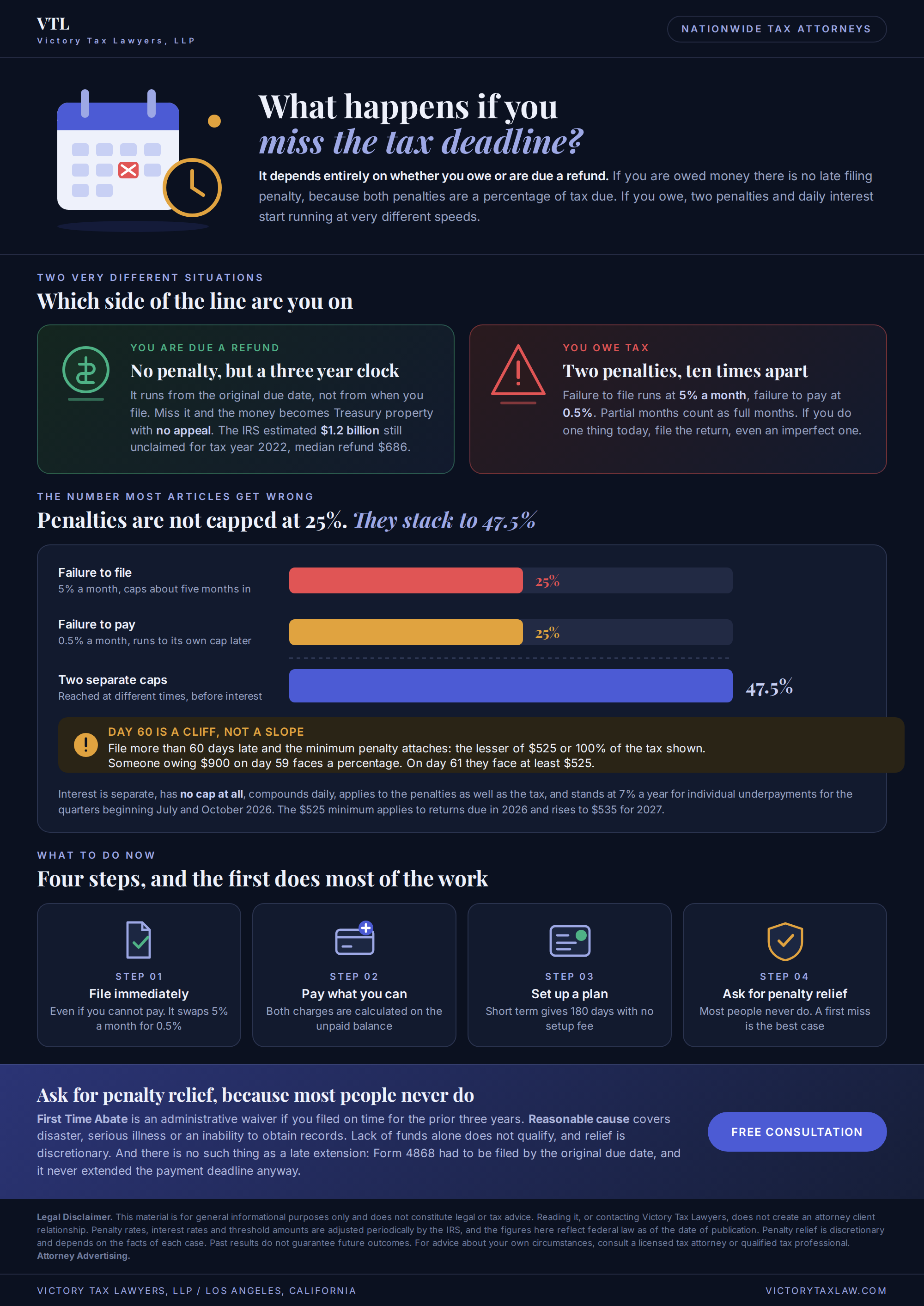
You face no penalties at all. Both the failure-to-file penalty and the failure-to-pay penalty are calculated as a percentage of tax due, so when no tax is owed, the arithmetic produces nothing. Filing your tax return late still costs you something. It delays your refund, and it starts a clock most people do not know exists. You have three years to file and claim that refund. After that, the money becomes the property of the Treasury, and there is no appeal.
The clock runs for three years from the original return due date, not from whenever you eventually file. Withholding and estimated tax payments are treated as paid on the due date, which is what sets the deadline for someone who has not filed at all.
The scale of this is larger than most people assume. In March 2026, the IRS estimated that $1.2 billion in refunds was still unclaimed. More than 1.3 million taxpayers never filed a return for tax year 2022, and the median refund was $686. That deadline has now passed, and those refunds are gone. The figure is an IRS estimate and excludes credits such as the Earned Income Tax Credit, which would sit on top.
What If You Owe Taxes?
In our experience, two penalties and interest start running, and they run at very different speeds. The failure-to-file penalty is 5% of the tax due per month. The failure-to-pay penalty is 0.5% per month. Interest accrues on top of both. Filing taxes late is far cheaper than not filing at all. If you take one action today, file a tax return, even an imperfect one. Taxpayers who owe the IRS money and file on time face penalties an order of magnitude smaller than those who do not file.
Resolving a Tax Problem
In our experience, taxpayers often wait to address a missed deadline because they assume they need to pay the entire IRS balance before anything can be done. We have helped clients turn six-figure tax debts into affordable monthly payment arrangements, including cases where monthly payments were reduced to as little as $25.
The lesson is simple: if you cannot afford to pay the IRS in full, filing the return and addressing the balance early can open the door to resolution options instead of allowing the debt to move further into collections. The right payment amount depends on your income, expenses, assets, and overall financial circumstances. A payment arrangement isn't the right solution for everyone, but taxpayers shouldn't assume an unaffordable IRS balance means they have no options.
What Are the IRS Penalties for Filing Late?

There are three separate charges, including a late-filing penalty, a late-payment penalty, and interest. They stack, they have different caps, and the common claim that penalties stop at 25% understates what you can actually owe. The failure-to-file penalty is 5% of the tax due for each month or partial month your federal tax return is late, up to a maximum penalty of 25%. Partial months count as full months, so a return filed one day into a new month incurs another full 5%.
There is also a minimum penalty that can catch people out. If you file more than 60 days after the due date, including extensions, the minimum penalty applies. It is the lesser of $525 or 100% of the tax shown on the return. That $525 figure applies to returns due in 2026 and rises to $535 for returns due in 2027, because it is adjusted for inflation each year. Older articles still quoting $485 or $510 are citing prior years.
Day 60 is therefore a genuine cliff, not a gradual slope. A taxpayer owing $900 who files on day 59 faces a percentage-based penalty. The same taxpayer filing on day 61 faces at least $525. The failure-to-pay penalty is 0.5% of the unpaid balance per month, capped at 25%. It applies from the original due date, regardless of any extension, and continues until the tax is paid in full. The rate drops to 0.25% per month under an approved installment agreement, but only for taxpayers who filed their tax return on time.
Most people will not qualify for that reduction, which is another reason the filing date matters more than people think. The rate rises to 1% per month once tax remains unpaid ten days after a notice of intent to levy. When both late payment penalties and filing penalties apply in the same month, the failure-to-file penalty is reduced by the failure-to-pay amount. The combined charge is 4.5% plus 0.5%, not 5.5%.
How Does Interest Accumulate on Unpaid Taxes?
Interest is charged on any unpaid tax from the original due date of the return, and it compounds daily. It applies to penalties as well as to the tax itself. The rate is set quarterly at the federal short-term rate plus three percentage points. It stands at 7% per year for individual underpayments for the quarter beginning July 1, 2026.
The IRS has held it at 7% for the quarter beginning October 1, 2026. Unlike the penalties, interest charges have no maximum cap. They accrue until the balance is paid. The table below shows what each charge does, because people routinely confuse them.
| Charge | Rate | Maximum | Starts accruing |
|---|---|---|---|
| Failure-to-file penalty | 5% per month, reduced to 4.5% in a month when the failure-to-pay penalty also applies | 25% of unpaid tax | Filing deadline |
| Minimum late-filing penalty | Lesser of $525 or 100% of the tax due | Not applicable | 61st day after the deadline |
| Failure-to-pay penalty | 0.5% per month; 0.25% under an installment agreement if you filed on time; 1% after a levy notice | 25% of unpaid tax | Original payment due date |
| Interest | 7% annually, compounded daily, with rates resetting quarterly | None | Original payment due date |
The two 25% caps are separate, and they are not reached at the same time. The failure-to-file penalty maxes out about five months in. The failure-to-pay penalty keeps running to its own cap long afterward. Together, they can reach 47.5% of the tax owed before interest is counted, which is why saying penalties are capped at 25% is misleading.
What Does the Timeline Look Like After a Missed Deadline?

Four points matter in the first three years, and knowing where you are on that line tells you how urgent your situation is. Below are the separate timelines that lead to expiration.
Day 1 to day 60 - Penalties accrue at 5% a month on tax due, and nothing arrives in the post. This is the cheapest window to act, and the one most people waste waiting for a letter.
Day 61 - The minimum penalty attaches if the return is still unfiled and tax is owed. From here, the floor is the lesser of $525 or the full tax due.
Weeks to Months - If you filed and owe, the first bill arrives as a CP14 notice. Ignoring it moves you through reminder notices toward a final notice before levy. If you never filed, the IRS may eventually prepare a substitute return for you. It uses its own figures and gives you none of the deductions or credits you would have claimed.
Three Years - The deadline to claim a refund expires, and the failure-to-file penalty has long since capped.
The key takeaway is that a missed tax deadline becomes more expensive and more difficult to resolve the longer you wait. The first few days may feel uneventful, but penalties and interest can continue accumulating while the IRS moves through its collection process. If you are approaching the three-year refund deadline, have received an IRS notice, or have unfiled returns from multiple years, acting now can help you understand your options before the situation becomes more serious.
Can You Still Get a Tax Extension After the Deadline?
No. You must request a tax extension by the original due date, and once that date passes, there is nothing left to extend. This is the single most common misunderstanding about missed deadlines, and it is worth being blunt about. Form 4868 gives an automatic six-month extension of time to file. For a 2025 return filed on time, that moves the filing deadline from April 15, 2026, to October 15, 2026.
It does not extend the payment deadline. Tax owed is still due on the original date, and the failure-to-pay penalty and interest run from that date whether or not you have an extension. An extension protects you from the 5% monthly failure-to-file penalty, nothing more. Because the two penalties differ tenfold, that protection is still worth having.
Taxpayers living outside the United States get an automatic two-month extension to June 15, though interest still runs on anything unpaid from the April date. Members of the armed forces serving in a combat zone get at least 180 days after leaving the zone, and penalties and interest do not accrue for that period. Taxpayers in a federally declared disaster area receive a postponed deadline based on their address of record, applied automatically.
These are exceptions to the rule, not late extensions. Nobody can file Form 4868 after the deadline and have it work.
What Should You Do If You Missed the Tax Deadline?

When a tax deadline is missed, the biggest mistake is waiting for the IRS to contact you before taking action. From handling tax matters, we know that acting early can reduce penalties, interest, and collection issues.
The right approach is to follow five steps: file the return, pay what you can, set up a plan for the remaining balance, request penalty relief when you qualify, and address the reason you missed the deadline so it doesn't happen again.
Step 1 - File Your Return Immediately, Even if You Cannot Pay.
Filing stops the 5% monthly charge and replaces it with 0.5%. Electronic filing is available for the current and two prior tax years, and it is faster than paper. If you need to assemble records first, our tax preparation checklist lists what to gather.
Step 2 - Pay Your Taxes as Far as You Are Able When You File.
The failure-to-pay penalty and interest charges are calculated on the unpaid balance, so any payment reduces both penalties and interest. The IRS will charge interest only on the remaining balance. You can pay directly from a bank account, or by credit or debit card through an approved processor.
Step 3 - Set Up a Payment Plan for Whatever Is Left.
A short-term plan gives you up to 180 days with no setup fee. A long-term installment agreement spreads the balance over monthly payments and can run for several years. Our guide to IRS payment plans compares the two.
Step 4 - Ask for Penalty Relief.
Most people never do, and a first missed deadline is exactly the situation the relief was designed for. The next section covers how.
Step 5 - Adjust for Next Year So You Avoid Penalties Altogether.
If a balance caught you out, check your withholding or your estimated tax payments. Self-employed taxpayers who underpay quarterly face a separate estimated tax penalty, which is calculated at the underpayment interest rate and is not covered by first-time relief.
How Do You Reduce or Remove the Penalties?
Two routes exist, and a single missed deadline is the best case for both. Penalty relief is discretionary so that nobody can promise an outcome, but you may qualify. First Time Abate is an administrative waiver for taxpayers with a clean record. You generally qualify if you filed the same return type on time for the prior three years.
You must also have had no penalties assessed in that period, other than the estimated tax penalty. It covers the failure-to-file penalty, the failure-to-pay penalty, and the failure-to-deposit penalty. Full criteria are on the IRS penalty relief page.
Reasonable cause relief applies where circumstances outside your control stopped you from filing. Examples include a fire or natural disaster, a death or serious illness in the immediate family, or an inability to obtain records. The IRS is explicit that a lack of funds on its own does not qualify, and neither does a simple mistake or not knowing the rule. Our penalty abatement guide explains which penalties can be waived, and our abatement letter template walks through the request itself with a sample.
What If You Cannot Pay the Tax Bill at All?

In our experience, you can file anyway, then choose the route that matches your finances rather than your preference. Filing is what stops the expensive penalty, and it is separate from paying. If you can pay over time, an installment agreement is the standard answer.
If your income and assets genuinely cannot cover the tax debt, an offer in compromise lets qualifying taxpayers resolve a liability for less than the full amount owed. The IRS applies a defined financial formula rather than a negotiation. If you cannot pay anything at all, Currently Not Collectible status pauses collection, while interest continues to accrue.
Which Tax Resolution Option Makes Sense?
The right solution depends on what you can realistically afford. An installment agreement is generally the most straightforward option when you can repay the balance over time, but it does not eliminate the tax debt and interest may continue to accrue. An Offer in Compromise can potentially settle qualifying tax debt for less than the full balance, but eligibility is based on your financial circumstances and the IRS’s collection analysis.
Currently Not Collectible status may provide temporary relief when you cannot afford to pay, but the debt does not disappear and collection can resume when your financial situation changes. In practice, the trade-off is between affordability, eligibility, and how quickly the debt can be resolved.
Paying in full is usually the simplest route when you can afford it, while a payment plan may be more practical when you need time. Taxpayers with limited income or assets may need to examine whether an Offer in Compromise or Currently Not Collectible status is more appropriate.
Could Missing the Tax Deadline Be a Crime?
Almost certainly not in your case. Willful failure to file is a misdemeanor under federal law, but willfulness is the whole of it. The government must prove you knew of the duty and voluntarily and intentionally violated it.
Missing a deadline through disorganization, confusion, illness, or simply not having the money is not willful and is not criminal. Nearly every late filer is in a civil penalty situation, not a criminal one. Our page on whether you can go to jail for not paying taxes covers where the line actually sits.
Does Missing the Tax Deadline Affect Your Credit Score?

Not directly. Since 2018, the three national credit bureaus have not included federal tax liens on consumer credit reports, so an IRS balance does not by itself move your score. It still shows up where it counts.
A recorded federal tax lien is public record, and mortgage underwriters, commercial lenders, and licensing boards check for it. An unresolved tax liability can also complicate a loan application through the documentation rather than the score, because lenders ask for tax transcripts.
A missed tax deadline can look like a simple filing problem until penalties, IRS notices, and collection activity enter the picture. Our approach is different from simply helping you submit a late return. We look at the filing issue, the underlying tax liability, the penalties and interest, and the IRS collection position together so the recommended solution addresses the entire problem.
That matters because filing a return does not necessarily resolve an existing tax debt. Depending on the circumstances, the next step may involve penalty abatement, an installment agreement, an Offer in Compromise, or another IRS resolution strategy. Our attorneys handle these matters as tax controversy cases, giving clients a legal team that can address both the underlying liability and IRS collection issues when they arise.
Do You Need a Tax Lawyer?

Not every missed tax deadline requires a tax lawyer. For a straightforward late return that you can resolve yourself, hiring an attorney may not be necessary. For a complicated tax debt, however, the potential benefit of having someone evaluate the liability, negotiate with the IRS, and protect your interests may outweigh the cost of representation. The right choice depends on the case's complexity and your ability to resolve it yourself.
With over $100 million saved for clients since 2017, Victory Tax Lawyers, a Los Angeles-based tax firm, delivers experienced legal help you can count on to get real tax solutions. Get the honest, effective tax assistance you deserve. Contact us for a free consultation today!
Frequently Asked Questions
These are the questions we hear most often in the weeks after a filing deadline passes.
What Happens If I Miss the Tax Deadline?
If you owe taxes, a failure-to-file penalty of 5% per month begins, alongside a 0.5% failure-to-pay penalty and daily compounding interest. If you are owed a refund, there is no penalty, but you have three years to claim it.
Can I Still File My Taxes After the Deadline?
Yes, and you should file as soon as possible. Every month you wait adds another 5% of the tax due, and after 60 days, a minimum penalty attaches.
How Much Is the Penalty for Filing a Tax Return Late?
The penalty for filing a tax return late is 5% of the taxes owed per month, up to a maximum penalty of 25%. If the return is more than 60 days late, the minimum is the lesser of $525 or 100% of the tax owed.
Can I Get a Tax Extension After the Deadline Has Passed?
No, you must file Form 4868 by the original due date. Only combat zone service, living abroad, and federally declared disasters automatically extend a deadline.
Will I Face Legal Consequences for Missing the Tax Deadline?
Missing a deadline is a civil penalty matter, not a criminal one, in nearly every case. Criminal charges require willful conduct, which negligence or inability to pay does not meet.
Can the Penalties Be Removed?
Sometimes. First Time Abate is available to taxpayers with a clean three-year filing record, and reasonable cause relief covers circumstances outside your control.
What Should I Do If I Have Missed the Tax Deadline?
File the return immediately, pay what you can, and arrange a payment plan for the balance. Then request penalty relief, because a first missed deadline is your strongest case.
Legal Disclaimer: This article is for general informational purposes only and does not constitute legal or tax advice. Reading it or contacting Victory Tax Lawyers does not create an attorney-client relationship. Penalty rates, interest rates, and threshold amounts are adjusted periodically by the IRS, and the figures here reflect federal law as of the date of publication. Penalty relief is discretionary and depends on the facts of each case. Past results do not guarantee future outcomes. For advice about your own circumstances, consult a licensed tax attorney or qualified tax professional.