
A CDTFA audit notice is the opening move in a review that can reach back three years, and sometimes eight. California businesses that handle it alone often hand the auditor the exact records that create the assessment. At Victory Tax Lawyers, our experienced tax attorneys help California business owners through a CDTFA audit. We review sales records, tax returns and financial documents to find the discrepancies that lead to additional tax, penalties or interest. We can help you prepare an effective CDTFA audit defense, communicate with the auditor, challenge proposed assessments, and pursue a fair outcome through the appeals process when necessary.
Contact us today and let us help with your tax liability.
What Is CDTFA Audit Representation?
The California Department of Tax and Fee Administration administers sales, use, and special taxes statewide. It registers sellers, processes sales tax returns, and audits businesses to confirm that reported sales match actual business operations. CDTFA is not the IRS, and it is not the Franchise Tax Board. It runs its own audit process, deadlines, and appeals track.
CDTFA audit representation means a licensed professional stands between you and the sales tax auditor. We file a Power of Attorney, which California requires before anyone can represent a client in a CDTFA audit. From that point, the auditor contacts us, not you. We control what gets produced, when it gets produced, and how we explain it.
That control matters more than most business owners expect. In our experience, auditors build assessments from the documents in front of them. Every purchase record, bank statement, and POS report you hand over becomes evidence. Professionals reviewing records help prevent inadvertent disclosure during audits and catch problems while there is still time to fix them.
We also handle the work that follows an audit. This includes penalty abatement requests, offers in compromise, and structured payment plans when a balance remains after the process. Our broader audit representation practice covers federal and state examinations under one roof.
What Does a California Sales Tax Audit Involve?

A CDTFA sales tax audit tests one question. Did you collect and remit the correct tax on your taxable transactions during the audit period? To answer it, the auditor must reconcile several record sets that rarely agree on the first pass.
The auditor pulls your sales tax filings and compares them against federal income tax returns, bank deposits, and purchase records. Gaps between reported taxable sales and income tax filings draw immediate attention. So do out-of-state purchases with no use tax reported. The auditor then tests your exempt sales, because every claimed exemption needs a valid document behind it.
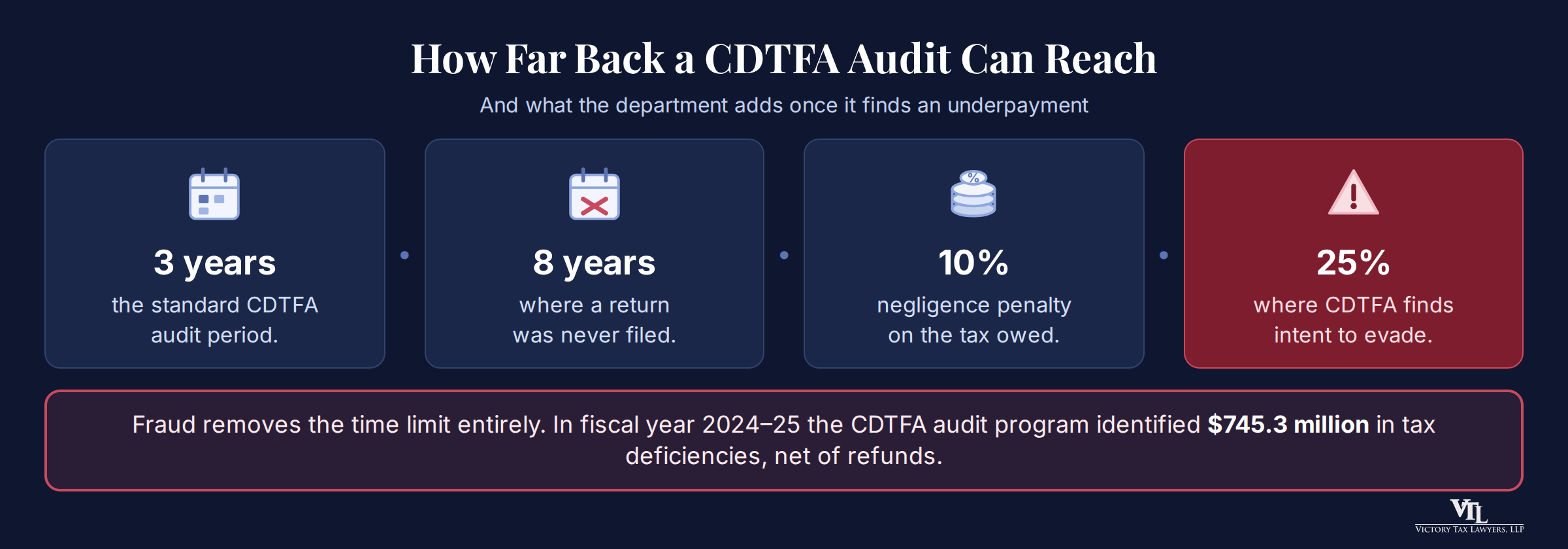
Most audits cover three years of returns. CDTFA runs its audit program on a three-year cycle, and its Publication 76 explains what auditors request and how they work. Under California law, the department can reach back eight years when no return was filed, and fraud removes the time limit entirely. Substantial underreporting quickly expands audit exposure.
Auditors also use sampling rather than reviewing every invoice. They select a sample period, measure the error rate, then project that rate across the entire audit period. A small error in a sample month can become a six-figure assessment. This projection step is where representation earns its keep, because the sample itself is negotiable.
We build a strategic defense around three points. We challenge the sample when it is unrepresentative. We rebuild missing documentation before the auditor estimates it for you. We keep the scope of the review inside what the law actually requires.
"An audit is a documentation contest, not an argument about intent," says Parham Khorsandi, Esq., Managing Attorney of Victory Tax Lawyers. The businesses that come out clean are the ones whose resale and exemption certificates were already in order. Most audits are won in the file cabinet, before anyone meets the auditor."
Who Is Likely to Get Notice of a Pending California Sales Tax Audit?
CDTFA does not select accounts at random. The audit program prioritizes larger accounts and businesses whose filings show patterns the department associates with underreporting. Restaurants, bars, convenience stores, auto dealers, construction contractors, and online retailers all draw regular attention. The table below outlines the triggers we most often see behind a CDTFA notice and what the sales tax auditor examines once the file opens.
| Audit Trigger | What the Auditor Examines | Why It Raises Risk |
|---|---|---|
| Inconsistent sales tax filings | Quarter-over-quarter reported sales | Significant swings without a clear business reason may indicate reporting errors or unreported sales. |
| High cash sales | Bank deposits compared with POS reports | Cash-heavy businesses can be harder to reconcile and may face closer scrutiny. |
| Late or missing tax returns | Filing history for the audit period | Missing returns can extend the assessment period to as long as eight years. |
| Sales below industry norms | Purchase records, markups, and reported sales | Unusually low reported margins may suggest underreported taxable sales. |
| Prior audit history | Findings and adjustments from previous examinations | Repeat discrepancies can signal unresolved compliance problems. |
| Referrals from other agencies | Income tax returns, licensing records, and agency data | Mismatched information across agencies can trigger additional scrutiny. |
Watch for the early signs. A questionnaire about your business entity and business operations often precedes a formal engagement letter. A request for exemption certificates on a handful of invoices can be the first test of a larger file. Treat either as the start of the CDTFA audit process, not as routine correspondence.
Prevention is cheaper than defense. Reconcile your sales tax returns against your income tax returns every year. Collect resale and exemption certificates at the time of sale, not at the time of audit. Keep sales invoices, purchase records, and POS exports for at least four years, because CDTFA expects taxpayers to maintain records required under its recordkeeping regulations.
How Does Undercover Observation Work in Sales Tax Audits?

We have found that CDTFA auditors sometimes observe a business before or during an audit. An auditor may visit as a customer, buy an item, and record how the sale is rung up. They note whether tax was charged, whether the receipt matches the register, and how much traffic the location handles in an hour.
Those observations then become data. An auditor who watches a lunch rush can build a sales estimate from the counts and apply it across the sample period. If that estimate exceeds your reported taxable sales, the department has a basis to assess additional tax. Observation results are especially common in cash-heavy retail and food service.
We advise clients to assume that any observation is possible and to run the business accordingly. Ring every sale through the point-of-sale system. Charge tax on taxable items consistently. Keep voids, comps, and employee meals documented as they happen. These habits are ordinary tax compliance, and they also remove the auditor's best argument.
When an observation has already occurred, the response is technical. We request the auditor's workpapers, examine the methodology, and test whether the observed period fairly represents normal business operations. A single busy Saturday is not a valid proxy for a year. Challenging that assumption early keeps it out of the final determination.
What Are the Benefits of Hiring a Professional for CDTFA Audit Representation?
The first benefit is the one clients mention most. The auditor stops calling you. Every request routes through counsel, deadlines get tracked, and you go back to running the business instead of assembling documents at midnight.
The second benefit is technical. Experienced tax lawyers know which requests are mandatory and which are negotiable. They know how CDTFA applies sampling, what makes a sample defensible, and when an auditor has exceeded the audit period. Timely responses can prevent inflated assessments during audits, and missed responses invite estimates that favor the state.
The third benefit is documentary. We review financial records before CDTFA does. Missing resale certificates can lead to immediate deficiency assessments, so we validate certificates, chase replacements from customers, and rebuild support for non-taxable sales. CDTFA does not need perfect records to assess tax. Missing records lead the department to estimate, and CDTFA audits often rely on estimation methods when documentation is thin. Incomplete records therefore produce inflated tax assessments and a tax liability larger than the business actually owes. Proper documentation prevents that outcome.
The fourth benefit is protection of your personal assets. Under California law, CDTFA can pursue personal liability against owners and officers for unpaid sales tax collected but not remitted. That exposure survives the business entity and reaches personal assets. Once an assessment is final, the department can move to bank levies and tax liens against unpaid tax balances. Defending a bank levy after the fact is harder than preventing one.
The numbers explain why professional representation typically pays for itself. According to the CDTFA's annual report to the Legislature on sales and use tax audit activities, the audit program identified $745.3 million in tax deficiencies in fiscal year 2024-25, net of refunds. That is the scale of the program aimed at California businesses. Against a single business, the arithmetic compounds fast. A routine negligence penalty runs ten percent of the tax. Penalties reach twenty-five percent where the department finds intent to evade.
Interest accrues at the CDTFA rate, which tracks the IRS underpayment rate plus three percent and has sat near ten percent annually in recent periods. Representation also opens doors that stay closed to unrepresented taxpayers. Penalty abatement can be requested for reasonable cause. Representatives can negotiate for a waiver or reduction of penalties based on good faith. Where a balance remains, an offer in compromise may reduce total tax liabilities, and an installment agreement can make the remainder manageable.
What Is the Process for CDTFA Audit Representation?

The steps below describe how a CDTFA audit defense runs from the first notice through resolution. The order matters because each stage narrows what the auditor can assess in the next.
Step 1: Initial consultation and assessment
We review the CDTFA notice, identify the audit period, and map the records you already have. This meeting establishes the realistic audit exposure before anyone talks to the department.
Step 2: Power of Attorney and First Contact
We file the Power of Attorney and take over communication with the sales tax auditor. From here, the department speaks to us. We set the schedule instead of reacting to it.
Step 3: Pre-Audit Preparation
We reconcile sales tax returns against bank statements, federal income tax returns, and POS reports. We validate exemption certificates and flag every gap. We find what the auditor would find first.
Step 4: Document Production
We produce what the law requires, in an organized form, with an explanation attached. Nothing goes out unreviewed. We package purchase records, bank deposits, and invoices so the auditor draws the right conclusion.
Step 5: Representation During the Audit
We attend the meetings and discussions with CDTFA, negotiate the sample period and the sampling, and respond to preliminary findings as they arise. Most CDTFA audits are shaped in this stage, not at the end.
Step 6: Review of Audit Results
When the auditor issues a draft, we test the math and the method. We challenge projection errors, misclassified exempt sales, and double-counted transactions before the department issues anything final.
Step 7: Notice of Determination and Appeal
If CDTFA issues a Notice of Determination, you have thirty days to file a Petition for Redetermination. That petition should clearly identify the errors in the findings. Missing the thirty-day deadline finalizes the assessment.
Step 8: Tax Appeals and Post-Audit Support
Unresolved cases move to the Office of Tax Appeals after administrative review, and that process can take two to four years. Where tax assessments stand, we negotiate the payoff and defend against collection.
How Should You Prepare for a CDTFA Audit?
In our experience, preparation starts with the records. Pull sales tax filings, income tax filings, bank statements, purchase records, and POS exports for the entire audit period. Organize them by quarter, not by pile. Auditors reward clarity with narrower questions.
Exemption certificates deserve their own pass. Validating exemption certificates is one of the highest-value tasks in any sales tax audit, because each missing certificate converts an exempt sale into a taxable one. Pull every resale certificate on file, check the permit numbers, and request replacements now, not during fieldwork.
Communication with your representative should be complete and early. Tell us about the messy quarter, the cash register that failed, the vendor who never sent paperwork. The surprises that hurt clients are the ones the auditor finds before we do. Before the audit begins, stop informal contact with the department. Do not answer substantive questions on the phone, and do not hand over records at the counter. Route everything through counsel so that answers are consistent and documented.
Businesses in Los Angeles, Sacramento, San Diego County, and the Inland Empire all work with our team. If you prefer a local starting point, start with our Los Angeles tax attorney page. Our Sacramento tax attorney and Chula Vista tax attorney pages cover the same representation with regional context.
Why Does Professional Representation Matter During a CDTFA Audit?
A sales tax audit is a legal proceeding centered on a documentation problem. The department has statutory authority, trained auditors, and estimation methods that fill any gap in your records. You have the right to representation, and using it changes the file from day one.
Professional representation protects your rights during the audit, keeps the scope inside the law, and preserves every appeal deadline. It also protects the part clients care about most, which is the ability to keep running the business while the audit proceeds. That is the peace of mind we are hired to provide.
Ready to Speak With a CDTFA Audit Defense Attorney?
A CDTFA notice has a clock attached. The earlier we get involved, the more we can shape the audit. Waiting until a Notice of Determination arrives leaves thirty days and far fewer options. Victory Tax Lawyers is a tax controversy firm. Our attorneys and licensed Enrolled Agent handle CDTFA, IRS, and Franchise Tax Board matters daily.
Reach Out to Us at Victory Tax Lawyers Today to Build a Strong Case.
Frequently Asked Questions
These are the questions California business owners ask us most often after a CDTFA audit notice arrives. We have provided brief answers.
What Is CDTFA Audit Representation?
CDTFA audit representation is legal representation during an audit by the California Department of Tax and Fee Administration. A Victory Tax Lawyers attorney handles the audit on your behalf from start to finish.
Why Is CDTFA Audit Representation Important?
Representation protects your rights and keeps the audit process on schedule. It also reduces the risk of an inflated assessment built from incomplete records.
What Does CDTFA Audit Representation Involve?
Your attorney communicates with CDTFA, reviews and organizes your financial records, and responds to audit inquiries. The attorney also represents you in any discussions or negotiations with the department.
How Can Victory Tax Lawyers Help During a CDTFA Audit?
We advise on California sales and use tax rules, advocate for your position, and prepare responses to audit findings. We also negotiate settlements or payment plans with CDTFA where a balance remains.
How Can I Benefit From Hiring Victory Tax Lawyers for CDTFA Audit Representation?
You hand the administrative burden and the technical arguments to a tax attorney. Your rights stay protected through every stage, including the appeal.
Legal Disclaimer: This page is for informational purposes only and does not constitute legal or tax advice. Reading it or contacting Victory Tax Lawyers does not create an attorney-client relationship. Tax outcomes depend on the specific facts of each matter, and past results do not guarantee future outcomes.