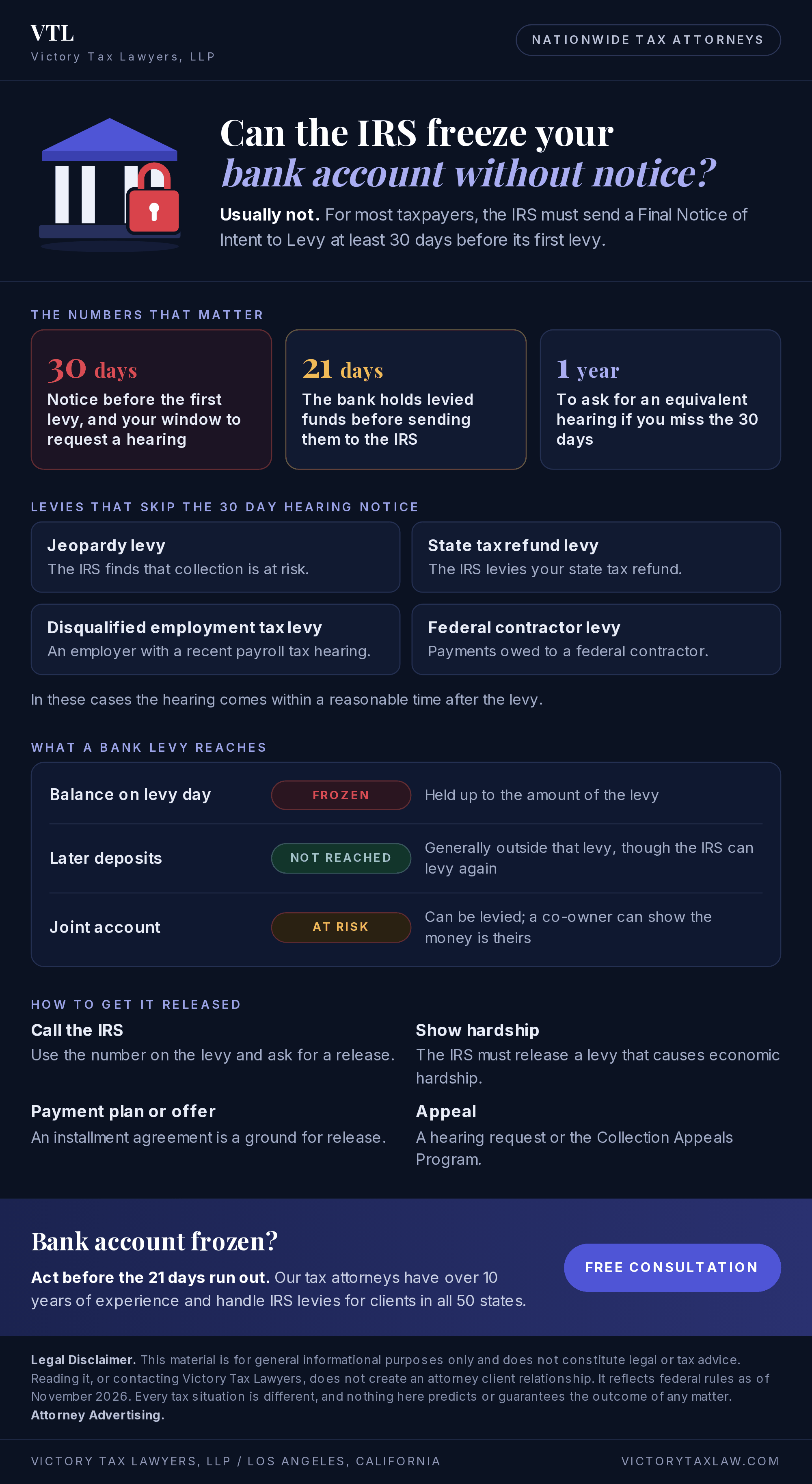
The IRS generally cannot freeze your bank account without warning, but a few levy types skip the hearing notice. For most taxpayers, the IRS must send a Final Notice of Intent to Levy at least 30 days before its first levy. When the bank receives the levy, it keeps your available balance aside for 21 days, and no court order is involved.
Victory Tax Lawyers, LLP represents taxpayers in IRS collection matters from its Los Angeles office, and our attorneys have at least ten years of experience in tax disputes. Our tax attorneys and IRS Enrolled Agents review levy notices, call the IRS about bank levies, and negotiate releases for clients in all 50 states. If a tax levy has already reached your account, contact our firm for a confidential consultation.
This article explains the notices that come before a bank levy, the exceptions, the 21-day hold, and how to get your funds released.
Does the IRS Have to Warn You Before Freezing a Bank Account?

In most cases, yes. The Internal Revenue Service can levy your bank account, but under section 6331 it must first tell you in writing, no less than 30 days before the levy. Someone can hand you the notice, leave it at your home or business, or send it by certified or registered mail to your last known address. A second statute, section 6330, adds a Final Notice that explains your right to a hearing, also sent at least 30 days before the first levy.
The IRS doesn't need a court order to seize someone's bank account because the law gives it that right directly. Once the tax is assessed, billed, and unpaid, and the required notices are out, the IRS can seize assets held by your bank.
People say the IRS freezes accounts, and the agency uses that word too. Its bank levy page says the bank freezes funds as of the date and time it receives the levy. A levy is different from a tax lien. A lien is a legal claim against your property. A levy is the IRS actually taking it.
Which IRS Notices Come Before a Bank Levy?

Before a bank levy happens, most people receive multiple notices, and the Code has two notice requirements. The CP504 notice is the Notice of Intent under section 6331(d). The notice that carries hearing rights is the Final Notice, sent as Letter 1058 or LT11. An LT11 or Letter 1058 can satisfy both requirements on its own, so you may not get a separate CP504. Usually, bank levies follow unpaid taxes and unaddressed notices.
A notice sent by certified or registered mail to your last known address counts as proper notice, even if you never opened it or have moved since then. That is why a levy can feel like it came from nowhere. You have 30 days from the final notice to ask for a Collection Due Process hearing. A timely request generally bars a levy on that subject while the hearing and any appeal are pending.
The final notice is legally required only once for each tax period, according to section 6330. The IRS need not send a new one before every later levy for the same tax liability, so one ignored letter can leave your accounts exposed for months. Unpaid payroll taxes generally follow the same rules, except for the disqualified employment tax levy covered below.
When Can the IRS Levy a Bank Account Without Notice?
There are four different situations. Section 6330(f) says the 30-day hearing notice does not apply to a jeopardy finding, a levy on a state tax refund, a disqualified employment tax levy, or a federal contractor levy. In these cases you get a hearing within a reasonable time after the levy instead. Apart from jeopardy, these exceptions only move the hearing to after the levy: you still get the 30-day Notice of Intent to Levy, usually a CP504, first. A state refund levy also takes a state tax refund, not money in your bank account.
A jeopardy finding is the most drastic of these. When the IRS decides that collection is at risk, section 6331(a) lets it demand immediate payment and levy without waiting the 10 days the law normally allows after it demands payment. Section 6331(d)(3) also removes the 30-day Notice of Intent to Levy in jeopardy cases. A disqualified employment tax levy collects payroll taxes from a business (or its predecessor) that already requested a Collection Due Process hearing on payroll taxes from the two years before the tax period now being collected.
This article covers federal levies. The California Franchise Tax Board uses orders to withhold, which can reach bank accounts under separate rules, so state collection actions need their own plan.
Notice Rules for Each Type of IRS Levy
The table below compares what the Code requires before each kind of levy, using sections 6330 and 6331 and IRS Publication 594. Compare your own notices with it, because the dates printed on them set your deadlines.
| Situation | Notice Before the Levy | Hearing Rights |
|---|---|---|
| Standard bank levy | Notice of Intent to Levy and Final Notice, each at least 30 days before the first levy for the tax period | Request a hearing within 30 days of the final notice. |
| Jeopardy levy | No 30-day notice required | Hearing offered within a reasonable time after the levy. |
| State tax refund levy | No 30-day hearing notice | Hearing offered within a reasonable time after the levy. |
| Disqualified employment tax levy | No 30-day hearing notice | Hearing offered within a reasonable time after the levy. |
| Federal contractor levy | No 30-day hearing notice | Hearing offered within a reasonable time after the levy. |
What Happens After the IRS Levies Your Bank Account?

When the IRS issues a levy, it usually mails the bank a Form 668-A. The bank must freeze the funds available in the account at the moment it receives the levy, up to the amount of the levy. Under section 6332(c), it must hold the money and may surrender it only after 21 days following service of the levy.
During that waiting period, you can contact the IRS to pay, set up a payment plan, or report an error in the levy. During those days, you can't use the held funds. Generally, deposits made after the levy date are not affected by that levy. If a revenue officer is assigned to your case, ask that officer when the bank received the levy.
You may learn about the levy from your bank before you get your own copy. For levies mailed locally, IRS procedures tell employees to time your copy so you do not receive it before the bank does. The warning letters come weeks earlier, but the levy itself may show up in your account before your copy arrives.
In fiscal year 2025, the IRS requested 339,137 notices of levy on third parties such as banks and employers, up from 313,792 the year before, according to the IRS Data Book (Table 4-1). These are nationwide counts across all levy types, not Victory Tax Lawyers' results.
Can the IRS Freeze a Joint Bank Account?

Yes. According to the Internal Revenue Manual (IRM 5.11.2.2.1), property in which the taxpayer has an interest is subject to levy even if it is jointly owned, and the manual gives joint bank accounts as an example. The same section tells employees to consider another source when the co-owner is not liable, because wrongful levy claims can follow.
If you share an account with someone who owes the IRS, your money in that account can be frozen even if you personally owe nothing. Joint account holders should call the number on the levy and explain why the funds are theirs. The IRS bank levy page uses a parent's account as its example, and the IRS may ask for proof of ownership. When a spouse owes back taxes, gather statements showing which deposits are yours before you call.
Which Funds in Your Account Are at Risk?
The funds in your account when the bank receives the levy are at risk, but only up to the amount of the levy. The IRS says the levy normally does not affect money you add afterward. Section 6334 exempts some income from levy, but IRS procedures say that once income is deposited in a bank there is no exempt amount, so the usual way to free that money is an economic hardship release. If the IRS caused the error, such as levying after you paid in full, you did not add to it, and you answered its earlier requests, you can claim the bank's levy fees on Form 8546. The claim is due within one year of the charge and is capped at $1,000.
Social Security works differently. The federal payment levy program can take up to 15 percent of certain Social Security benefits and other federal payments before they reach you. Supplemental Security Income is not levied. How the IRS takes Social Security benefits is a separate matter from a bank levy.
How to Get a Frozen Bank Account Released Step by Step

Move quickly, because 21 days go by fast and the order of the steps matters. First reach the IRS, then back your request with records, then pick the resolution that fits your finances.
Call the IRS the Day You See the Levy
First, call the number printed on Form 668-A and ask the IRS to release the levy. The IRS's own guidance is to contact it immediately, resolve the liability, and request a release of the levy. Under section 6343, the IRS must release a levy when the tax is paid or time-barred, when release helps collection, or when you enter an installment agreement. It must also release when the levy creates economic hardship for an individual, or when the property is worth more than the debt and releasing part of it would not hinder collection. Release does not erase the debt, and the IRS can issue another levy if you do not make arrangements.
Show Economic Hardship or Prove Whose Money It Is
Second, document why the levy hurts. The IRS defines economic hardship as a levy that leaves an individual unable to meet basic, reasonable living expenses. Gather your pay stubs and your rent, utility and medical bills, because the IRS will use them to decide whether you qualify. If the money belongs to someone else, send account records that show who owns it, because the IRS can return property it levied wrongfully, generally within two years of the levy.
Request an Installment Agreement or Offer
Third, propose a payment plan. A pending request for an installment agreement bars new levies, and an agreement in effect is a ground for release unless its terms say otherwise. If you cannot pay the full amount even over time, an offer in compromise asks the IRS to settle for less. Generally, no levy can be made while an offer is pending, for 30 days after it is rejected, or while an appeal of the rejection is pending. You may qualify for Currently Not Collectible status if paying would leave you without enough for basic expenses.
Request a Collection Due Process or Collection Appeals Review
Fourth, appeal. Request that the IRS hold a Collection Due Process hearing on Form 12153 within 30 days of the date on the Final Notice. A timely request suspends the levy actions that are the subject of the hearing. If you disagree with the Appeals determination, you then have 30 days to petition the U.S. Tax Court. If you miss that deadline, the Collection Appeals Program with Form 9423 can still review the levy, but you cannot take a CAP decision to court.
Ask the Taxpayer Advocate Service for Help
Last, the Taxpayer Advocate Service is an independent organization inside the IRS, and it can step in when a levy is causing financial difficulty or when normal IRS channels have not solved the problem. If you're having trouble financially because of a levy, you can submit Form 911 to open a case. The help is free.
What Happens if You Ignore a Frozen Account?
After 21 days the bank sends the held money, with any interest on it, to the IRS. The levy collects only the funds frozen when the bank received it, up to the levy amount, and the rest of the debt stays outstanding. Interest and penalties continue accruing. The IRS can levy other assets and income until the balance is paid, and you should respond to every new notice. Acting within the 21 days gives you the best chance to fix a mistake or negotiate.
Ready to Get Your Bank Account Released Before the 21 Days End?

The clock on a bank levy runs fast, and you have fewer options as it runs out. Reviewing your notices, your income, and the ownership of the funds shows which release ground or payment plan fits. Reaching out early gives a lawyer time to contact the IRS and prepare that request before the funds move.
If you need bank levy help, our Los Angeles team handles levy releases, hearings, and payment plans for clients in all 50 states. Contact us today to discuss your levy in a private meeting.
Frequently Asked Questions
Our tax attorneys and Enrolled Agents answer these questions for account holders who have received IRS letters or found a hold on their account. That experience with levy cases lets us explain how the rules usually work, though your notices and dates decide your options.
Can the IRS Take Money From My Bank Account Without Going to Court?
Yes. The IRS levies a bank account administratively and needs no court order. It does have to send the required notices first, except in jeopardy cases and the other exceptions above.
How Long Does the IRS Freeze a Bank Account?
The bank keeps available funds for 21 days after service of the levy. Then it transfers the money to the IRS unless the levy has been lifted or otherwise resolved.
Can the IRS Freeze My Account for a Tax Debt I Did Not Know About?
It can if the final notice was sent by certified or registered mail to your last known address, even if you never saw it. If the IRS levied before sending the required notice, it says it will release the levy. If you missed the 30 days, you can still ask for an equivalent hearing within one year after the date of the levy notice, but it does not stop the levy, and you cannot take the result to Tax Court.
Does the IRS Notify the Bank Before It Notifies Me?
For the levy itself, often yes. For levies mailed locally, IRS procedures tell employees to time your copy so it does not reach you before the bank receives the levy. The Notice of Intent to Levy and the Final Notice come weeks before that.
Can I Get Money Back After the Bank Sends It to the IRS?
Sometimes. If the money belonged to someone else, such as a co-owner who owes nothing, that person generally has two years from the date of the levy to ask the IRS to return it. If the IRS levied your own money in error, it can return it, and you may also recover the bank's fees with Form 8546.
Will a Payment Plan Release My Bank Levy?
Usually, yes. The IRS must release a levy when you enter an installment agreement, unless the agreement says otherwise. A pending request also blocks new levies.
Legal Disclaimer. This article provides general information only and is not intended as legal or tax advice. Reading this article or contacting Victory Tax Lawyers, LLP does not establish an attorney-client relationship. Tax laws and procedures from the IRS can change, and every individual case will depend on its facts. Past results do not guarantee future outcomes. Victory Tax Lawyers, LLP, 1100 S Robertson Blvd, Los Angeles, CA 90035. Responsible attorney: Parham Khorsandi, Esq. (California Bar No. 266658). Attorney Advertising.