A tax levy on your paycheck usually means the IRS determines you have an outstanding tax debt from unpaid back taxes and has taken steps to collect it. Before garnishing wages, the IRS generally sends an IRS notice or levy notice explaining the debt and giving you an opportunity to respond. A levy can affect your wages and, in some cases, other personal property, making it more serious than an ordinary legal claim from a creditor.
At Victory Tax Lawyers, we help taxpayers nationwide resolve IRS disputes and tax debt matters. Our attorneys bring more than 10 years of experience handling tax controversy, resolution, and litigation matters, have secured over $100 million in tax relief for clients, and have assisted more than 10,000 taxpayers across all 50 states. Our results include reducing a $1 million tax liability to $16,194 through an Offer in Compromise and converting six-figure tax debts into affordable monthly payment plans as low as $25 per month. If you are facing IRS issues, contact us today for a free consultation.
This article covers why the IRS may levy wages, what happens to your paycheck and personal property, and how a tax attorney may help you challenge or resolve the legal claim.
What Is a Tax Levy?
A tax levy is the legal seizure of your property to satisfy a tax debt. It is not a warning or a threat. It is the collection itself. IRS levies permit the legal seizure of property to satisfy a tax debt. That includes authority to garnish wages, take money from a bank or other financial account, and seize property such as vehicles and real estate. Federal law lets the IRS garnish wages without a court order. That is the single biggest difference between an IRS tax levy and an ordinary creditor garnishment.
In our experience, a private creditor must sue you first and win. The IRS assesses the tax liability, sends a tax bill, works through the IRS collection process, and the IRS proceeds on its own authority. State tax agencies hold parallel powers. A state tax levy for unpaid state taxes runs on its own track, and in California the Franchise Tax Board collects through an earnings withholding order. The CDTFA and EDD have their own collection tools.
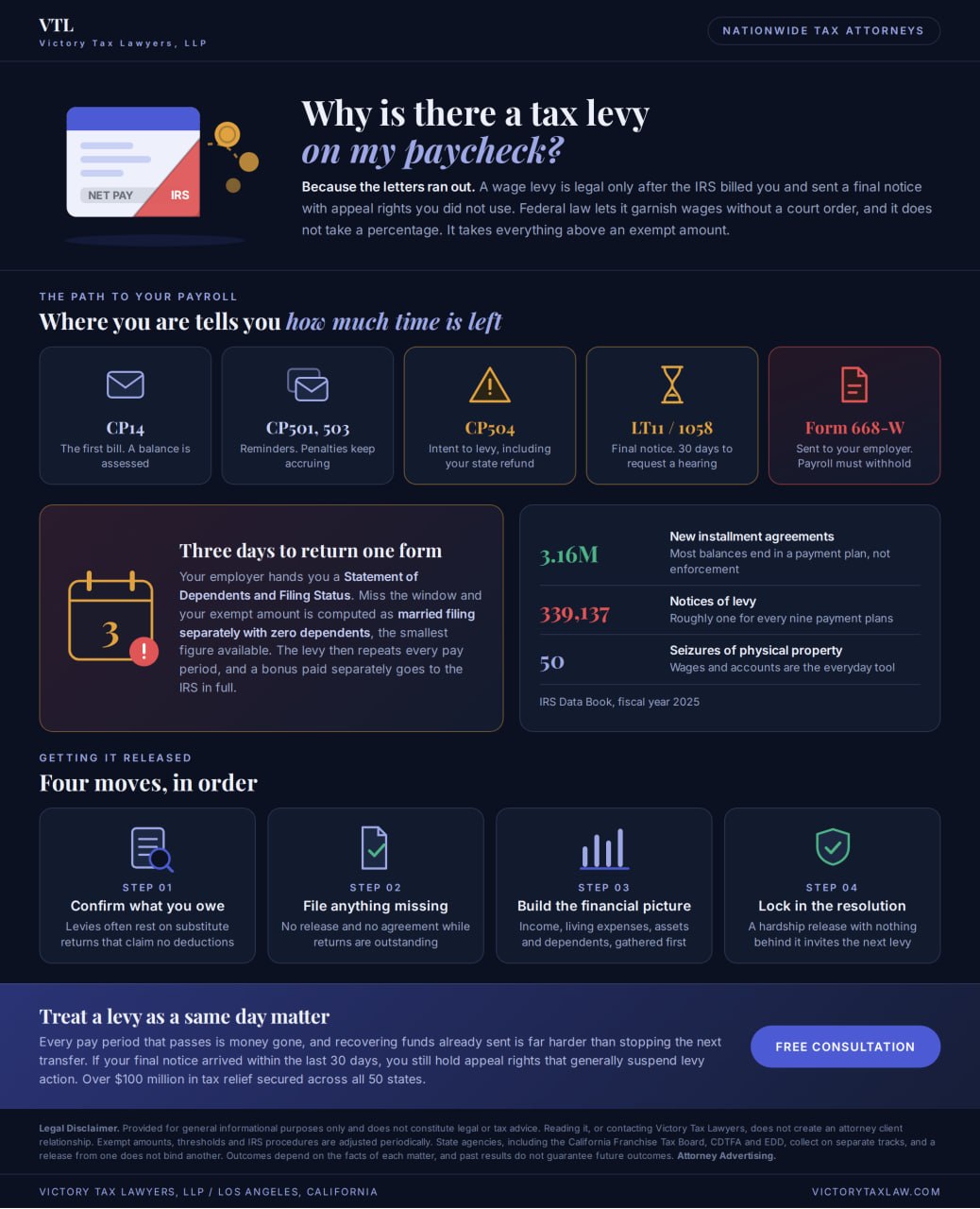
Wages are the most common target because your employer is easy to identify, legally obligated to comply, and pays you on a predictable schedule. A wage levy costs the government almost nothing to enforce. According to the IRS Data Book for fiscal year 2025, the IRS requested 339,137 notices of levy on third parties that year, up from 313,792 the year before. Over the same period, it conducted 50 seizures of physical property. Levies on wages and accounts are the everyday tool, and property seizure is the rare exception.
How Does a Tax Levy on a Paycheck Work?

The IRS sends your employer Form 668-W, and your employer becomes legally required to withhold. Payroll has no discretion in this. Refusing to comply makes the employer liable for the money it failed to send. Here is the part that surprises people most. An IRS wage levy does not take a fixed percentage of your check. It takes everything except an exempt amount, and the wages exempt from levy are usually far less than people assume.
As the IRS explains in its guidance on wage levies, the exempt amount comes from IRS tables. It is based on the standard deduction, plus an amount determined by the number of dependents you are allowed for the year the levy is served. Publication 1494 is mailed with the levy and tells your employer how to run that calculation.
That calculation depends on a form most people never see coming. Your employer gives you a Statement of Dependents and Filing Status, and you have three days to complete and return it. Your filing status and dependent count drive the entire figure. Miss that window and your exempt amount is computed as though you were married filing separately with zero dependents, which is the smallest figure available.
In our experience, that three-day form is the single most expensive piece of paper in the whole process. A wage levy is continuous, so it repeats every pay period until the debt is paid, the levy is released, or you make other arrangements. And a bonus paid separately is not protected, because the exempt amount already went out with the regular check, so the entire bonus goes to the IRS.
Your normal payroll deductions do not stop either. Regular tax withholdings continue during a wage levy enforcement, so the levy comes out of what is left after them. Child support is the one common carve-out. If a court ordered support before your employer received the levy, the IRS will release the amount needed to keep paying it. You can't then count the same child in the exempt amount calculation.
Why Did the IRS Levy My Paycheck Instead of Sending Another Letter?
This is simply because the letters already ran out. A wage levy is legal only after the agency has billed you, demanded payment, and given you a final notice with appeal rights that you did not use. The sequence below is the standard federal path from unpaid balance to wage levy, and knowing where you are in it tells you how much time you have left.
| Stage | What Arrives | What It Means |
|---|---|---|
| First bill | CP14 | The IRS has assessed a balance and demands payment. |
| Reminders | CP501, CP503 | The balance remains unpaid, and penalties and interest continue to accrue. |
| Intent to levy | CP504 | The IRS warns that it may levy certain assets, including your state tax refund. |
| Final notice | LT11 or Letter 1058 | The IRS issues a Final Notice of Intent to Levy and Notice of Your Right to a Hearing, generally giving you 30 days to request a Collection Due Process hearing. |
| Collection | Form 668-W to your employer | A wage levy is active, requiring your employer to withhold part of your paycheck and send it to the IRS. |
Most people who call us skipped a step for an understandable reason. The notices went to an old address, or arrived during a move, or sat unopened because the number on them felt impossible. None of that changes the legal effect. The IRS is entitled to rely on the last address on file. The other common path is a state balance. Unpaid California income tax, sales tax, or payroll tax has its own notice cycle and withholding order, entirely separate from anything federal. It is possible to be levied by two agencies at once.
Why Does the IRS Use Wage Levies?
A wage levy is serious, but it is not automatically evidence that the IRS acted improperly. Once the IRS has assessed a tax, billed the taxpayer, issued the required notices, and the applicable response period has expired, federal law gives the IRS significant collection authority. From the government’s perspective, a wage levy provides a predictable way to collect an established liability without waiting for the taxpayer to voluntarily pay.
The key distinction is between a lawful levy and one that should be released. A taxpayer may have grounds for release because of economic hardship, an error in the collection process, an approved payment arrangement, or another legally recognized circumstance. The fact that a levy is causing financial difficulty does not by itself invalidate the underlying tax debt, but it can make the taxpayer’s financial circumstances critical to determining how collection should proceed.
What Else Can the IRS Levy Besides My Wages?

We have found that the IRS can also levy bank accounts, federal payments, receivables, and retirement accounts. Wages are the most visible target, but an IRS federal tax levy reaches most things of value that someone else is holding for you. A bank levy works differently from a wage levy, and the difference decides how you respond. Bank levies are one-time actions based on the account balance when the levy arrives.
Financial institutions freeze those bank funds as of the date and time of delivery, hold them for a 21-day waiting period, then send them to the IRS. Money you deposit after that date is normally untouched. That 21-day window exists specifically so you can call and fix the problem before the funds leave.
The Federal Payment Levy Program is the third mechanism. It is authorized under Internal Revenue Code section 6331(h) and applies a continuous levy to federal payments disbursed by the Bureau of the Fiscal Service. Those payments include federal employee retirement annuities, contractor and vendor payments, military retirement, Railroad Retirement Board benefits, and certain Social Security benefits. The IRS sends a final notice, usually CP90 or CP297, and transmits the levy if it does not hear from you within 30 days.
Business owners and the self-employed face an additional exposure. An accounts receivable levy goes to your customers rather than an employer, turning a private tax problem into a client-facing one overnight. The IRS can also levy retirement accounts, though it applies additional internal restrictions before reaching them.
In our experience, some income is off limits entirely. Federal law protects certain categories from garnishment or levy, including unemployment benefits, workers' compensation, and welfare benefits, along with a minimum amount of wages, salary, and other income. If a levy captures protected income, that is grounds for immediate release, not negotiation.
What Is the Difference Between a Tax Levy and a Tax Lien?
A lien is a claim on your property. A levy is the taking of it. The lien secures the debt, and the levy collects it. A federal tax lien attaches to everything you own once the debt is assessed and unpaid. It gives the government a legal interest that follows the property, which is why it interferes with selling or refinancing a home. A levy is the enforcement step that converts that interest into money. A lien often precedes a levy, but plenty of liens never become levies.
It is important to note that tax liens no longer appear on consumer credit reports. Under the National Consumer Assistance Plan, the nationwide credit reporting agencies removed civil judgments and tax liens from credit files, and by April 2018 none remained. As the Consumer Financial Protection Bureau reported, bankruptcies are now the only public record type carried on those reports.
That does not make a lien harmless. It is still a public record that title companies, lenders, and underwriters find during a transaction, and it still clouds title. The correction matters because people delay dealing with a lien to protect a credit score that was never actually at risk. The real damage sits in the transaction they cannot close.
How Does a Levy Affect My Paycheck and My Finances?
In our experience, the exempt amount is calculated for survival, not for your actual budget, so most households cannot absorb it. Rent, car payments, and childcare do not adjust because your wages are garnished this period. An IRS wage garnishment ignores what you owe to everyone else. That is exactly why a levy pushes people into missed payments on obligations that do report to credit bureaus. The credit damage from a levy is indirect and arrives that way.
The debt also keeps growing while the levy runs. Penalties and interest continue to accrue on the unpaid balance, so a levy that captures a few hundred dollars a pay period may barely outrun the additions. This is the trap. It feels like the problem is being handled, while the balance moves very little.
Longer term, an unaddressed balance escalates. The IRS can file federal tax liens against what you own and levy bank accounts as well as wages. It can also refer the matter for passport certification once back taxes reach the statutory threshold, and a recorded tax lien follows the property until the balance clears. Each step is harder to unwind than the last.
Can I Stop a Tax Levy on My Paycheck?

Yes, a wage levy is a collection action, not a judgment, and the IRS will release one when the legal grounds are met. The most common ground is economic hardship. You can request a release of the levy if you cannot meet basic living expenses while it runs, and proving financial hardship can lead to a levy release.
Economic hardship must be claimed and documented, because the IRS assumes the exempt income is still sufficient for living expenses until you show otherwise. That means a document-supported financial statement, not a phone conversation. A levy issued in error, or after the collection statute expired, also comes off. So does one where releasing it would not harm the government's interest in collecting the tax.
Entering a resolution is the more durable route. A levy is generally released once you have an approved installment agreement, or once the account is placed in a status that stops enforcement. Negotiating a payment agreement is the most reliable way to stop a wage garnishment for good. The release usually comes faster than people expect, because the IRS wants a paying arrangement more than it wants a fight with payroll.
We have found that timing rules the whole process. Every pay period that passes is money gone, and recovering funds already sent to the IRS is far harder than stopping the next transfer. That is why we treat levy calls as same-day matters and contact the assigned unit before building the longer resolution.
If your final notice arrived within the last 30 days, you also hold appeal rights. You can request a Collection Due Process hearing within 30 days, and that right generally suspends levy action while the appeal is pending. An independent Appeals officer reviews the matter, and the Tax Court can review an adverse determination.
The Collection Appeals Program reviews levy actions on a faster timetable, though without Tax Court review afterward. The Taxpayer Advocate Service can intervene where a levy is causing immediate economic hardship and normal channels have stalled. Contacting a tax professional early usually determines which of these routes fits, because filing the wrong request wastes the time you do not have.
One exception removes the notice period entirely. Jeopardy levies allow the IRS to act immediately, without the usual 30 days, when it determines collection is at risk. These are rare, and they carry their own expedited appeal rights. A state levy can move on its own timetable, so a release from one agency does not bind the other.
How Do You Get a Wage Levy Released?

Six steps carry a levy from active to released. Follow them in order, because each one supplies what the next one requires, and skipping ahead is what leaves people on hold for hours with nothing to show.
Step 1 - Confirm What You Actually Owe.
Pull the account transcripts for every year at issue. Levies frequently rest on substitute returns the IRS filed for you, which claim no deductions and overstate the balance.
Step 2 - File Anything Missing.
The IRS will not release a levy or approve an agreement while returns are outstanding. Compliance comes before relief, without exception.
Step 3 - Build the Financial Picture.
Income, necessary living expenses, assets, and dependents drive both the hardship argument and whatever resolution follows. Gather the documents before the call, not during it.
Step 4 - Contact the assigned unit with a specific request.
Ask for the release on a stated ground, whether hardship, error, or a pending agreement, and be ready to submit the financial statement the same day.
Step 5 - Lock In the Resolution.
A release granted on hardship without a resolution behind it invites the next levy. Convert it into an installment agreement, an offer in compromise if you qualify, or a currently not collectible determination.
Step 6 - Confirm the Levy Is Released in Payroll.
The IRS sends Form 668-D, the levy release, to your employer. Until your payroll department has that document, withholding continues, so verify rather than assume.
What Are My Options for Resolving the Debt Behind the Levy?
Three paths cover almost every case, and which one fits depends on what you can actually pay rather than what you would prefer. An installment agreement spreads the balance into monthly installments you can actually afford, restoring predictable cash flow. It is by far the most common outcome. The IRS Data Book records 3,160,047 new installment agreements established in fiscal year 2025, against 339,137 levies. Most balances end in a payment plan, not in enforcement.
An offer in compromise settles the liability for less than the full amount when your finances genuinely support it. Be realistic about the odds. The same report shows 38,797 offers received in fiscal year 2025 and 5,464 accepted. An offer is a documented financial argument, not a negotiation tactic, and anyone promising a specific reduction before reviewing your numbers is selling something.
Currently Not Collectible status pauses enforcement when you cannot pay basic living expenses and the tax at the same time. It does not erase anything, and penalties and interest continue, but it stops the levy while circumstances improve. Where penalties drove the balance up, a separate penalty abatement request for reasonable cause can also be worth filing.
Stopping a Wage Levy
Consider a taxpayer who discovers that the IRS is withholding a significant portion of each paycheck because of an unpaid tax balance. The taxpayer cannot afford the reduced income while covering basic household expenses, but the levy continues because the IRS has not yet received the financial information needed to evaluate the hardship.
In this situation, the immediate objective is to determine whether the taxpayer qualifies for a levy release based on economic hardship. The taxpayer can document income, housing costs, transportation expenses, dependents, and other necessary living expenses and submit the information to the IRS with a request to release the levy. If the IRS agrees that continued collection would prevent the taxpayer from meeting basic living expenses, it can release the levy.
The case illustrates an important point: resolving a wage levy is not always about proving that the tax debt is wrong. Sometimes the issue is demonstrating that the current collection method is financially unsustainable and then putting a longer-term resolution in place so the levy does not return.
How Do You Avoid a Tax Levy in the First Place?
Open the mail and respond to the first notice. Nearly every levy we release traces back to unopened correspondence, not to a taxpayer who fought and lost. File on time even when you cannot pay, because failure to file penalties run far heavier than failure to pay penalties, and non-filing keeps every resolution option closed. If a balance is coming, arrange the agreement before the notice cycle finishes rather than after.
Keep your address current with the IRS and the state, and treat any notice with the words intent to levy as urgent. That phrase means the clock has started. Thirty days is enough time to act and not much more. When the numbers are beyond what you can resolve alone, get help early. Professional guidance is cheapest at the notice stage and most expensive after payroll is already withholding. Our audit representation and collection work covers both ends, though we would rather meet you at the first one.
Ready to Get the Levy Off Your Paycheck?
Most explanations of IRS wage levies stop at telling you that the government can garnish your paycheck. This guide goes further by connecting the entire collection process: why the levy happened, how the exempt portion of your wages is calculated, what other assets the IRS can reach, when a levy can be released, and which tax resolution may prevent it from returning. That matters because stopping the immediate withholding is only part of the problem. You still have to resolve the underlying tax debt.
With over $100 million saved for clients since 2017, Victory Tax Lawyers, a Los Angeles-based tax firm, delivers experienced legal help you can count on to get real tax solutions. Get the honest, effective tax assistance you deserve. Contact us for a free consultation today!
Frequently Asked Questions
These are the questions we hear most often from people who just found a levy on their pay stub. We have answered some of them.
Why Is There a Tax Levy on My Paycheck?
A levy or wage garnishment means the IRS or a state tax authority is collecting unpaid taxes directly from your wages. It follows a bill, several reminders, and a final notice of intent to levy that expired without a response.
How Can Victory Tax Lawyers Help With a Tax Levy on My Paycheck?
We contact the assigned collection unit, request a release on the applicable ground, and submit the financial documentation that supports it. We then put a resolution in place so the levy does not simply return.
Can I Prevent a Tax Levy on My Paycheck?
Yes, by staying current on filings and responding to notices before the final notice period runs out. Arranging a payment plan while the balance is still in the notice stage prevents almost every wage levy.
What Are the Consequences of a Tax Levy on My Paycheck?
Your take-home pay drops to an exempt amount calculated from the standard deduction and your dependents, which usually causes real hardship. Penalties and interest keep accruing on the balance while the levy runs.
How Quickly Should I Respond to a Levy on My Paycheck?
Treat it as a same-day matter, because the levy repeats every pay period and money already sent to the IRS is difficult to recover. Stopping the next transfer is far easier than reversing the last one.
Legal Disclaimer: This article is for informational purposes only and does not constitute legal or tax advice. Reading it or contacting Victory Tax Lawyers does not create an attorney-client relationship. Tax outcomes depend on the specific facts of each matter, and past results do not guarantee future outcomes.