
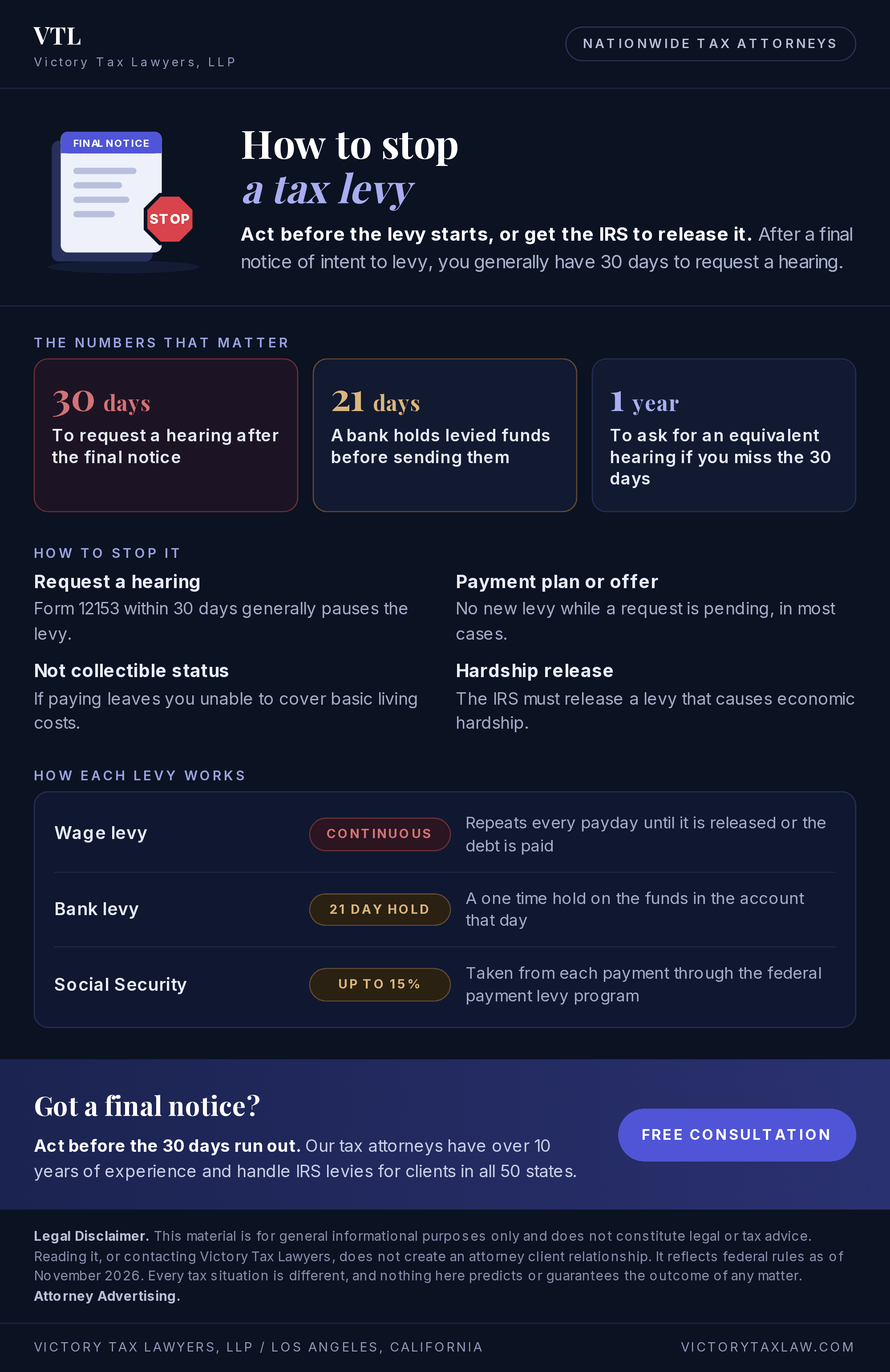
You stop a tax levy by getting the IRS to release it, or by acting before it starts. The IRS must release a levy on set grounds, such as full payment of your tax liability, a payment plan, or economic hardship. If you have a Final Notice of Intent to Levy in hand and want to request a Collection Due Process Hearing, you generally have 30 days to do that.
Victory Tax Lawyers, LLP, represents taxpayers in IRS collection matters from its Los Angeles office, and our attorneys have more than ten years of experience in tax disputes. Our tax attorneys and IRS Enrolled Agents review levy notices, prepare financial statements, and negotiate payment options for clients in all 50 states. If a tax levy notice is in your hands, contact our firm to set up a confidential consultation.
This article explains the notices before a levy, the steps that stop one, the release grounds, and how levy types differ.
What Is a Tax Levy, and How Does It Differ From a Tax Lien?

A tax levy is an official taking of your property or rights to property like wages, money from your checking account, or Social Security payments. A federal tax lien is a legal claim against your property, a public notice that secures the debt. The levy is the actual seizure, and the IRS can levy without having filed a lien.
Before the IRS takes anything, they send you a series of notices about your tax bill. The CP504 notice is a Notice of Intent to Levy under Internal Revenue Code section 6331(d). It warns that the IRS may seize your refund from state income taxes. A Letter 1058 or LT11 matters more. This is the Final Notice of Intent to Levy and Notice of Your Right to a Hearing. The IRS generally cannot levy until 30 days after it, according to IRS Publication 594.
How to Stop a Tax Levy Step by Step

The right move depends on your income, your expenses, and whether the levy has started. In the steps below, we’ll cover deadlines first, then paperwork, and finally the resolution options that fit your numbers.
Check Your Final Notice and Mark the Deadline
Find the final notice first and read the date printed on it. You have 30 days from that date to request a hearing, and the notice specifies that deadline. A late request can still obtain an equivalent hearing within one year. That hearing does not legally bar a levy, and you cannot take the result to court. If collection proceedings have already started, you should contact the IRS using the phone number found on the levy notice. If a revenue officer has been assigned to your case, you should contact that officer.
Gather Your Financial Records
Almost every relief option depends on how much you earn and how much you must spend. The IRS asks for a collection information statement, which is usually Form 433-F or Form 433-A for individuals. They may also ask for pay stubs and recent bank statements. The IRS compares your expenses against its collection financial standards. This standard sets national limits for food and clothing and local limits for housing and transportation. Your household size also matters. From these figures the IRS estimates your reasonable collection potential, meaning what it believes it can collect from your income and assets.
Request a Collection Due Process Hearing
Third, file Form 12153 within the 30-day window. A timely CDP hearing request generally prohibits levy while the hearing and any appeal are pending, and it suspends the 10-year collection statute. An independent appeals officer will review your case, and you can also put forward a proposal for a payment plan at that time. After the decision is made, you have 30 days after the determination to petition the U.S. Tax Court.
Propose a Payment Plan or Offer in Compromise
Fourth, look at a payment plan. Under Internal Revenue Code section 6331(k), the IRS cannot levy while a request for an installment agreement is pending or one is in effect. Section 6343 states that an existing levy will be released once you enter an installment agreement, unless the agreement says otherwise. You must have filed all required returns, and interest and penalties accrue as you make your payments.
If you cannot fully pay even over time, an offer in compromise asks the IRS to settle for less than you owe. The IRS may consider an offer in compromise if the debt is incorrect, your income and assets are insufficient, or exceptional circumstances make payment a hardship. Applicants pay a fee and an initial payment unless they qualify for the low-income waiver. Generally, no levy can be made while an offer is pending, or for 30 days after a rejection. The IRS decides each offer based on its own facts.
The 2025 IRS Data Book shows 3,160,047 new installment agreements in fiscal year 2025, plus 38,797 offers received and 5,464 accepted. These are nationwide counts, not Victory Tax Lawyers' results, and past outcomes do not guarantee future results.
Ask for Currently Not Collectible Status
Fifth, if paying would leave you unable to meet your basic living expenses, ask for Currently Not Collectible status. If the IRS agrees you can't pay, it may temporarily delay collection until your financial situation gets better before acting further. The debt remains, penalties and interest continue to accrue, and the IRS may file a Notice of Federal Tax Lien or apply federal tax refunds to the balance.
Contact the Taxpayer Advocate Service
Last, the Taxpayer Advocate Service is an independent organization inside the IRS that helps people whose IRS problems cause financial difficulty. Its help is free, and it fits best when normal channels have failed.
How the IRS Releases a Levy

Even after a levy starts, an IRS levy release is based on specific grounds. Internal Revenue Code section 6343 lists five. The first four grounds are full payment or expiry of the collection period, a release that helps collection, a qualifying installment agreement, and a levy that creates economic hardship. The fifth applies when the property is worth more than the debt, and a partial release would not hinder collection efforts.
Economic hardship means the levy leaves you unable to pay reasonable basic living costs because of your financial condition. This ground applies to individuals, not businesses. Treasury regulations tell the IRS to weigh your age, earning ability, dependents, necessary expenses, and local cost of living, but not a luxurious lifestyle. If you're facing immediate financial hardship, bring that up on your first call and mention which bills this new levy is preventing you from paying. The IRS can release part of the levy on your wages so that you have enough money left to meet your needs.
The IRS ends a levy with Form 668-D, Release of Levy. They must also release levies that were levied incorrectly, such as levies on exempt assets, before proper notice is given or during bankruptcy stays. If the IRS has already seized property, you generally have two years from the seizure to request its return, so please act promptly.
Wage Levy vs Bank Levy vs Other IRS Levies
The type of levy changes both the timing and the way to stop it. The table below compares the levies most taxpayers meet, using the rules in IRS Publication 594 and the Internal Revenue Code.
| Levy Type | What the IRS Reaches | Timing Rule | Main Ways to Stop or Release |
|---|---|---|---|
| Wage levy | Pay above the exempt amount. | One levy, continuous until the debt is paid, the levy is released, or the collection period ends. | Payment plan, hardship release, or a hearing request before it starts |
| Bank levy | Funds available in the account on the levy date, up to the levy amount | The bank holds the funds 21 days before sending them to the IRS. | Resolve the matter within the 21 days, such as a payment plan, hardship release, or proof the funds are not yours. |
| Federal payment levy | Up to 15 percent of most federal payments, including Title II Social Security benefits; federal vendor payments can be levied up to 100 percent | Continuous until the debt is paid or other arrangements are made | Payment plan, offer, or hardship; taxpayers in bankruptcy are excluded from the program. |
| State tax refund levy | A state refund owed to you | No 30-day pre-levy hearing is required. | Request a hearing after the levy, or arrange payment. |
| Property seizure | Vehicles, real estate, and other assets | A principal residence needs written federal court approval. | Payment plan, hearing request, or a manager conference within 10 business days of the seizure notice |
A levy on a paycheck repeats every pay period, while a bank levy is a one-time hold that makes the 21 days the window that counts.
Which Income and Property Is Off Limits

Internal Revenue Code section 6334 generally exempts unemployment benefits, workers' compensation, some service-connected disability payments, some public assistance, and income needed for court-ordered child support. It also sets aside a minimum amount from each paycheck according to standard deductions and dependents you have. Without a verified statement of your filing status and dependents, the statute defaults to married filing separately with one exemption.
Retirement accounts are not exempt as a group. The IRS can levy IRAs, employer retirement plans, and the Thrift Savings Plan, and depending on the terms of the plan, a levy may reach the funds in which you have a vested right. The IRS manual also limits these levies: collectors generally may not levy a retirement account unless the taxpayer's conduct has been flagrant. Social Security retirement and disability benefits can be levied through the federal payment levy program with up to 15% of each payment.
Which Levies Skip the 30-Day Notice

When the IRS finds that collection is in jeopardy, it can levy without notice, and your appeal rights come afterward. Jeopardy levies, state refund levies, and levies on federal contractors work this way. A disqualified employment tax levy applies if you requested a hearing on unpaid employment taxes from the two years before the tax period now being collected. Business owners should also know about the Trust Fund Recovery Penalty under IRC 6672. It can make a responsible person who willfully failed to pay personally liable for the income and payroll taxes withheld from employees' wages that were never paid over.
Can Bankruptcy Stop a Tax Levy?
Filing bankruptcy triggers an automatic stay that generally bars collection of debts that arose before you filed. The IRS must release a levy issued during the stay. The stay has limits under the Bankruptcy Code. It does not stop an audit, a notice of deficiency, or an assessment. Results depend on the chapter you file under, and whether bankruptcy clears tax debt turns on the type of tax and the tax years involved.
What Can You Do If You Missed the Hearing Deadline?
Missing the 30-day deadline doesn't mean you lose your options. An equivalent hearing remains open for one year from the date of the final notice of intent to levy. The Collection Appeals Program allows you to ask a collection manager to review a levy decision. If that conference does not resolve it, you can appeal to the IRS Independent Office of Appeals using Form 9423. For seized property, you have 10 business days after the Notice of Seizure to ask the collection manager for that review. Neither an equivalent hearing nor a CAP decision can go to Tax Court, because only a CDP determination can be appealed there.
State Tax Levies From the California Franchise Tax Board
California's Franchise Tax Board lists withholding orders, which cover wage garnishments and other levies, among its collection tools. Those orders follow state rules on exemptions and timelines, so a California wage garnishment needs its own plan.
Ready to Stop a Tax Levy Before the Deadline Passes?

A wage levy repeats every payday, and your choices get limited when the 30-day period is over or when the bank hold expires. Looking at your notices, income information, and expenses now lets you see which ground of release, payment plan, or appeal is right for you. Since windows are short, acting early gives an attorney extra time to prepare your request before the deadline hits.
Our Los Angeles team handles levy releases, hearings, and payment plans for clients in all 50 states. Parham Khorsandi, ESQ, California Bar No. 266658, leads the team that works alongside our IRS Enrolled Agents. Contact us today to discuss your levy notice in a confidential consultation.
Frequently Asked Questions
Our tax lawyers and Enrolled Agents deal regularly with people who open a levy notice or see their paychecks shrink. That experience with IRS collection cases lets us explain how the rules usually apply, though your notices and numbers control the answer.
How Fast Can an IRS Levy Be Removed?
Release speed depends on which release ground applies to you and how quickly the IRS reviews your information. Internal IRS procedures tell employees to release a levy without delay once they determine it causes economic hardship.
How Do I Get a Wage Garnishment Removed?
Regardless of whether it's called a levy or wage garnishment, the IRS does not need a court order. It must release the levy if you pay the debt, enter a payment plan whose terms do not allow the levy to continue, or show economic hardship. Call the phone number listed on the levy notice.
Can the IRS Levy My Bank Account Without Warning?
Generally no. The IRS usually must send a final notice at least 30 days before levying, with exceptions such as jeopardy and state refund levies. After the bank levies your account, it will hold the funds you currently have available for 21 days.
Does a Payment Plan Stop a Levy?
A pending request or an active agreement precludes new levies. Once you enter an installment agreement, the IRS must release any levies already in place unless the agreement says otherwise. Generally speaking, you need to file all required returns first.
Can the IRS Take Social Security Benefits?
Yes, through the federal payment levy program, which can take up to 15 percent of Title II Social Security benefits. A hardship finding, a payment arrangement, or bankruptcy can keep your payments out of the program.
What Happens If I Cannot Afford to Pay?
Ask for a currently not collectible status, which postpones collection until you start recovering financially. The debt, along with any interest and penalties, still stands. An offer in compromise or a partial installment agreement may work too.
Legal Disclaimer. This article contains general information only and should not be considered as legal or tax advice. Reading about Victory Tax Lawyers, LLP or contacting the firm doesn't mean you have a lawyer-client relationship. Tax laws and procedures with the IRS do change, and every case is different based on its facts. Past results do not guarantee future outcomes. Victory Tax Lawyers, LLP, 1100 S Robertson Blvd, Los Angeles, CA 90035. Responsible attorney: Parham Khorsandi, Esq. (California Bar No. 266658). Attorney Advertising.