
Yes, the IRS can garnish Social Security benefits when you owe unpaid federal taxes, usually through its Federal Payment Levy Program. Up to 15% of each monthly benefit, but only after waiting 30 days and approval from a final notice. Supplemental Security Income is exempt, and the program also skips individuals whose income is below a certain poverty level each month.
At Victory Tax Lawyers, we have tax attorneys with over 10 years of experience defending seniors against collection actions by the IRS in all 50 states. We negotiate releases of IRS levies, we arrange installment payments, and we ask the IRS to pause collection for clients who rely on benefits. If a final notice has arrived and the 30-day clock is running, contact us for a free consultation before the deadline passes.
This article explains which Social Security payments the IRS can take, how much it takes, and how to respond to a levy.
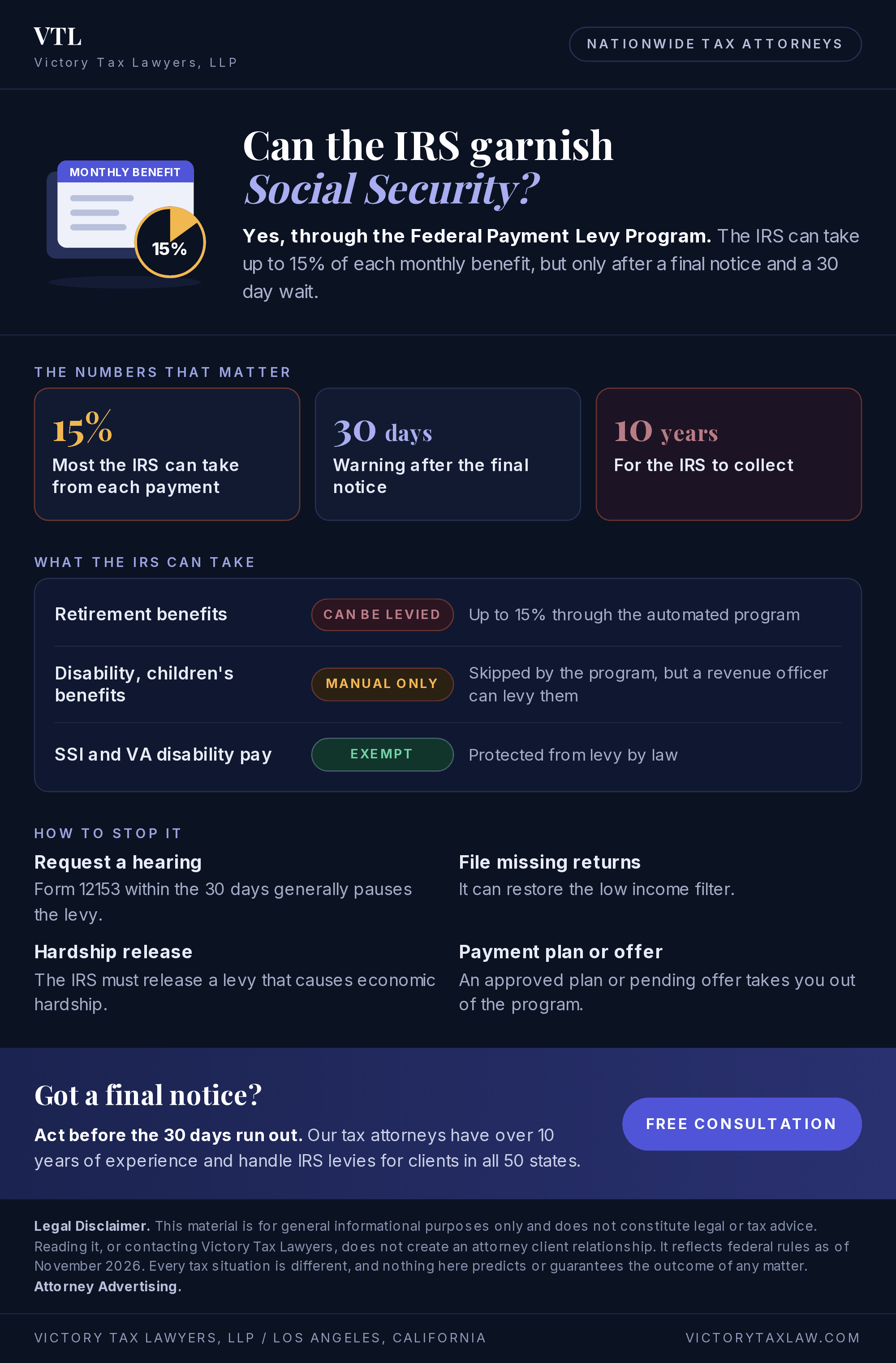
How the IRS Can Garnish Your Social Security Benefits

Federal law protects Social Security from most creditors but not from the federal government if taxes are unpaid. Section 6331(h) of the tax code allows the IRS to collect levies of up to 15% of Social Security payments on an ongoing basis. The IRS needs no court judgment, only a final notice and a 30-day wait.
What the Federal Payment Levy Program Does
The program checks IRS records against payment information that the Bureau of the Fiscal Service sends out for federal payments. When a delinquent taxpayer also receives Social Security payments, the match can trigger a levy without a revenue officer ever calling. The Internal Revenue Manual says that they take 15% of a retirement check from the Social Security Administration.
The levy keeps taking money every month until the debt is paid, the IRS releases it, or the collection period ends. Under Section 6502, the IRS generally has 10 years from the date of assessment to collect, though some events extend that window.
When the IRS Serves a Manual Levy Instead
Besides relying on automated programs, a revenue official can also serve a paper levy to the Social Security Administration. The manual treats these benefits as attainable because they do not depend on need. It also tells collectors to use discretion and to weigh other viable levy sources first.
A manual levy has its own rules, so amounts will vary from the 15% that is automated. Consult an attorney to compare any levy amount against your actual household expenses.
Which Social Security Payments the IRS Can and Cannot Take

Benefit type decides whether a payment is subject to the program, open to a manual levy, or barred by law.
Retirement Benefits
Payments for retirement are among those that are most vulnerable, and many people rely heavily on them. The Social Security Administration's fact sheet shows nearly nine in ten people age 65 and older received benefits in December 2024. Among beneficiaries age 65 and older, using 2015 data, 39% of men and 44% of women receive at least half their income from that source.
You can keep collecting Social Security while you owe back taxes, but the IRS may levy a portion of each payment.
Social Security Disability Benefits
The automated program skips Social Security disability benefits so that they do not go through routine matching for levies. That does not make them untouchable, because a revenue officer can still levy disability payments by hand. In those cases, the IRS makes individual decisions rather than making them automatically.
SSI, Children's Benefits, and VA Disability Pay
Under tax law, Supplemental Security Income is exempt from IRS levy, and therefore the IRS does not levy against it. Section 6334 also excludes service-connected disability payments from the Department of Veterans Affairs.
The automated program also skips children's benefits and lump-sum claims, but that is a program rule, not a legal exemption. A manual levy could still reach those payments, so do not treat them as protected.
How Much of Your Social Security the IRS Can Take

The limit is a percentage rather than a number of dollars, so the effect is easy to estimate from your monthly benefit.
The 15 Percent Limit
In one example, a monthly benefit of $2,000 could lose as much as $300 every month until the IRS releases the levy. A few months of levies can mean missing rent payments or utility bills as well as failing to pay for medicine; timing is important.
The Low Income Filter
The manual excludes people whose estimated total income is less than 250% of the Department of Health and Human Services poverty guidelines. Unfiled returns can remove that protection, because the filter is skipped when the IRS shows a missing return on your account. Then the IRS can still proceed with the levy even if your income from Social Security is low.
How the IRS Compares to Credit Card Companies and Other Creditors
Different collectors might go after Social Security, and the rules for IRS garnishments are quite different from those for private creditors. This table compares garnishment rights, court orders, and legal limits among different collectors.
| Collector | Can It Garnish Social Security? | Court Order Needed? | Limit or Protection | Source |
|---|---|---|---|---|
| IRS | Yes, retirement benefits | No, but a final notice and 30 days are required | Up to 15 percent through the levy program, with a low-income filter. | IRC 6331(h) and 6330 |
| Credit card companies and most other creditors | No | Not applicable | Federal law shields benefits from garnishment, levy, and attachment. | 42 U.S.C. 407 |
| Child support and alimony | Yes | Handled through the support enforcement process | Federal law allows for withholding, and the amount follows the support order. | 42 U.S.C. 659 |
| IRS and Supplemental Security Income | No | Not applicable | Exempt from levy | IRC 6334(a)(11) |
Credit card companies and most creditors can't garnish Social Security, and the IRS is the main exception, along with child support orders and debts owed to other federal agencies. Those agency debts are collected through the Treasury Offset Program, which can take up to 15% of a benefit but cannot reduce it below $750 a month. If a private creditor tries to garnish your Social Security, dispute it, because federal law protects those benefits from most creditors. A Social Security garnishment for child support is governed by different federal rules and has no connection to your tax debt.
What Happens to Benefits Already in Your Bank Account
Federal rules make a bank protect up to two months' worth of directly deposited benefits when a private creditor's garnishment order arrives. The rules apply to court orders and state levies but do not protect against an IRS levy on a bank account, so that doesn't extend to tax debt.
Keeping benefits in a separate bank account makes deposits easier to identify, which helps against private creditors but not the IRS. State rules vary, so confirm how your state treats deposit funds in a bank account.
Notices You Receive Before the IRS Levies Your Benefits

The IRS cannot start a levy without warning, because Section 6330 requires notice at least 30 days before the first levy. That notice must also explain your hearing right in simple and nontechnical terms, though many people find these letters hard to follow.
The Final Notice of Intent to Levy
The letter might be either CP90, CP297, Letter 1058, or LT11 notice depending on which section of the IRS sent it. Each one acts as a notice of intent to levy and starts your countdown at 30 days.
Retirees get one more warning after the hearing notice: a CP91 or CP298 about a levy on Social Security. The IRS says it plans to take up to 15% of your benefits, and under the Internal Revenue Manual the levy is not sent until at least eight weeks after that letter. These letters typically follow earlier balance-due CP notices, so an ignored letter from months ago can be where the process began.
Your 30-Day Collection Due Process Hearing Right
Within that 30-day period, you can ask for a Collection Due Process hearing with the IRS Independent Office of Appeals. There you can propose a payment alternative, challenge the levy, and ask the IRS to consider your finances. Take the date on the notice seriously because missing that date reduces your options.
How to Stop the IRS From Garnishing Your Social Security

Each step below is a request to the IRS, and the right mix depends on your income, filing history, and debt size. Going through them in order keeps sight of each deadline in view and shows what remains open.
Read the Notice and Mark Your Deadline
First, read the notice the day it arrives and note down the response deadline that comes 30 days after the notice date. Also keep any CP91 or CP298, because the levy on your benefits cannot be sent until at least eight weeks after that letter. Calling the number on that letter will let you check which tax years are involved and how much is owed.
File Any Missing Tax Returns
Then check that you've filed every required return, because an unfiled return means that you lose the benefit of low income filters. Filing back taxes is often the first fix, and once the returns are in, the filter can work as designed.
Request a Collection Due Process Hearing
Then, while the 30 days are still open, ask for the hearing by sending Form 12153 to the address on your notice. Under Section 6330, a timely hearing request generally suspends the levy while the hearing and any appeal are pending. This delay allows you time to present an alternative method of paying to Appeals.
Ask for a Hardship Release or Currently Not Collectible Status
Tell the IRS if this levy leaves you short for necessities. The tax code requires the IRS to release a levy that is causing economic hardship. Many people never bring up their hardships at all, often because they do not know the IRS must stop collection in that situation; this was noted by National Taxpayer Advocate Nina Olson in an article from 2019 called "The IRS is Not Doing Enough to Protect Taxpayers Facing Economic Hardship".
A hardship release asks the IRS to lift a levy that cuts your access to food, housing, or medical care. IRS Tax Topic 201 says the IRS may temporarily delay collection if financial hardship leaves you unable to pay any tax debt. The IRS does this by reporting the account as currently not collectible, but the debt remains, and interest keeps building.
Set Up a Repayment Plan or Offer in Compromise
Then, look at ways to pay over time or resolve the balance. An IRS-accepted repayment plan like an installment agreement spreads the tax debt into regular monthly payments. An offer in compromise is asking the IRS to settle the debt based on what you can afford.
The manual excludes accounts in an approved installment agreement, a pending or approved offer, or currently not collectible status from the levy program. It releases the levy when an account moves into one of those. Qualification depends on income level, expenses, and asset status, and ultimately the IRS makes the final decision.
Hire a Tax Attorney to Deal With the IRS
Finally, a tax attorney can file a power of attorney, request the hearing, and speak to the IRS for you. Lots of folks start out with afree attorney consultation because that way you can read the notice, check the deadline, and compare the options too.
Ready to Deal With an IRS Levy on Your Social Security?

The IRS can withhold as much as 15% of your Social Security benefits, but only after you've waited for 30 days and have gone through a final notice process. A hearing, hardship release, repayment plan, or offer in compromise can each ask the IRS to ease a levy. Acting before the date on your notice keeps the most options open, so reach out as soon as the letter arrives.
Our IRS levy professionals have over 10 years of experience dealing with release levies, installment agreements, and hardship requests for retired people. Our office in Los Angeles handles matters for clients across all 50 states, and we route contacts with the IRS through powers of attorney. Contact us today so we can review your notice before the 30-day window closes.
Frequently Asked Questions
Our tax practice handles IRS levy notices and collection hearings for clients in all 50 states, so we hear these questions often. The responses below pertain specifically to federal tax debt only and follow the above-mentioned rules.
Can the IRS Take All of My Social Security Check?
No, under the IRS levy program, they can take up to 15% from each payment. The program also filters out people with very low incomes, and Supplemental Security Income cannot be levied.
Can the IRS Garnish Social Security Disability Benefits?
The automated program skips disability insurance payments, but a revenue officer can still levy them by hand.
Is SSI Protected From the IRS?
Yes, Supplemental Security Income is exempt from levy under the tax code, and the IRS does not levy it.
Does the IRS Have to Warn Me Before Garnishing My Benefits?
Yes, the IRS must send a notice of intent to levy and wait at least 30 days before the first levy. Retirees will also get a second letter called CP91 or CP298, and the levy is not sent until at least eight weeks after it.
Can Credit Card Companies Garnish My Social Security?
No, credit card companies and most other creditors cannot garnish Social Security. Child support payments, alimony payments, federal tax debts, and debts owed to other federal agencies are major exceptions to that kind of protection.
Is Social Security in My Bank Account Safe From the IRS?
It may not be, because bank protections apply to private creditor orders and do not stop an IRS bank levy.
How Do I Stop the IRS From Taking My Social Security?
You can ask for a hearing, request a hardship exception, or work out a payment plan or an offer to settle. Each option has specific deadlines and requirements, so make sure you start working with the deadline noted in your notice.
Can I Get Social Security If I Owe Back Taxes?
Yes, owing back taxes does not stop you from collecting Social Security. The IRS can still levy a portion of your payments if the debt goes unresolved.
Can IRS Garnish Social Security Over Old Back Taxes?
Generally speaking, the IRS has 10 years from the date they assess a tax bill to collect that debt. It can levy Social Security within that period, and some events can extend the window.
Attorney Advertising. This piece is purely for informational purposes only and is not legal advice. Reading or contacting Victory Tax Lawyers doesn't create any attorney-client relationship. Every tax situation is different, and nothing here predicts or guarantees the outcome of any matter. Past results do not guarantee a similar outcome.