If you received a CP14 notice, the IRS says you owe money for a tax year, and ignoring it can lead to serious collection action. At Victory Tax Lawyers, we understand how stressful an IRS balance can be. That is why we help taxpayers explore options such as payment plans, Currently Not Collectible status, and other solutions before the IRS files a lien, garnishes wages, or levies a bank account. Let us help you respond to your CP14 notice and work toward the best possible resolution.
Contact us today, and let us help you with your CP14 Notice!
What Is an IRS CP14 Notice?
An IRS CP14 notice is a balance due notice. It tells you the IRS processed a return, calculated tax owed, and did not receive full payment. It is the first formal communication in the IRS collection process for that tax year. Three things make a CP14 different from the notices that follow it.

It arrives by regular mail, not certified mail. It carries no appeal deadline, although it does include a payment deadline. It occurs early in the collection process, with several more notices generally coming before the IRS can levy your property or accounts.
None of that makes a CP14 safe to ignore. Interest continues to accrue from the original due date of the return, not the notice date, and failure-to-pay penalties can continue to build while the balance remains unpaid. The balance may also reflect issues such as missed, underpaid, or improperly credited estimated tax payments. According to the IRS Collection Statistics, the agency collected more than $16 billion through installment agreements in FY 2024, an increase of more than 12% from the previous year.
If you cannot pay the full amount, you may be able to set up a payment plan for balances under $50,000. Businesses may also qualify for up to 24 monthly payments when they owe $25,000 or less. If you recently filed an amended return, keep in mind that the IRS may take 8 to 16 weeks to process it, so the CP14 balance may not immediately reflect the change.
What Does Your CP14 Notice Actually Say?
Every CP14 contains the same core information. Find these before doing anything else:
- The notice number, printed in the upper right corner, confirming it is a CP14 and not a later notice
- The tax year the balance relates to
- The combined tax, penalties, and interest making up the total
- The payment deadline stated on the notice
- Your Social Security number, partially masked
Two charges make up the difference between the tax you reported and the amount the IRS now requests. The failure-to-pay penalty runs at 0.5% of the unpaid tax for each month, or part of a month, it remains unpaid, capped at 25%. Interest runs at the federal short-term rate plus three percentage points, compounds daily, and is set quarterly.
That combination is why a small balance grows faster than people expect, and why partial payment is better than no payment. Penalties and interest are both calculated on what remains unpaid.
What Happens If You Ignore a CP14 Notice?
It is not wage garnishment, at least not next. This is worth stating plainly because most pages on this topic jump straight from CP14 to asset seizure, and that is not how the collection process works. The IRS moves through a sequence of notices, each one escalating. The table below shows where a CP14 sits and what actually has to happen before anything is taken.
| IRS Notice | What It Means | What It Authorizes |
|---|---|---|
| CP14 | First notice that you owe a federal tax balance. | Nothing beyond a request for payment. |
| CP501 | Reminder that a tax balance remains unpaid. | Nothing; it is still a reminder to pay. |
| CP503 | Second reminder with a more urgent tone. | Nothing; it remains a reminder to pay. |
| CP504 | Notice that the IRS intends to levy your state tax refund. | Levy of a state tax refund only; the IRS may also file a federal tax lien. |
| LT11 or Letter 1058 | Final Notice of Intent to Levy and Notice of Your Right to a Hearing. | Wage garnishment and bank levies may begin after the 30-day period expires. |
The notice that matters most is the last one. LT11 or Letter 1058 arrives by certified mail and gives you 30 days to request a Collection Due Process hearing. A timely request generally stops levy action and preserves your right to Tax Court review. CP504 is frequently mistaken for the final notice because it is titled a notice of intent to levy, but it applies only to your state tax refund.
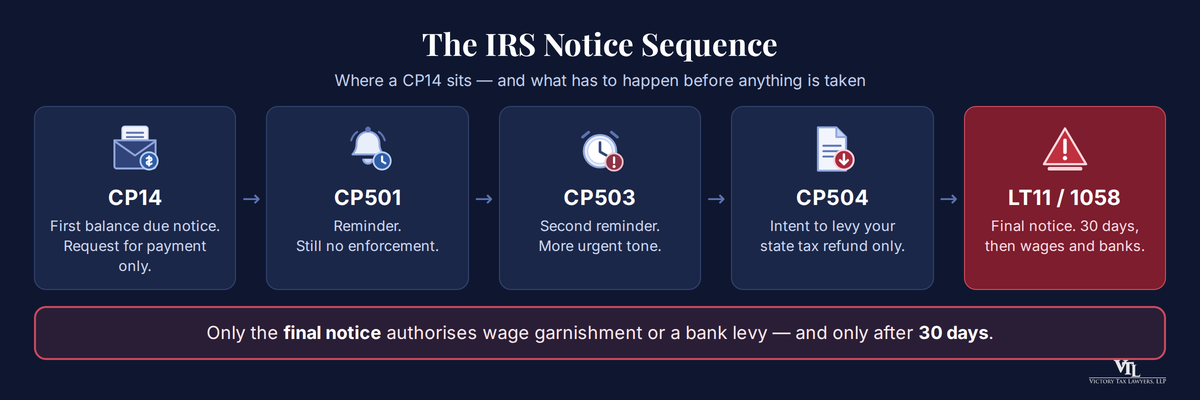
So ignoring a CP14 does not cause wages to be garnished. It causes penalties and interest to keep compounding, moves you toward a federal tax lien filing, and eventually produces the notice that does authorize a levy. The practical cost of waiting is the money, not the immediate seizure.
One correction to a claim you will see elsewhere. Unpaid taxes do not damage your credit score. Since April 2018, the three major credit bureaus have not included federal tax liens on consumer credit reports at all. Liens remain public records that a lender may find independently, but the common warning about credit damage from a CP14 is outdated.
What Should You Do After Receiving a CP14 Notice?
Work through this in order. The first three steps cost nothing and frequently resolve the matter.

Step One: Verify the Balance Before You Pay It.
CP14 notices are sometimes wrong. Log in to your IRS Online Account and download your Tax Account Transcript for that tax year. Check the payment dates and amounts against your own records, bank statements, and payment confirmations.
Step Two: Look for the Four Common Causes of an Incorrect Notice.
A payment credited to the wrong tax year. A misapplied payment. A math error correction on your return. An amended return the IRS has not finished processing, which can take 8 to 16 weeks.
Step Three: Pay in Full if the Balance Is Correct and You Can.
Pay through your IRS online account, by bank account transfer, or by money order using the notice's payment coupon. Timely payment stops further penalties from accruing.
Step Four: Dispute It in Writing if the Balance Is Wrong.
Call the IRS number on the notice first. Follow up with a written explanation and supporting documents showing the payment was made and applied correctly. Keep copies of everything.
Step Five: Set Up a Payment Plan if You Cannot Pay in Full.
Individuals owing $50,000 or less in combined tax, penalties, and interest can generally apply online. That covers a long-term installment agreement. Businesses owing $25,000 or less can generally arrange up to 24 monthly payments.
Can You Get CP14 Penalties Removed?
In our experience, yes, and this is the most overlooked opportunity on a CP14. First-Time Penalty Abatement is available if you have no penalties in the three prior tax years and all your required returns are filed. Where you qualify, the IRS removes the failure-to-file and failure-to-pay penalties for one tax year on request. You can usually ask by calling the number on the notice.
Interest on the original tax cannot be abated, though interest charged on the abated penalties is removed automatically. And First-Time Penalty Abatement applies to one tax year, so if several years carry penalties, it is worth thinking about which year to use it on.
Reasonable cause relief is a separate route. If a serious illness, a natural disaster, or another circumstance genuinely outside your control prevented timely payment, you can request abatement with a written explanation and supporting documents. This is not the same as an inability to pay, and it needs evidence rather than assertion.
What Are Your Resolution Options?
Which route fits depends on what you can actually pay. The table below compares the four options the IRS makes available for a balance due.
| Option | Best For | What to Know |
|---|---|---|
| Pay in Full | Balances you can clear now | Stops further failure-to-pay penalties from accruing once the balance is fully paid. |
| Installment Agreement | Balances you can clear over time | Available online for individuals who owe $50,000 or less; the failure-to-pay penalty rate is reduced while an agreement is in effect. |
| Offer in Compromise | Situations where full payment is not realistic, and you meet the eligibility criteria | The IRS may accept less than the full balance when its criteria are met. It is not available to everyone and requires full financial disclosure. |
| Currently Not Collectible (CNC) Status | Situations where paying anything would prevent you from meeting basic living expenses | Pauses collection actions without erasing the debt. Penalties and interest continue to accrue. |
Why Do People Receive CP14 Notices?
Most IRS Notice CP14 letters trace back to a small number of issues involving your tax liability or tax return. You may have underpaid estimated taxes during the year, filed an extension without paying the estimated balance, or had a math error on your return that the IRS corrected. An extension gives you more time to file, not more time to pay, so late payment can result in a tax debt, penalties, and interest.

Sometimes, the IRS system has not properly credited a payment. A payment may have been applied to the wrong tax year or otherwise misapplied, meaning you may not actually owe the amount the notice CP14 requests payment for. Processing delays and other IRS issues can also affect your account.
Insufficient withholding is different. If too little was withheld throughout the year, the tax liability may be real. In that situation, you should review the specific notice carefully, consider your payment options, and address the balance while adjusting your withholding going forward. If the CP14 includes a civil penalty, a tax professional can also determine whether you may qualify to request penalty relief and help you respond before additional notices arrive.
How Does Victory Tax Law Help With a CP14 Notice?
Initial consultation. We review the notice, pull your account transcript, and compare the IRS records against your own. That single comparison identifies whether the balance is correct, which decides everything that follows.
Strategy and IRS contact. Where the balance is wrong, we prepare the written dispute with supporting documents. Where it is correct, we identify which resolution route fits and whether penalty relief is available. Under a Form 2848 power of attorney, we deal with the IRS directly, so you are not managing the calls.
Resolution and follow-up. We confirm the account reflects the outcome. We also address the withholding or estimated payment issue that produced the balance, so next year does not generate another notice.
Ready to Speak to a Tax Attorney About Your CP14 Notice?
A CP14 is the least expensive step in the collection process to resolve a tax problem. The balance is the smallest, no deadline has been forfeited, and penalty relief is still on the table. Bring your notice, your account transcript (if you have pulled it), and your last two federal returns to your free consultation. We will tell you whether the balance is correct, what it should be, and which route to take to resolve it.
Reach Out to Us at Victory Tax Lawyers Today to Build a Strong Case.
Frequently Asked Questions
These are the questions taxpayers ask most often after a CP14 arrives.
What Is an IRS CP14 Notice?
It is the first notice the IRS sends when it determines you have an unpaid balance for a tax year, showing the tax owed plus penalties and interest. It is a request for payment rather than an enforcement action, and it arrives by regular mail rather than certified mail.
Why Did I Receive an IRS CP14 Notice?
The IRS processed a return for that tax year and did not receive full payment of the balance it calculated. Common causes are underpaid estimated tax, an extension filed without payment, a math error correction, or a payment credited to the wrong year.
What Should I Do If I Receive an IRS CP14 Notice?
Verify the balance first by downloading your Tax Account Transcript from your IRS Online Account and checking it against your payment records. If the balance is correct, pay it or arrange a payment plan by the deadline; if it is wrong, dispute it in writing with supporting documents.
What Happens If I Ignore an IRS CP14 Notice?
Penalties and interest continue to compound, and the IRS moves through further notices toward a federal tax lien filing and eventually a Final Notice of Intent to Levy. Wage garnishment is not the next step, but it is where the sequence ends if nothing is resolved.
Can CP14 Penalties Be Removed?
Often, through First-Time Penalty Abatement, which removes the failure-to-file and failure-to-pay penalties for one tax year. It requires a penalty-free prior three years and all returns filed, and reasonable cause relief may apply separately where circumstances outside your control prevented payment.
Legal Disclaimer: The information on this page is provided for general educational purposes and is not legal or tax advice. Penalty rates, interest rates, payment plan thresholds, and eligibility for relief change over time. They also depend on the facts of each matter, including the tax years involved and your filing and payment history. Interest rates are set quarterly by the IRS. Reading this page does not create an attorney-client relationship with Victory Tax Law. For advice about a notice you have received, consult a licensed tax attorney, certified public accountant, or enrolled agent.