
To apply for garnishment hardship relief, file a claim of exemption or hardship request with the court or agency handling the garnishment. File a claim of exemption within 5 to 30 days, depending on your state and the type of garnishment. Provide financial information showing that the garnishment prevents you from paying essential living expenses. In our experience, if approved, a hardship application can pause a garnishment.
At Victory Tax Lawyers, we help taxpayers nationwide resolve IRS disputes and tax debt matters. Our attorneys bring more than 10 years of experience handling tax controversy, resolution, and litigation matters, have secured over $100 million in tax relief for clients, and have assisted more than 10,000 taxpayers across all 50 states. Our results include reducing a $1 million tax liability to $16,194 through an Offer in Compromise and converting six-figure tax debts into affordable monthly payment plans as low as $25 per month. If you are facing IRS issues, contact us today for a free consultation.
This guide is for people facing wage garnishment who need to understand how to apply for hardship relief, what to provide, and how the process may help stop or reduce the garnishment.

What Is Garnishment Hardship?
Garnishment hardship is the legal argument that the money being taken leaves you unable to cover basic living expenses. Financial hardship means you cannot pay for essential living needs such as housing, food, utilities, and medical care once the garnishment comes out. If you owe money, hardship relief does not change that. What it changes is how much comes out while you deal with the balance.
Every system that garnishes wages recognizes some version of this argument. The names differ. A court judgment creditor faces a Claim of Exemption. The IRS calls it economic hardship and releases the levy. The FTB treats it as a hardship modification of its withholding order. The underlying question is identical across all three, which is whether what remains of your take-home pay covers basic needs.
The common scenarios look alike too. A medical event cuts your hours while medical costs climb, and the financial strain arrives before the paperwork does. A household drops from two incomes to one and can no longer pay rent on what is left. Rent rises, a car dies, or a garnishment order lands on a paycheck that was already short. Multiple garnishments running at once are a category of their own, because each one was calculated as if it were the only claim on your wages.
Garnishment leaves most households short immediately, and relief is generally prospective. Act quickly, because collection actions keep running while you decide. In California, you can recover money garnished after you file a Claim of Exemption if you win, but you usually can't recover money sent before you filed. We have found that immediate action is worth real dollars.
Who Is Garnishing You, and Why Does That Change Everything?

In our experience, the first step is identifying who is garnishing your wages, because the garnishing authority determines the hardship form, where you must file it, and the deadline. A private creditor with a court judgment follows a different process than the IRS or a California state tax agency, and you generally can't use their forms interchangeably. Start by reviewing your garnishment notice to identify the issuing agency or creditor, then use the table below to find the route that applies to your situation.
| Who Is Garnishing | What You File | Where It Goes | Timing |
|---|---|---|---|
| Private creditor with a court judgment | Claim of Exemption (Form WG-006) and Financial Statement (Form WG-007) | The levying officer named on the Earnings Withholding Order, usually the sheriff | The creditor generally has 10 days to oppose; if unopposed, the claim may be granted |
| IRS | Collection Information Statement and request for levy release based on economic hardship | The IRS unit identified on the levy or notice. | No fixed deadline, but each pay period affected by the levy reduces your available income |
| Franchise Tax Board (FTB) | Financial hardship request concerning the earnings withholding order | FTB, through MyFTB or the contact information on the order | Contact FTB directly because only FTB can modify or release its own order |
A court Claim of Exemption does nothing against a tax garnishment, because the sheriff has no authority over the IRS or the FTB. Also, with an FTB earnings withholding order for taxes, your employer cannot reduce the amount even if it agrees with you. Only the agency can modify or release the order.
Our 4-Part Hardship Test
At Victory Tax Lawyers, we look at a garnishment hardship problem through four questions: Authority, Amount, Necessities, and Remedy. This framework helps separate a paperwork problem from a genuine financial hardship and identifies the fastest available path to relief.
Authority: First, identify who issued the garnishment. A private creditor, the IRS, and the FTB operate under different rules, so the correct remedy depends on the authority behind the order.
Amount: Next, calculate exactly how much is being withheld from each paycheck and what income remains afterward. Do not estimate. Use recent pay stubs and the actual withholding amount.
Necessities: Then document the household expenses that must be paid from the remaining income. Focus on housing, food, utilities, transportation, medical care, insurance, and support obligations, and connect unusual expenses to documents.
Remedy: Finally, determine what outcome makes sense. That could mean stopping the garnishment, reducing the amount withheld, obtaining a levy release, negotiating a payment arrangement, or pursuing another available remedy.
The advantage of this approach is that it prevents a common mistake. That is, filing a hardship request before determining whether the request is going to the right authority and whether the numbers actually demonstrate hardship.
How Much of Your Paycheck Can Be Garnished?

For an ordinary court judgment, less than most people fear. For tax debt, potentially far more. Federal law sets the outer limit for ordinary debts. Under 15 U.S.C. section 1673, garnishment for any workweek cannot exceed the lesser of two figures. Those are 25 percent of disposable earnings, or the amount by which disposable earnings exceed thirty times the federal minimum hourly wage. Disposable earnings are what remains after legally required deductions, not what remains after your bills.
California is more protective than the federal floor. As the California Courts self-help guide explains, a debt collector can have your employer take up to 20 percent of your wages. When state law provides a smaller garnishment than federal law, the state limit is what applies. Now, the exception that matters most for our clients. Section 1673 expressly does not apply to any debt due for state or federal taxes. A tax garnishment is not capped at 25 percent or at 20 percent.
The IRS leaves you an exempt amount based on your filing status, standard deduction, and dependents, and takes the rest, which frequently exceeds what a private creditor could ever reach. Support orders also sit outside the cap and can run to 50 or 60 percent of disposable income, depending on family circumstances.
We have found that some income is protected regardless. Social Security, unemployment benefits, and public assistance are generally protected income against private creditor garnishment. That protection is not absolute against the government, since certain Social Security benefits can be levied through federal programs for tax debt and can also be reached for child support.
Are You Eligible for Garnishment Hardship Relief?
In our experience, you qualify when your documented income cannot cover necessary living expenses after the garnishment. Eligibility depends on math and evidence, not how difficult the situation feels. Every decision maker compares income against allowable expenses. Housing, utilities, food, transportation, health care, and support of dependents count. Discretionary spending does not, and expenses that look optional will be excluded even when they feel essential to you.
Income below the relevant state or agency threshold is what produces relief, and garnishment can be reduced rather than eliminated when your income sits near the line. Family circumstances carry weight. Dependents, a spouse who cannot work, ongoing medical costs, and recent job loss all support a hardship claim. So does a documented change in circumstances, since a garnishment amount calculated six months ago may bear no relation to what you earn today.
Assess your own situation honestly before filing. Pull your recent pay stubs, add up what you actually pay to keep the household running, and compare the two with the garnishment in place. If the gap is real, the claim is real. If the gap depends on expenses you cannot document, the claim will fail, and you will have spent weeks learning that.
What Does Garnishment Hardship Look Like in Real Life?
Consider a California employee earning $4,200 per month after legally required deductions whose paycheck is subject to a $700 judgment garnishment. The employee’s household has $2,450 in rent, $650 in groceries, $380 in utilities and insurance, $325 in transportation costs, $275 in medical expenses, and $300 in court-ordered support, leaving only $120 before other necessary household expenses.
The problem is not simply that the employee has less money than before. The garnishment creates a documented shortfall between available income and necessary expenses. A hardship claim would therefore focus on the actual numbers, supporting documents, household circumstances, and the amount needed to keep essential expenses current.
This example also shows why hardship relief is not necessarily an all-or-nothing decision. Depending on the applicable procedure, the result may be a complete release, a reduction in the amount withheld, or another arrangement that allows the debtor to meet basic expenses while addressing the underlying debt.
What Documents Do You Need to Prove Hardship?
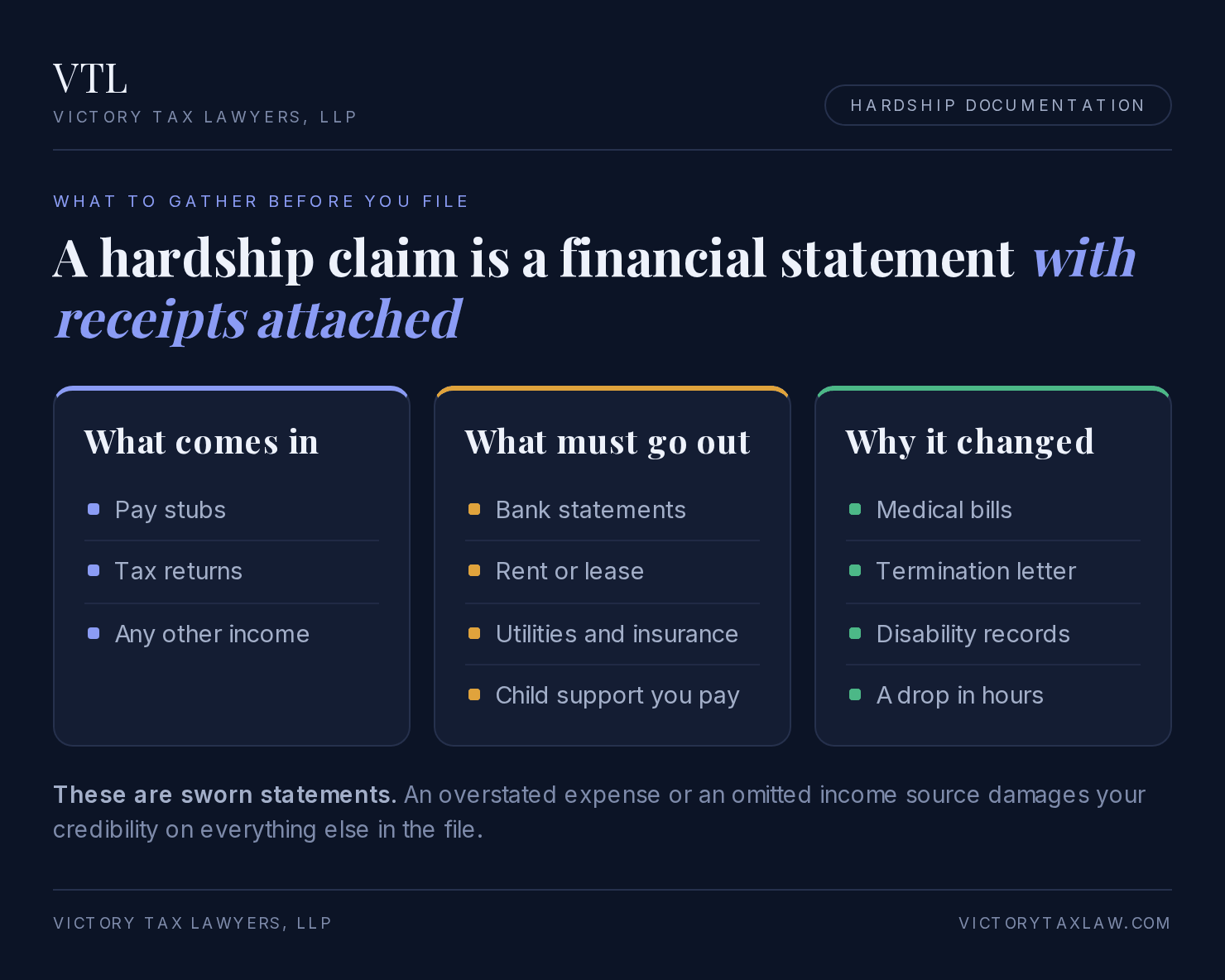
Proof of what comes in and proof of what must go out. A hardship claim is a financial statement with receipts attached, and applications fail more often for missing documentation than for weak facts. Gather income first. Recent pay stubs for everyone in the household, the most recent tax returns, and documentation of any other income, including benefits. Then gather expenses. Bank statements, rent receipts or a lease, utility bills, insurance, transportation costs, and any court-ordered child support you pay.
Hardship-specific evidence is what separates a granted claim from a denied one. Medical bills, a termination letter, disability documentation, or records of a recent drop in hours all show why your finances changed. Accuracy matters more than sympathy. These are sworn financial statements, and an overstated expense or an omitted income source damages credibility on everything else in the file. When you black out account numbers on documents, as California courts advise, leave the balances and dates visible.
How Do You File a Claim of Exemption in California?

Seven steps carry a court judgment garnishment from active to reduced or stopped. The California process is well defined, and each step has its own paperwork, so work through them in order rather than calling the court clerk and hoping. For the exemption amounts themselves, which earnings the state protects and how the figures are calculated, see our guide to the California wage garnishment exemption.
Step 1 - Find your Levying Officer.
Your employer cannot fire you over a single wage garnishment, so filing does not put your job at risk. Look at the upper right corner of the Earnings Withholding Order, form WG-002. The levying officer named there is usually a sheriff, and it may not be the sheriff in your county.
Step 2 - Fill Out the Forms.
You need the Claim of Exemption, form WG-006, and the Financial Statement, form WG-007. Complete both fully, because an incomplete financial statement is the most common reason a claim stalls.
Step 3 - Copy and File.
Make two copies of the completed forms. Take or mail the original and one copy to the levying officer, and keep one copy. The sheriff keeps the original and sends a copy to the debt collector.
Step 4 - Wait Out the Opposition Window.
The debt collector has 10 days to respond. If the other side does not respond, your claim is granted, and the sheriff directs your employer to stop or reduce the garnishment and return money garnished after you filed.
Step 5 - Read the Opposition if It Comes.
If the creditor opposes, you receive a Notice of Opposition to Claim of Exemption, form WG-009, and a Notice of Hearing, form WG-010. The notice of hearing includes the date, time, and place of the court hearing.
Step 6 - File a Reply
You can reply using a Declaration, form MC-030, attaching pay stubs and bills as evidence. File your reply at least five court days before the hearing, and serve a copy on the debt collector.
Step 7 - Go to the Hearing.
Ask the court clerk whether your court uses tentative rulings, because in some courts the hearing is canceled unless you call to keep it. At the hearing, the burden is yours. Show the judge, with evidence, that you cannot pay for your family's basic needs if the money is taken.
It is advisable to note what continues in the meantime. Your wages may keep being garnished while you wait, and you get that money back only if you win. That is the strongest argument for filing the day you understand the problem, not the week after.
How Do You Apply for Hardship Relief From the IRS?

You call the number on the levy, state that it is causing hardship, and back it with financial information. There is no court form and no filing fee, and the standard is stronger than most people realize. The IRS states plainly that if a levy on your wages is creating an immediate economic hardship, the levy must be released. A levy on a bank account in the same situation may be released. Our page on the IRS hardship program covers what the agency looks at when it decides you cannot pay.
That difference between must and may is why wage levy hardship claims move faster than bank levy claims, and why speed matters more on the bank side. Economic hardship in this context means the IRS has determined the levy prevents you from meeting basic, reasonable living expenses. The agency will want financial information about your financial situation to make that determination.
Before you call, document your income, expenses, assets, and dependents, along with the fax number for the employer or bank processing the levy. It is important to understand what a release does and does not do. A levy release does not cancel the balance. The IRS will expect a resolution behind it, whether that is an installment agreement, currently not collectible status, or an offer in compromise if you qualify.
In our experience, if penalties inflated the balance, a penalty abatement request is worth filing alongside it. The IRS Data Book for fiscal year 2025 records 339,137 notices of levy requested on third parties that year, up from 313,792 the year before. The same report shows 3,160,047 new installment agreements, which is the resolution most of those cases eventually reach.
State tax garnishment follows its own path. The FTB issues an earnings withholding order for taxes, and only the FTB can adjust or modify how much your employer withholds. Hardship requests go directly to the agency rather than a court, and our California tax attorney team handles those alongside the federal side.
Can You Apply for Garnishment Hardship Online?
Partly, and it depends again on who is garnishing. No system handles the entire application online. California has a free guided online tool for the Claim of Exemption and Financial Statement. You still print the completed forms and deliver them to the levying officer by mail or in person. The convenience is in the drafting, not the filing.
For state tax garnishments, MyFTB lets you check balances, verify the status of a withholding order, and request a modification. For the IRS, hardship relief runs through a phone conversation and document submission rather than a web portal, which is why having everything assembled before you call is so valuable.
Traditional methods still carry advantages worth weighing. Filing in person produces a stamped copy and a date you can prove, and mail creates a paper trail. Whichever route you choose, keep proof of what you filed and when, because a disputed filing date can cost you the money garnished in between.
How Do You Write a Hardship Letter That Works?

In our experience, a strong hardship letter states monthly income, states monthly necessary expenses, shows the shortfall the garnishment creates, and attaches the documents proving both. Keep it short and specific. Name the debt, the garnishment order, and the amount being taken each pay period. Then show what that leaves and what it fails to cover, in dollars. A reader deciding dozens of these needs to reach your bottom line quickly.
Be honest about everything, including income you might prefer not to mention. These statements are made under penalty of perjury, and a single omission a creditor can find turns your credibility into the issue. Explain any unusual expense rather than hiding it.
Finally, we advise that you close with what you are asking for. A full stop to the garnishment, a reduction to a stated amount, or a payment plan you can sustain are all legitimate requests. Naming one makes it easier to grant. In our experience, a claim that proposes a workable number gets a better reception than one that simply asks for relief.
How Do You Follow Up and Speed Up Approval?
Track the other side's deadlines and hold them to them. Most delay comes from paperwork sitting in an inbox, not from a decision being weighed. For a California claim of exemption, calendar the 10-day opposition window and contact the levying officer after it closes if you have heard nothing.
For an IRS hardship request, call back within a week if the levy release has not reached your employer, and confirm payroll actually received it. A release that exists only in the agency's system does not stop withholding.
Communicate with the creditor or agency directly and in writing where you can. Open communication resolves more of these than escalation does, and a creditor that believes it will collect steadily through a payment plan often prefers that to a contested hearing. That is a negotiation you can conduct in good faith while the claim is pending.
If your application is denied, you are not finished. You can request a hearing where one is available, or correct the deficiency and refile with better documentation. You can also challenge the amount through a different remedy, such as a negotiated settlement or a motion to pay the judgment in installments. Remember also that a Claim of Exemption may be temporary, and a change in your circumstances can require you to file again.
Bankruptcy sits at the far end of the range as a separate remedy with its own consequences, and it stops most garnishments on filing. It is not a step to take on a blog's advice. Talk it through with counsel who can compare it against the alternatives for your specific facts.
Ready to Get the Garnishment Off Your Paycheck?

This guide separates private judgment garnishments from IRS levies and California FTB withholding orders, then explains the documents, deadlines, evidence, and follow-up steps that apply to each. Our approach focuses first on identifying the garnishing authority, then calculating the actual financial shortfall, documenting necessary expenses, and selecting a remedy that addresses both the immediate withholding and the underlying debt.
With over $100 million saved for clients since 2017, Victory Tax Lawyers, a Los Angeles-based tax firm, delivers experienced legal help you can count on to get real tax solutions. Get the honest, effective tax assistance you deserve. Contact us for a free consultation today!
Frequently Asked Questions
Below are answers to some of the questions we hear most often from people trying to stop a garnishment.
What Is Garnishment Hardship?
Garnishment hardship means the amount being taken leaves you unable to cover basic living expenses such as housing, food, utilities, and medical care. Every garnishing authority recognizes some version of this claim, though each uses its own process.
How Do I Prove Hardship for a Garnishment?
Provide documented income and documented necessary expenses that show the shortfall, using pay stubs, bank statements, rent receipts, and utility bills. Add evidence of what changed, such as medical costs or a reduction in hours.
Can I Apply for Garnishment Hardship Online?
You can prepare California claim of exemption forms with a free online tool, but you still print and deliver them to the levying officer. You can start state tax hardship requests in MyFTB, while IRS levy hardship runs by phone with documents.
How Can I Apply for Garnishment Hardship With Victory Tax Lawyers?
Contact our office by phone or through the contact form and describe who is garnishing you and what you received. We will identify the applicable process and what documentation your claim needs.
What Documents Will I Need to Provide?
Proof of income including pay stubs and tax returns, plus bank statements and bills showing necessary expenses. Include anything supporting the hardship itself, such as medical bills or a termination letter.
How Long Does a Garnishment Hardship Application Take?
An unopposed California claim of exemption can resolve in roughly 10 days once the creditor's response window passes. Timelines vary with the agency involved and how quickly complete documentation is provided.
Legal Disclaimer: This article is for informational purposes only and does not constitute legal or tax advice. Reading it or contacting Victory Tax Lawyers does not create an attorney-client relationship. Procedures and deadlines vary by state, by agency, and by the type of debt involved, and outcomes depend on the specific facts of each matter. Past results do not guarantee future outcomes.