No law limits how many years of back tax returns you can file, so you can generally submit unfiled tax returns no matter how old they are. However, the IRS often requires the last six years of returns to bring most taxpayers into filing compliance, although it may request additional years in certain situations. Filing sooner can stop additional penalties from growing, preserve refund opportunities for eligible years, and help prevent IRS collection actions such as levies on your bank account. If you’re behind on several years, start with the years the IRS has asked for and any year that is still inside the three-year refund window.
At Victory Tax Lawyers, we help taxpayers nationwide resolve IRS disputes and tax debt matters. Our attorneys bring more than 10 years of experience handling tax controversy, resolution, and litigation matters, have secured over $100 million in tax relief for clients, and have assisted more than 10,000 taxpayers across all 50 states. Our results include reducing a $1 million tax liability to $16,194 through an Offer in Compromise and converting six-figure tax debts into affordable monthly payment plans as low as $25 per month. If you are facing IRS issues, contact us today for a free consultation.
In this post, we’ll walk you through the process of filing for back taxes, including the timelines for filing, how to determine what you owe, and how to correctly file your past-due tax returns.
What Are Back Taxes?
Back taxes are simply taxes that were either not fully paid or completely unpaid in the year they were due. In essence, if taxpayers cannot pay their taxes for a year, they end up owing back taxes. People often end up owing back taxes for different reasons. Some of the most common reasons include filing a return without paying the full amount, underreporting income, especially when they earn from multiple sources, or making errors when claiming deductions or credits.
Regardless of the reason, those unpaid taxes accumulate and end up becoming what the IRS calls back taxes. A key concern when it comes to back taxes is that if you ignore them for long, they begin to rack up interest and penalties, leaving you with a much bigger tax bill to deal with. And that’s not all. The IRS takes unpaid taxes seriously and has a range of legal tools to recover what’s owed. That means you may also face collection actions, or, in severe cases, criminal charges.
What Are the IRS Rules on How Many Years You Can File Back Taxes?
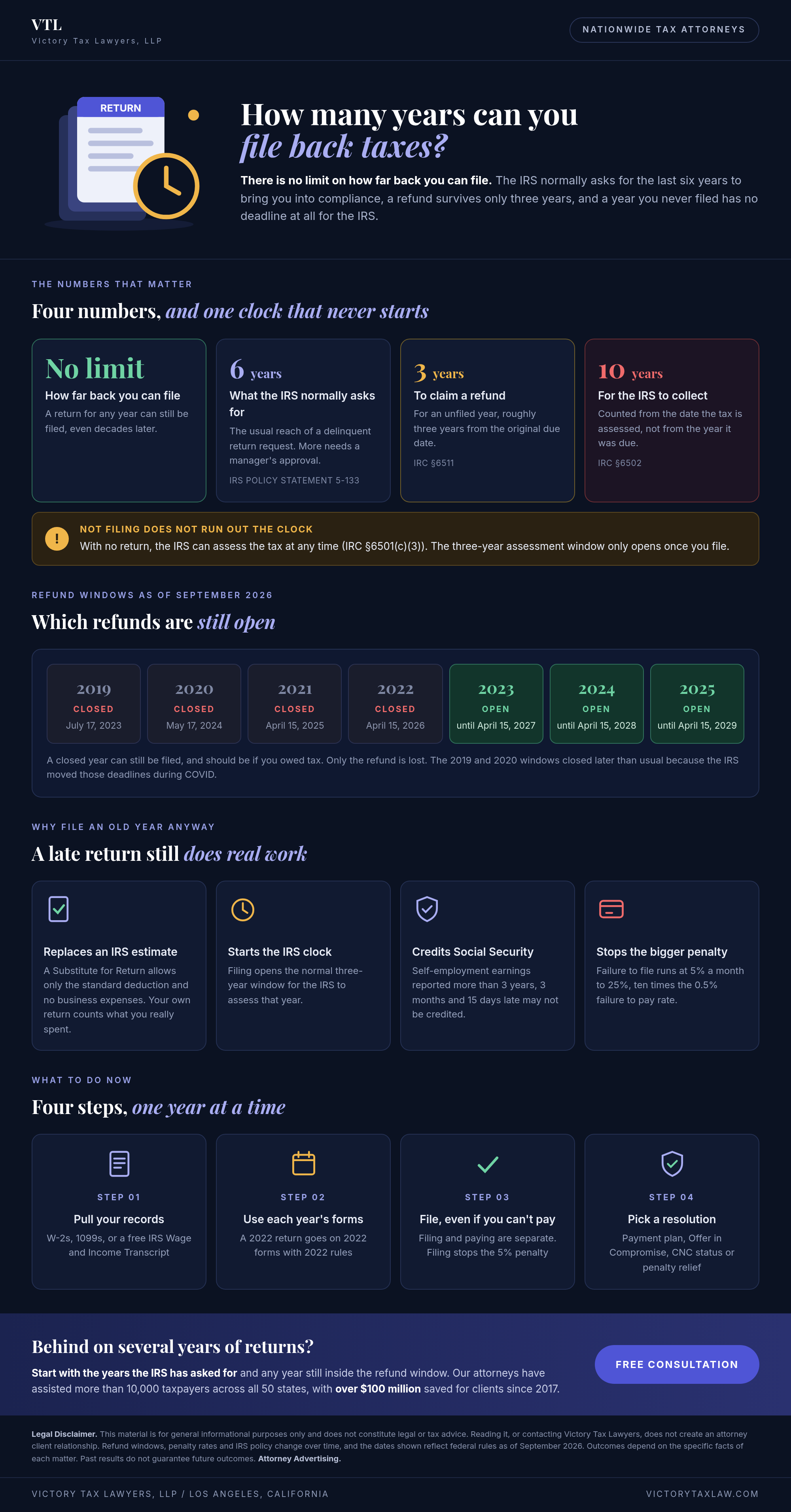
There is no legal limit on how far back you can file a prior year tax return. You can file tax returns for tax years that are decades old if necessary. The key question is not how old the return is, but whether you are meeting IRS filing requirements and whether you can still claim a refund or receive credits.
To become compliant, the IRS generally expects most non-filers to submit the last six years of returns. This policy comes from IRS Policy Statement 5-133, which states that delinquent filing enforcement normally covers the six most recent years. The IRS can require additional years based on factors such as repeated noncompliance, significant unpaid tax, or income from illegal sources. Expanding the six-year window requires managerial approval, making six years the practical standard for most taxpayers.
Filing an older return can still be worthwhile even when no refund is possible. It replaces any Substitute for Return the IRS has prepared with your real income and deductions, it starts the three-year assessment clock for that year, it gets self-employment earnings onto your Social Security record, and it stops the failure-to-file penalty from growing on any tax you owe.
Refunds, however, are subject to strict deadlines. Under IRC §6511, a refund claim generally must be made within three years of filing the return or two years of paying the tax, whichever is later, and for a year you never filed, that works out to roughly three years from the original due date. The same limit applies to refundable credits such as the Earned Income Tax Credit. After that deadline, any refund is forfeited, even if the IRS owes you money.
If you never file, the rules work differently. Under IRC §6501(c), the IRS assesses tax without a statute of limitations for unfiled returns or fraudulent returns. The normal three-year assessment period begins only after a valid return is filed, meaning the IRS can pursue an unfiled tax year indefinitely until you submit the required return. This is why filing overdue returns is usually the first step toward resolving back tax issues.
| Tax year | Can you still claim a refund? (as of September 2026) | Refund deadline |
|---|---|---|
| 2025 | Yes | April 15, 2029 |
| 2024 | Yes | April 15, 2028 |
| 2023 | Yes | April 15, 2027 |
| 2022 | No | Closed April 15, 2026 |
| 2021 | No | Closed April 15, 2025 |
| 2020 | No | Closed May 17, 2024 |
| 2019 | No | Closed July 17, 2023 |
The refund deadline is the only thing in this table that changes with the year. For every year, penalties can apply if tax was owed, and while a return stays unfiled there is no time limit on assessing the tax. Once the IRS assesses it, the 10-year Collection Statute Expiration Date (CSED) starts to run. Our guide to how long the IRS can collect back taxes explains how that period can be paused or extended.
“Many taxpayers believe that waiting long enough will make old tax problems disappear,” says Parham Khorsandi of Victory Tax Lawyers. “In reality, unfiled returns can leave the IRS with unlimited time to pursue collection because the normal assessment period generally does not begin until a valid return is filed.”
How Filing Years of Back Taxes Can Change the Outcome
Every back tax situation is different, but the biggest mistake taxpayers make is assuming that old tax problems become impossible to fix. In practice, many taxpayers can still regain compliance by filing missing returns and choosing the right IRS resolution strategy.
For example, one Victory Tax Lawyers client faced a tax liability of more than $1 million after years of unresolved tax issues. Instead of allowing the balance to continue growing through penalties and interest, our team reviewed the client’s financial situation, prepared a resolution strategy, and successfully reduced the liability to $16,194 through an Offer in Compromise.
In another case, a taxpayer with six figures of tax debt was unable to pay the full balance immediately. After reviewing income, expenses, and financial hardship factors, we helped convert the IRS debt into an affordable monthly payment arrangement. These cases show why filing back taxes is only the first step. The right solution depends on factors such as the amount owed, your income, assets, filing history, and whether the IRS has already started collection activity.
How Can You Find Out How Much Back Taxes You Owe?
There are several ways to determine how much back taxes you owe and understand your current IRS balance. Start by creating or logging into your IRS online account, where you can view your unpaid tax balance, accrued penalties and interest, payment history, and other account details from recent years.

You can also request your tax records from the IRS by submitting Form 4506-T, Request for Transcript of Tax Return. A tax transcript provides important information about your tax account, including previously filed returns, reported income, and account activity, and you can request it online or by mail.
If you need additional help, you can contact the IRS directly by phone to ask about your outstanding balance. Be prepared to verify your identity by providing information such as your Social Security number, taxpayer identification number, and current mailing address. Reviewing any IRS notices or letters you have received can also provide details about unpaid balances, penalties, and required next steps.
If you have unfiled tax returns, you can generally file back taxes for the last six years to become current with IRS filing requirements. Filing these back tax returns allows you to accurately determine what you owe and may help you claim any eligible deductions or tax credits that were missed.
If your tax situation involves multiple years, significant debt, or IRS collection actions, a tax professional can help gather the necessary records, communicate with the IRS, and guide you through the process of resolving your back taxes.
The Victory Tax Lawyers 4-Step Back Tax Resolution Process
When taxpayers come to us with years of unfiled returns, we typically follow a four-step process to identify the problem, stop further damage, and build a path toward resolution.
Step 1: Identify Every Missing Filing Requirement
We begin by reviewing IRS transcripts, income records, prior notices, and available financial documents to determine which tax years are missing and what information the IRS already has.
Step 2: Reconstruct Accurate Tax Returns
Next, we prepare accurate prior-year returns using available records, including wage transcripts, income documents, deductions, and credits. Filing accurate returns is important because IRS-prepared Substitute for Returns often exclude deductions and increase the amount owed.
Step 3: Analyze the Best IRS Resolution Option
Once filing compliance is restored, we evaluate whether the taxpayer may benefit from an installment agreement, Offer in Compromise, penalty abatement, or Currently Not Collectible status.
Step 4: Resolve the IRS Issue and Prevent Future Problems
The goal is not just filing old returns. We help taxpayers create a long-term plan to remain compliant and avoid returning to the same tax problems.
How Do You File Back Taxes, and What Deadlines Matter?
Each year’s return has its own original due date, and every other deadline is measured from it. The federal filing deadline is generally April 15. When the 15th lands on a weekend or a holiday, it shifts to the next business day. Your 2025 return was due April 15, 2026. Your 2026 return will be due April 15, 2027. That due date matters because it’s the starting line for penalties.
Any tax you owed for a given year was due on that year’s original deadline, and the late filing penalty and interest begin accruing from that point, not from the day you eventually get around to filing. The longer a balance sits, the more it grows. Filing prior-year returns promptly is the single biggest lever you have to stop that accrual. To actually file prior-year taxes, work through these steps. Start by pulling the records for each year you missed, then file on the correct forms.
Step 1: Gather information for every unfiled year.
This should include W-2s, 1099s, and other income records. If you can’t find them, request a free IRS Wage and Income Transcript, which shows what employers and payers reported to the IRS for that year.
Step 2: Use each year’s own forms.
A 2022 return goes on 2022 forms with 2022 rules; you can’t file an old year on the current year’s form. A tax preparer or tax software that supports prior-year returns handles this correctly.
Step 3: File each year separately, and file even if you can’t pay the full balance.
Filing and paying are two different obligations, and getting the return in stops the larger failure-to-file penalty from running.
If several years are involved, or a large balance is likely, a tax preparer or a tax attorney can keep the sequencing straight and deal with the IRS on your behalf.
Can You Still Get an IRS Tax Refund When Filing Back Taxes?
Sometimes filing a back return puts money in your pocket, and sometimes it doesn’t. The dividing line is the three-year refund deadline in IRC §6511. You generally have three years from a return’s original due date to claim an IRS tax refund. Miss it, and the refund is gone, even if the IRS clearly owed you.
Filing after that three-year window still has value. It doesn’t produce a refund, but it stops the failure-to-file penalty, caps the damage on any balance you owe, starts the assessment clock, and brings you back into compliance. Getting current is worth doing regardless of whether a check is coming.
Apply the three-year rule to the current calendar and the picture is clear. As of September 2026, refunds for tax year 2022 and earlier are gone, and tax years 2023, 2024 and 2025 are still open. The 2019 and 2020 windows closed later than usual because the IRS moved those filing deadlines during COVID.
A quick scenario makes it concrete. If you were owed a refund on your 2019 return, that money is now forfeited to the Treasury, though you should still file if you actually owed tax that year. If you’re owed a 2024 refund, you still have time to file and collect it. Two different years, two very different outcomes, driven entirely by the calendar.
What Are Your Payment Options for Paying Back Taxes?
If you cannot pay your back taxes all at once, the IRS offers several options to make the balance manageable:

1. Payment Plan
An IRS payment plan, also known as an installment agreement, is an arrangement with the IRS that allows you to settle your outstanding tax debt gradually through more manageable monthly payments. This can prove particularly helpful if you cannot afford to pay your tax debt at once. You can apply and set up your payment plan using the IRS’s Online Payment Agreement tool, but you generally need to have filed all required returns first.
The IRS offers both a short-term and long-term payment plan. With a short-term payment plan, you are given an extra 180 days to pay your tax debt in full. The long-term plan is better suited for taxpayers who need more time to make payments. The duration and terms you’re given are often based on what you owe and your ability to pay. To be sure you get the best terms and avoid mistakes, be sure to consult with a professional for guidance.
2. Offer in Compromise (OIC)
Taxpayers can also apply for an Offer in Compromise (OIC). With an OIC, the IRS allows you to settle your tax debt for less than the full amount of taxes owed. The IRS is quite rigid in its eligibility requirements for an OIC. They evaluate several things when considering whether or not to approve an offer.
There are three possible grounds for acceptance: doubt as to liability, doubt as to collectibility, and effective tax administration. Most offers rest on doubt as to collectibility, where the IRS works out your reasonable collection potential from your income, expenses, assets and equity. If that figure would pay the debt in full, the offer is usually rejected.
You must also be current with all filing and payment requirements, including estimated taxes, and not be in an open bankruptcy proceeding. The bottom line is that the agency will only approve your offer when it’s unlikely that they’d be able to collect your tax debt in full, and your offer represents the most they could reasonably expect to collect.
If all of this feels a bit overwhelming, it’s easy to see why not many people end up qualifying after applying. This is why we never recommend applying for an OIC without the help of a tax lawyer.
3. Request a Currently Not Collectible Status
If you’re facing economic hardship and are unable to keep up with your taxes and basic living expenses, you might be eligible to request what’s called Currently Not Collectible (CNC) status. What this does is pause the agency’s collection efforts temporarily because doing so would create more financial strain.
Bear in mind that your CNC status doesn’t automatically erase your tax debt; it only pauses the IRS’s efforts at collection. While your account is in CNC status, the IRS generally stops levies and wage garnishments, although it may still file a federal tax lien and will keep any future refunds to apply to the debt. The IRS will review your financial situation regularly, and once things improve, it may resume collection efforts, so it’s not a permanent fix. It also does nothing to stop penalties and interest, which keep accruing.
4. Penalty Abatement
Penalty abatement won’t erase your back taxes, but it can remove penalties that have made the debt harder to pay off. If you have a reason for not filing, perhaps you were seriously ill, or maybe you encountered unforeseen hardship, you may qualify for penalty abatement. The IRS calls this reasonable cause. There’s also First-Time Penalty Abatement, which is available if you had no penalties in the three prior years. With several unfiled years, it usually helps with only the earliest one, so reasonable cause matters more for the rest.
That said, successfully getting those penalties removed is neither straightforward nor guaranteed. It’s a good idea to work with an experienced tax lawyer who can guide you through this process and let you know if you might qualify for this option.
While professional representation can be valuable for taxpayers facing large balances, audits, liens, levies, or complicated filing histories, not every back tax situation requires legal assistance. Some taxpayers with simple missing returns and limited balances may be able to resolve the issue directly with the IRS. However, professional guidance may be beneficial when the amount owed is significant or when choosing between multiple IRS resolution options.
What Happens If You Don’t File Taxes for Several Years?
If you don’t file taxes for several years, the consequences become more expensive and more difficult to resolve the longer you wait. Penalties, interest, and IRS collection actions can all build over time, but filing your past-due returns is usually the first and most important step toward getting back into compliance.
According to the IRS, the failure-to-file penalty is 5% of the unpaid tax for each month or part of a month the return is late, up to 25%. The failure-to-pay penalty is 0.5% per month of the unpaid tax, also capped at 25%. When both apply in the same month, the failure-to-file penalty is reduced so the combined charge is 5% per month rather than 5.5%.
If your return is more than 60 days late, a minimum late-filing penalty may also apply. On top of these penalties, the IRS charges daily interest until the tax is paid in full. For taxpayers who need to file previous years’ taxes, the IRS has increasingly powerful collection tools if returns remain unfiled. After repeated notices, it can prepare a Substitute for Return (SFR) under IRC §6020(b) using income information it already has.
An SFR generally gives you only the standard deduction and a single or married filing separately status, and it leaves out business expenses and credits such as education credits. For self-employed individuals, this can be especially costly because all reported self-employment income may be treated as taxable profit without legitimate deductions, dramatically increasing the tax bill.
Filing your own return allows you to report your actual income and expenses, complete the proper tax forms, and claim every deduction and credit you’re legally entitled to. If you no longer have your tax records, don’t assume you can’t file. You can use Form 4506-T to request tax information from the IRS, including wage and income transcripts that can help you prepare previous years’ returns.
The IRS also allows electronic filing for some recent prior-year returns, while older past-due returns generally must be printed and mailed. Ignoring unfiled returns can eventually lead to IRS collection actions, including federal tax liens, bank levies, wage garnishment, and, in cases involving seriously delinquent tax debt, passport restrictions.
Although willful failure to file can result in criminal charges in rare situations involving tax fraud or deliberate tax evasion, the vast majority of non-filing cases are handled through the IRS’s civil enforcement process. In our experience, most disputes are resolved administratively or in tax court, where the issue is typically how much tax is owed.
Not filing also affects your financial future. Self-employment income only counts toward your Social Security retirement and disability benefits once it is reported on a tax return, and the Social Security Administration may not credit earnings reported more than three years, three months and 15 days after the end of the tax year. Unfiled returns can also create practical problems outside the IRS.
Many mortgage lenders, banks, and other financial institutions require recent tax returns, so loan approvals may be delayed without filed tax returns. The good news is that there’s usually a path forward, even if you’re several years behind. File your missing returns first, then address any balance due.
If you can’t pay everything immediately, the IRS offers payment options such as installment agreements, Offers in Compromise for qualifying taxpayers, and Currently Not Collectible status for those experiencing financial hardship. The sooner you file, the more opportunities you’ll have to reduce penalties, preserve your tax credits, and regain control of your tax situation.
What Are the Best Ways to Avoid Back Taxes?
To avoid back taxes and stay in good standing with the IRS, make tax compliance a year-round habit rather than something you only think about during filing season. Filing your federal income tax return on time is one of the most important steps you can take. Even if you cannot pay the full amount owed, submit your return by the deadline and pay as much as possible. If necessary, set up an IRS payment plan to manage the remaining balance and reduce additional penalties and interest.

Keeping accurate records of your income, expenses, deductions, and tax credits throughout the year also helps prevent costly mistakes. Well-organized financial records make it easier to prepare an accurate return and reduce the risk of underreporting income or overlooking eligible deductions.
It’s equally important to review your tax withholding if you’re an employee or make quarterly estimated tax payments if you’re self-employed or earn significant non-wage income. Paying the right amount throughout the year can help you avoid an unexpected tax bill and potential underpayment penalties.
If your tax situation is more complicated, consider working with a tax professional, such as a tax attorney or CPA. Professional guidance can help you stay compliant, maximize available tax benefits, and avoid errors that could lead to back taxes. Using reputable tax preparation software is another effective way to improve accuracy. Most programs identify missing forms, calculation errors, and other common issues before you file, reducing the likelihood of mistakes. You can use prior year tax software to file back taxes.
Since tax laws change regularly, staying informed about new IRS rules and filing requirements is essential. Reviewing annual tax updates can help you meet your obligations and take advantage of any new deductions or credits.
Finally, adjust your tax planning whenever you experience a major life event, such as getting married, having a child, changing jobs, or starting a business. These changes can significantly affect your tax liability, and updating your withholding or estimated payments can help you avoid accumulating back taxes.
Many tax companies focus only on submitting paperwork. Our approach is different. We combine tax controversy experience, legal representation, and IRS negotiation strategies to address both the immediate filing problem and the underlying tax liability. Our team focuses on understanding why the tax debt occurred, identifying available relief options, and communicating directly with the IRS when appropriate.
Behind on Years of Tax Returns?
Every month a return sits unfiled, the math works against you: penalties grow, interest runs, refund windows close, and Social Security credits go unearned. Filing sooner limits the late filing penalty, protects any refund still on the table, and gets the IRS assessment clock started so a resolution becomes possible.
With over $100 million saved for clients since 2017, Victory Tax Lawyers, a Los Angeles-based tax firm, delivers experienced legal help you can count on to get real tax solutions. Get the honest, effective tax assistance you deserve. Contact us for a free consultation today!
Frequently Asked Questions
Can I Still File Taxes From 10 Years Ago?
Yes. There’s no cutoff on filing an old return, so you can file one from ten years back. Any refund for a year that old is forfeited, though, since it’s well past the three-year window, and for compliance the IRS generally focuses on the last six years under Policy Statement 5-133.
What Happens if You Don’t File Taxes for 5 Years?
Penalties and interest keep stacking on any year you owed tax, and the IRS may file Substitute for Returns without your deductions and move toward collection. Filing all five years is the fastest way to stop the failure-to-file penalty and get back into good standing. The last six years generally cover what the IRS wants.
What Is the Oldest Tax Return I Can File?
There’s no age limit on filing a return. As a practical matter, the IRS concentrates on the six most recent years for compliance, and older years still carry any tax you owed. What you lose on very old years is the refund, which disappears once the three-year claim window passes.
Can I Still File My 2019 Taxes and Get a Refund?
As of 2026, no refund is available for 2019. The 2019 refund window closed on July 17, 2023, so any overpayment is now the Treasury’s. You can and should still file the 2019 return if you owed tax that year, since the balance and its penalties don’t go away.
How Many Years Can You File Back Taxes and Get a Refund?
Generally, the last three years, measured from each return’s original due date under IRC §6511. As of 2026, that means tax years 2023, 2024, and 2025 are still refundable; 2022 and earlier have generally closed.
Can I File Several Years of Back Taxes at Once?
Yes. Each year needs its own return on that year’s forms, and the IRS processes each one separately, but you can prepare and send several years at the same time. If you received an IRS notice, send the returns to the address shown on the notice. Recent years can often be filed electronically, while older years generally have to be mailed.
Is There a Statute of Limitations on Back Taxes?
There are two, and the first one never starts if you don’t file. The IRS generally has three years after a return is filed to assess the tax, but when no return is filed there is no time limit at all under IRC §6501(c)(3). Once the tax is assessed, whether from your own return or from an IRS Substitute for Return, the IRS generally has 10 years to collect it under IRC §6502.
Legal Disclaimer: This article is general information only and is not legal or tax advice. Reading it does not create an attorney-client relationship. IRS rules, penalty amounts, filing deadlines, and refund windows change over time and depend on your specific facts and the tax year involved. The refund-window dates described here are current as of 2026 and shift each year. Verify current rules at IRS.gov and consult a licensed tax professional or attorney about your situation before acting.