If you owe the California Franchise Tax Board, an unpaid tax liability can lead to collection action, involuntary actions, and other consequences. At Victory Tax Lawyers, our tax professionals help taxpayers facing an outstanding balance, delinquent debt, or financial hardship understand their payment options, including monthly payments and other solutions. Let us help you determine the best way to address your FTB debt and work toward a manageable resolution.
Contact us today and let us help with your tax liability.
Am I the Only One Who Owes the FTB?
No, and not by a wide margin. According to the Franchise Tax Board’s own reporting, it collected $6.1 billion in the 2024-25 fiscal year, and $4.73 billion of that came from individual taxpayers rather than businesses. The FTB’s collections program handles more than two million accounts a year. That matters for one practical reason. The FTB has standard, published procedures for people who cannot pay in full, and using them is routine, not exceptional.
What Do FTB Collection Notices Mean?

In our experience, FTB collection notices generally escalate in a predictable order. A Statement of Tax Due requests payment of an outstanding balance, while a Final Notice Before Levy warns that the FTB may take collection action. A Notice of State Tax Lien means a lien has been recorded against your property. An Earnings Withholding Order directs your employer to withhold wages, while an Order to Withhold directs your bank or another third party to turn over funds.
Unlike an ordinary creditor pursuing court-ordered debt, the FTB generally does not need to sue you first. It can take administrative collection actions, including wage withholding and bank levies, without obtaining a court judgment. If you dispute the claim or cannot pay the full amount by the due date, reviewing the notice and supporting documentation promptly can help you determine what options may be available.
What Happens If You Ignore an FTB Notice?
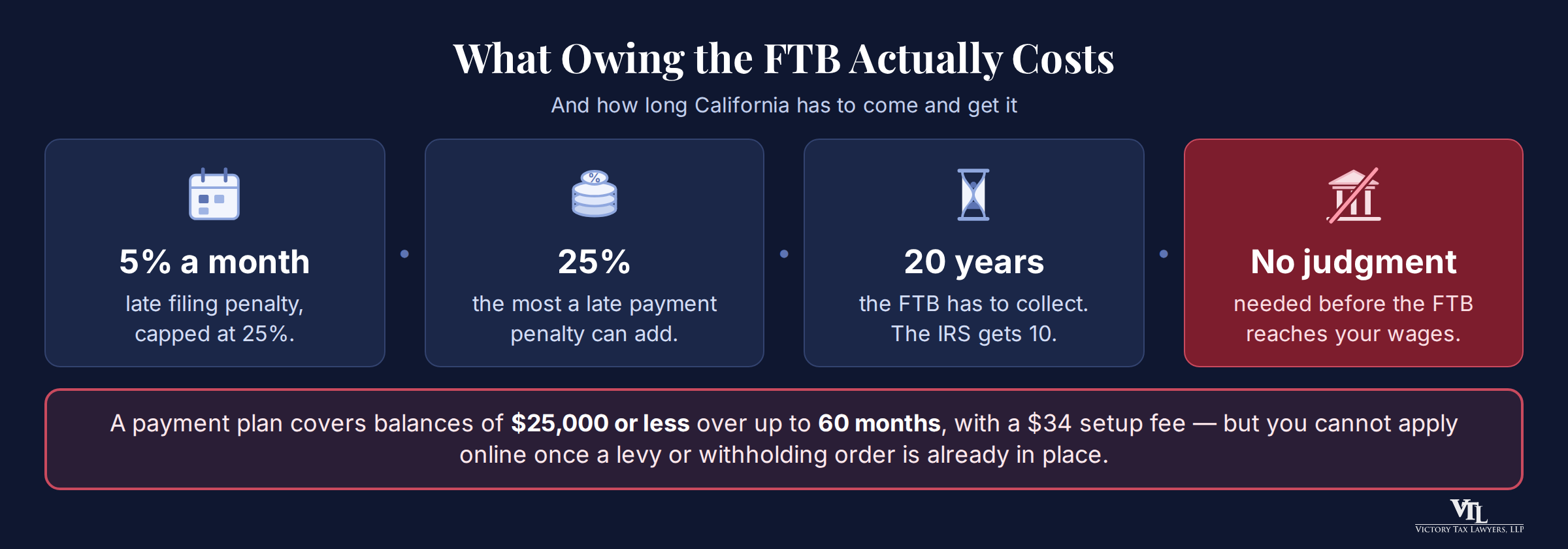
Penalties and interest are the first cost, and they compound. The late filing penalty runs at 5% of the tax due per month, capped at 25%. If you file late and the balance is $540 or less, the minimum penalty is $135 or 100% of the tax due, whichever is smaller. Late payment penalties can also reach 25%. Interest accrues throughout, and enforcement follows. The FTB can:
- File a state tax lien against your property, recorded automatically on non-payment
- Order your employer to withhold up to 25% of your pay until the balance is cleared
- Levy your bank account without a court judgment
- Intercept your state and federal tax refunds
- Suspend a professional or occupational license for non-payment
For a tax debt, an earnings withholding order takes up to 25% of your pay, and it stays in place until the balance is cleared. Disposable earnings means what is left after legally required deductions, not your gross pay. You may come across a lower limit worked out from the minimum wage. That one covers the non-tax debts the FTB also collects, such as vehicle registration and court-ordered debt, and it does not apply to tax.
One thing that will not happen is damage to your credit score. Since April 2018, the three major credit bureaus have not included tax liens on consumer credit reports. A state tax lien is still a public record a lender may find, but the widely repeated warning about credit score damage is outdated.
The longer-term problem is the clock. California allows the FTB twenty years to collect, running from the date the liability becomes due and payable under section 19221, against ten years for the IRS, which runs from assessment. Certain events pause that clock, and a new liability can reset it. Waiting out an FTB balance is not a strategy.
Why Do People End Up Owing the FTB?
Most balances trace to a handful of causes. They include:
- Underreported income, often from contract work, investment income, or a form the FTB received that did not appear on the return
- Filing errors, including math mistakes, missed credits, or wrong filing status
- Underpaid estimated tax during the year, common for the self-employed
- A federal adjustment flowing through, since the FTB receives IRS audit results and acts on them
- Unfiled returns, where the FTB estimates the tax itself and assesses on that basis
The last one produces the largest balances. An FTB estimate is not a calculation of what you actually owe; it is a figure built from third-party data without any deductions in your favor. Filing the real return frequently reduces it substantially.
How Do You Pay the Franchise Tax Board?

Paying online is fastest. A MyFTB account lets you pay by bank account transfer with no fee. Credit card payments go through the FTB’s processor and include a service fee, and Web Pay lets you schedule payments. Payments post faster than mailed ones and generate immediate confirmation.
By mail, send a check or money order with the payment voucher from your notice, and write your Social Security number and the tax year on the payment. Keep proof of mailing. For phone questions, the FTB takes personal income tax collection calls on 800-689-4776 and business collection calls on 888-635-0494. From outside the United States, personal income tax collections is 916-845-4470; business collections uses a different number for each entity type. Lines are open weekdays and are busiest early in the week.
Can You Set Up a Payment Plan With the FTB?
Often, yes, and the criteria are published rather than discretionary. For personal income tax, you may be eligible for an FTB installment agreement if:
- The balance is $25,000 or less
- You can pay it within 60 months
- You have filed all income tax returns for the past five years
A $34 setup fee is added to your balance, and processing can take up to 90 days. You cannot apply online if you already have an installment agreement, a wage garnishment, a bank levy, or another collection order in place. That is one more reason to act before enforcement starts.
For amounts above $25,000, or when you need more than 60 months, the FTB requires a financial statement and reviews the case individually. That is where the case is won or lost, because the outcome turns on how income and necessary living expenses are presented.
| Option | Best for | What to know |
|---|---|---|
| Pay in full | Balances you can clear now | Stops further penalties immediately |
| Installment agreement | Balances of $25,000 or less payable in 60 months | $34 setup fee; requires five years of filed returns |
| Financial-statement agreement | Larger balances or longer terms | Individual review; presentation of expenses matters |
| Offer in compromise | Where full payment is not realistic, and criteria are met | The FTB may accept less than the full balance; it requires full financial disclosure and is not available to everyone |
| Hardship status | Where paying anything prevents meeting basic living expenses | Pauses collection without erasing the debt; interest continues |
How Does Victory Tax Lawyers, LLP Help With FTB Debt?

We start by confirming what you actually owe, which is not always what the notice says. That review also establishes where you sit in the collection sequence and which deadlines apply. From there, we identify which resolution route fits your finances. That may be an installment agreement, an offer in compromise, hardship status, or filing missing returns to reduce an estimated assessment. Under a power of attorney, we then deal directly with FTB representatives. Where enforcement has already begun, we pursue release of the levy or withholding order.
“The FTB is more aggressive on collection than most people expect, and it does not need a judgment to reach your paycheck,” says Parham Khorsandi, Esq., Managing Attorney at Victory Tax Lawyers, LLP. “The single biggest difference between a manageable outcome and a bad one is whether the taxpayer calls before the withholding order goes to their employer or after. Once it is in place, you are negotiating from a worse position.”
If the IRS is involved, both matters must be handled together, since a federal resolution does not settle the state balance. Our California tax attorney page covers combined IRS and FTB representation, and our offer in compromise page explains how we assess settlement eligibility.
Ready to Resolve Your FTB Debt?
The best time to address an FTB balance is before enforcement action begins. If you owe the Franchise Tax Board, addressing the balance early may help you avoid additional penalties, interest, or collection measures. A new tax liability can also complicate an existing payment arrangement, while a suspended business may face separate consequences. The FTB website provides general information about available options, but every person’s circumstances are different.
Reach Out to Victory Tax Lawyers to Understand Your Options.
Frequently Asked Questions
These are the questions California taxpayers ask most often about FTB debt. We did our best to answer them.
How Do I Know If I Owe the California Franchise Tax Board?
Log into your MyFTB account, which shows your balance by tax year along with any notices the FTB has sent. If you have unfiled returns, the FTB may have assessed an estimated liability that appears there even if you never filed.
What Should I Do If I Owe Money to the FTB?
Confirm the amount is correct before paying, since estimated assessments for unfiled returns are often higher than the actual liability. Then either pay in full, apply for an installment agreement if the balance is $25,000 or less, or seek advice if enforcement has already started.
How Long Does the FTB Have to Collect a Tax Debt?
Twenty years from the date the liability becomes due and payable under section 19221, compared with ten years for the IRS, which runs from assessment. Certain events pause that period, and a new liability can reset it, so an old California balance is rarely as expired as people assume.
Can the FTB Garnish My Wages or Levy My Bank Account?
Yes, and it does not need a court judgment. A bank levy can reach the funds in your account directly. A wage garnishment for a tax debt takes up to 25% of your pay and runs until the balance is cleared.
Can I Settle My FTB Debt for Less Than I Owe?
The FTB operates an offer in compromise program and may accept less than the full balance where you meet its criteria. It requires full financial disclosure; it is not available to everyone, and eligibility depends on your assets, income, and ability to pay.
Legal Disclaimer: The information on this page is provided for general educational purposes and is not legal or tax advice. Franchise Tax Board procedures, penalty rates, interest rates, eligibility thresholds, and collection practices change over time and depend on the specific facts of each matter. The limitation periods and dollar figures described here are general rules subject to exceptions. Reading this page does not create an attorney-client relationship with Victory Tax Lawyers, LLP. For advice about a notice you have received, consult a licensed tax attorney, certified public accountant, or enrolled agent.