
The California Franchise Tax Board is the state agency that administers personal income tax and corporate franchise and income tax for California. It audits California returns, assesses additional tax, and collects what the state says it is owed, on its own timetable and under its own procedures. A Californian carrying an old state balance they assume has expired is frequently wrong about that, and the reason is further down this page.
At Victory Tax Lawyers, we help taxpayers nationwide resolve IRS disputes and tax debt matters. Our attorneys bring more than 10 years of experience handling tax controversy, resolution, and litigation matters, have secured over $100 million in tax relief for clients, and have assisted more than 10,000 taxpayers across all 50 states. Our results include reducing a $1 million tax liability to $16,194 through an Offer in Compromise and converting six-figure tax debts into affordable monthly payment plans as low as $25 per month. If you are facing IRS issues, contact us today for a free consultation.
This blog is for California taxpayers facing tax audits, notices, or collection issues, and explains which agency is involved, what to expect, and what steps to take so you can respond before penalties escalate.
What Does the California Franchise Tax Board Do?
The FTB administers California’s income tax system that covers personal income tax for residents and non-residents. It also covers corporate franchise and income tax under the Corporation Franchise Tax Act, for C corporations and S corporations operating in the state.

According to the California Franchise Tax Board, FTB collected about $162 billion in FY 2023–24, representing approximately 78% of California’s General Fund revenue. During that fiscal year, FTB received more than 23.8 million tax returns, processed more than 9.3 million payments, responded to more than 2.7 million telephone calls, and handled more than 55 million internet contacts.
The residency distinction drives more disputes than any other single issue. California residents are taxed on income from all sources, wherever earned. Non-residents are taxed only on California-source income. People who move away, keep property, or split time between states frequently find the FTB taking a different view of their residency than they did.
The agency is governed by a three-member board that includes the California State Controller. It also handles certain responsibilities beyond ordinary income-tax administration. Those include collecting delinquent vehicle registration debts for the Department of Motor Vehicles and certain court-ordered debts. Special audits can also involve compliance with the Political Reform Act, including financial activity involving candidates, committees, and lobbyists. These programs rarely affect the average person filing an individual income tax return, but they explain why an FTB communication is not necessarily about income tax.
On the service side, the FTB provides online tools that handle most routine matters without a phone call. A MyFTB account gives 24-hour access to your tax information, notices, and payment history. CalFile allows free e-filing of a state return with real-time confirmation. The California Tax Service Center provides guidance spanning several state agencies, and Volunteer Income Tax Assistance offers free tax help to those who qualify. California also administers the California Earned Income Tax Credit and the Young Child Tax Credit, both of which support lower-income households and are claimed on the state return.
How Is the FTB Different From the IRS and Other California Agencies?
Most people assume one tax agency handles everything. California uses three, and sending a dispute to the wrong one wastes time you may not have. The table below sets out who does what.
| Agency | What it administers | What it means for you |
|---|---|---|
| Franchise Tax Board (FTB) | Personal income tax, corporate franchise tax, and corporate income tax | Audits and collects California income taxes; the agency behind most California income tax notices |
| California Department of Tax and Fee Administration (CDTFA) | Sales and use tax, and most excise taxes and fees | Handles sales tax audits and collections; generally unrelated to your personal income tax return |
| Employment Development Department (EDD) | Payroll taxes and worker classification | Audits payroll tax compliance and whether workers were properly classified |
| Internal Revenue Service (IRS) | Federal income tax | Handles federal tax assessments separately, with separate deadlines, notices, and appeal procedures |
A federal and a state matter can run at the same time on the same facts. An IRS adjustment often triggers an FTB adjustment, because California receives federal audit results and can act on them. Resolving one does not resolve the other, and the deadlines do not align.

How Long Does the FTB Have to Audit and Collect?
In our experience, this is the part of California tax law that catches people out. For assessment, the FTB generally has four years from the date a return is filed to issue a Notice of Proposed Assessment. That is one year longer than the IRS. Where a return was never filed, or where fraud is involved, there is no limitation period at all and the FTB can assess at any time.
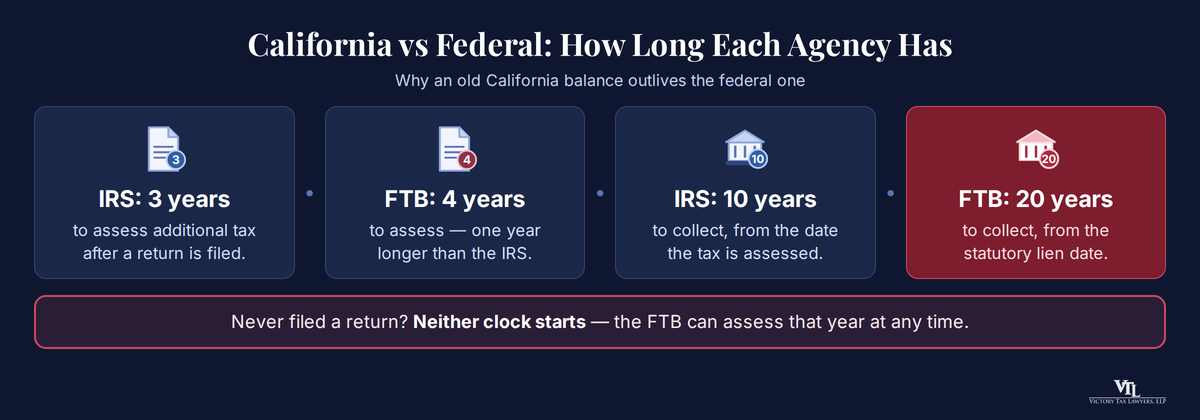
For collection, the difference is much larger. California prohibits the FTB from collecting on a liability more than twenty years after the statutory lien date. The federal collection statute is ten years. A taxpayer who has waited out an IRS balance may still have a decade of exposure on the California one. Old FTB debts resurface in ways old federal debts do not.
The enforcement tools are comparable to the federal ones. The FTB can garnish wages, levy bank accounts, file liens, and intercept payments. If those have started, our page on tax levy representation covers how a levy is released and what grounds apply.
“One of the most avoidable mistakes is treating an FTB notice as something that can be dealt with later,” says Parham Khorsandi of Victory Tax Lawyers. “If it is left unresolved, the matter can progress into an assessment, collection activity, or an appeal with a much narrower deadline.”
What Triggers an FTB Audit?
The FTB audits to verify compliance with California tax law, and its selection is not random. Residency changes are the most common trigger, particularly where someone claims to have left California while retaining a home, family, or business ties here. A federal audit adjustment is another, since the FTB receives IRS results. Large or unusual deductions, significant year-over-year income swings, and apportionment questions for businesses operating in multiple states all draw attention.

Notification arrives by mail. The FTB opens with an information request rather than an accusation, and how that first request is answered shapes everything after it. Vague or incomplete responses invite broader examination. The process runs through document requests, sometimes interviews, and then a determination.
If the FTB proposes an adjustment, it issues a Notice of Proposed Assessment setting out what it believes you owe and why. Our audit representation page explains what representation involves at each stage, and its value is mostly in the early document phase rather than the appeal.
What Does an FTB Residency Dispute Look Like in Practice?
Consider a taxpayer who moves from California to another state but continues to own a California home, keeps a California business interest, and returns regularly to see family. The taxpayer may consider the move permanent, while the FTB may look at the continuing California connections and reach a different conclusion.
That distinction can affect far more than one year’s tax bill. If the FTB determines the taxpayer remained a California resident, income earned outside California may become part of the state’s tax calculation. The practical issue is therefore not simply where the taxpayer says they live, but the complete pattern of their finances, property, business activity, family connections, and time spent in California.
For taxpayers in this position, we recommend preserving evidence of the move before an audit begins, including the new residence, driver’s license, voter registration, employment records, travel history, business records, and the date California ties were actually ended. A clear documentary record can be much more persuasive than a taxpayer’s recollection years later.
How Do You Dispute an FTB Assessment?
In our experience, you have options at three separate stages, and each has its own deadline. The first is protest. When the FTB issues a Notice of Proposed Assessment, you can protest it directly to the FTB within the period stated on the notice. This is the cheapest stage to resolve a disagreement and the one where new documentation has the most effect.
The second is an appeal. If the protest does not resolve it, the FTB issues a Notice of Action, and you can appeal to the Office of Tax Appeals within 30 days of that notice. The OTA is an independent state agency that took over tax appeals from the Board of Equalization, and appeals are decided by a panel of three administrative law judges. You can request an oral hearing.
The third is court. After the administrative routes, a claim for refund and subsequent suit is available, though that generally requires paying the assessment first. Separately from disputing the amount, there are resolution routes when the liability itself is not in question. The FTB operates an installment agreement program, and it accepts offers in compromise where full payment is not realistic and the criteria are met.
What Is the Best Way to Respond to an FTB Notice?
We use a simple four-step approach when reviewing an FTB matter: Identify, Verify, Preserve, Respond. Identify the agency, notice type, tax year, amount at issue, and deadline. An FTB notice should not be treated like an IRS notice because the agencies use different procedures and deadlines.

Verify the numbers against the filed California return, payment records, prior correspondence, and your MyFTB account. If the FTB’s position resulted from an IRS adjustment, compare the federal adjustment with the California treatment rather than assuming the two balances are identical.
Preserve the documents that support your position before responding. This is particularly important in residency, business apportionment, deduction, and payment-credit disputes, where records may become harder to obtain as time passes.
Respond to the correct agency within the applicable deadline. If you agree with the assessment, determine whether payment or a resolution option is appropriate. If you disagree, use the protest or appeal procedure identified in the notice rather than waiting for another collection letter. The objective is to establish what the FTB believes is wrong, determine whether it is actually wrong, and choose the least costly way to resolve the matter before the dispute moves to the next stage.
Should You Handle an FTB Matter Yourself or Hire a Tax Professional?
Not every FTB issue justifies the cost of professional representation. A taxpayer who agrees with a small balance and has complete records may be able to resolve the matter through the FTB’s online services. The same may be true when the agency requests a straightforward document that the taxpayer already has.
Professional assistance becomes more valuable as the financial stakes, factual complexity, or procedural risk increases. Residency disputes can involve multiple connections to California. An assessment may require reviewing tax returns and supporting records. An active levy or lien can require immediate action. An appeal also involves deadlines and procedures that are different from those used by the IRS.
The trade-off is that handling a simple matter yourself can save professional fees, while professional assistance may be worthwhile when the cost of an incorrect response or missed deadline is substantially greater than the cost of representation.
Ready to Speak to a California Tax Attorney?
An FTB problem is rarely just a question of how much money the state says you owe. The agency involved, the tax year, the reason for the assessment, the applicable deadline, and whether the IRS is involved can all change the appropriate response. That is why this guide focuses on the decisions taxpayers actually face. The goal is to help taxpayers determine what matters before they spend money or give the state information that could affect the outcome.
With over $100 million saved for clients since 2017, Victory Tax Lawyers, a Los Angeles-based tax firm, delivers experienced legal help you can count on to get real tax solutions. Get the honest, effective tax assistance you deserve. Contact us for a free consultation today!
Frequently Asked Questions
These are the questions California taxpayers ask most often about the Franchise Tax Board. We did our best to answer them.
What Is the California Franchise Tax Board?
The FTB is the state agency that administers California’s personal income tax and corporate franchise and income tax, and collects the resulting balances. It operates independently of the IRS, with its own auditors, appeal routes, and deadlines.
What Types of Taxes Does the Franchise Tax Board Handle?
The FTB handles personal income tax for residents and non-residents, and corporate franchise and income tax for C corporations and S corporations. Sales and use tax belongs to the California Department of Tax and Fee Administration, and payroll tax belongs to the Employment Development Department.
How Long Does the FTB Have to Collect a Tax Debt?
California generally allows the FTB twenty years from the statutory lien date to collect, compared with ten years for the IRS. An old California balance may therefore remain enforceable long after the federal equivalent has expired.
What Should I Do If I Receive a Notice From the Franchise Tax Board?
Identify what the notice is and what deadline it carries, then verify the figures against your own records and your MyFTB account. If it is a Notice of Proposed Assessment and you disagree, protest it within the stated period rather than waiting for the next letter.
Can a Tax Attorney Help With Franchise Tax Board Issues?
Yes, with audits, protests, appeals to the Office of Tax Appeals, residency disputes, installment agreements, and collection matters including liens and levies. Representation is most valuable early, during the document phase of an audit or before a protest deadline passes.
Legal Disclaimer: The information on this page is provided for general educational purposes and is not legal or tax advice. Franchise Tax Board procedures, deadlines, penalty and interest rates, and eligibility for relief change over time and depend on the specific facts of each matter. Limitation periods described here are general rules subject to exceptions, including circumstances in which no limitation period applies. Reading this page does not create an attorney-client relationship with Victory Tax Law. For advice about a notice you have received, consult a licensed tax attorney, certified public accountant, or enrolled agent.