An FTB audit begins when the California Franchise Tax Board identifies questions or discrepancies in your tax return and sends an audit notice requesting information. The process may involve reviewing tax returns, financial records, deductions, income, and other supporting documents before the FTB issues its findings or a proposed assessment. Defending an FTB audit means responding accurately and on time, challenging unsupported adjustments, providing the right documentation, and protesting or appealing an assessment when necessary. At Victory Tax Lawyers, our tax attorneys and licensed enrolled agent represent individuals and businesses throughout the audit process, from the initial notice through protest, appeal, and collection.
Contact us today, and let us help you with your tax liability!
What Is FTB Audit Representation?
FTB audit representation means a licensed professional stands between you and the FTB auditor for the duration of the examination. California taxpayers have the right to professional representation during an audit. Exercising that right changes who receives the calls, who answers the questions, and who decides what leaves your office.
Representation begins with paperwork. A Power of Attorney form must be filed before anyone can act as your authorized representative. Once it is on file, the FTB routes correspondence through us. We review every request, prepare the response, and produce documents on a schedule we control.
The purpose is narrow and practical. The FTB wants to determine the correct tax for the tax year under review. Our job is to make sure that determination rests on complete facts, correct California tax law, and records presented in context. Left alone, an auditor fills gaps with assumptions, and assumptions rarely favor the taxpayer.
We also handle the work that follows the audit. That includes penalty abatement requests, offers in compromise, and payment plans when a balance survives. Our full audit representation practice covers state and federal examinations together, which matters when both IRS and FTB files are open at once.
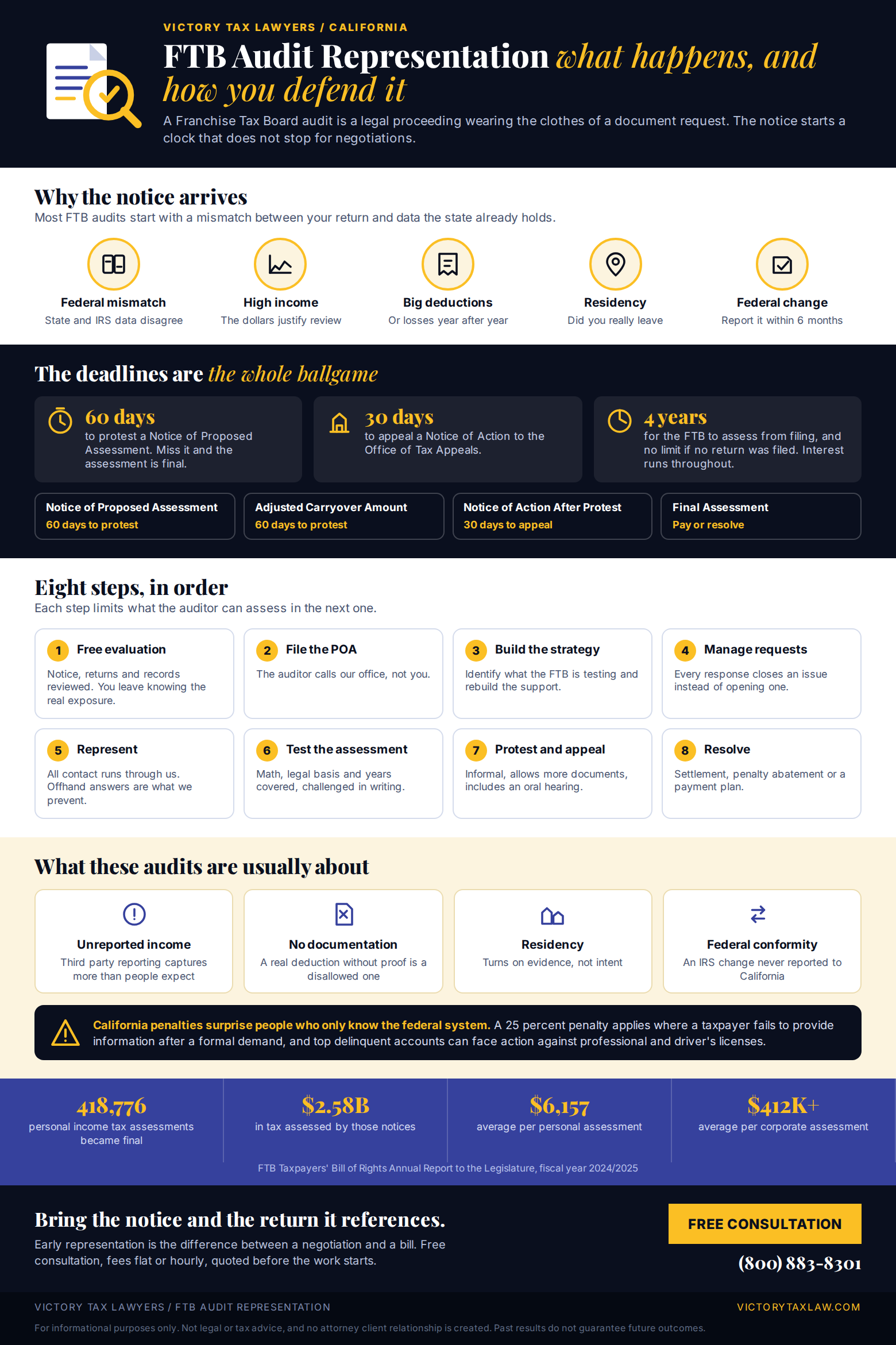
Why Are FTB Audits Conducted?

The Franchise Tax Board administers California personal income tax and corporation franchise and income tax. It processes returns, issues refunds, and runs the enforcement programs that conduct audits when reported figures do not hold up. The FTB is a state agency and operates separately from the Internal Revenue Service, though both the IRS and the FTB exchange information constantly.
In our experience, most California FTB audits start with a mismatch. The FTB compares your California return against federal data, wage and information returns, property records, and payments reported by third parties. Automated matching and analytics flag the outliers, and a human reviewer decides whether to open a file. Federal-state mismatches are one of the most reliable triggers we see.
Several patterns raise risk. High-income taxpayers face a higher audit risk in California, simply because the dollars justify the review. Unreported income surfaced by third-party reporting draws attention quickly. So do large or unusual deductions, aggressive credits, and business losses that continue year after year.
Residency audits deserve their own mention. California residents must report worldwide income, including out-of-state earnings, and the FTB examines whether a person who claims to have left California actually did. Auditors look at where you spend your days, where your family lives, where your professional licenses are held, and where your driver's license was issued. Large capital gains realized near a claimed move date almost guarantee scrutiny.
Federal adjustments create a second path. If the IRS changes your federal return, R&TC section 18622 requires you to report that change to California within six months. Report it on time, and the FTB has two years to act. If you report it late, the window is four years. If you never report it, the FTB can assess it at any time.
How Can FTB Audit Representation Help Me?
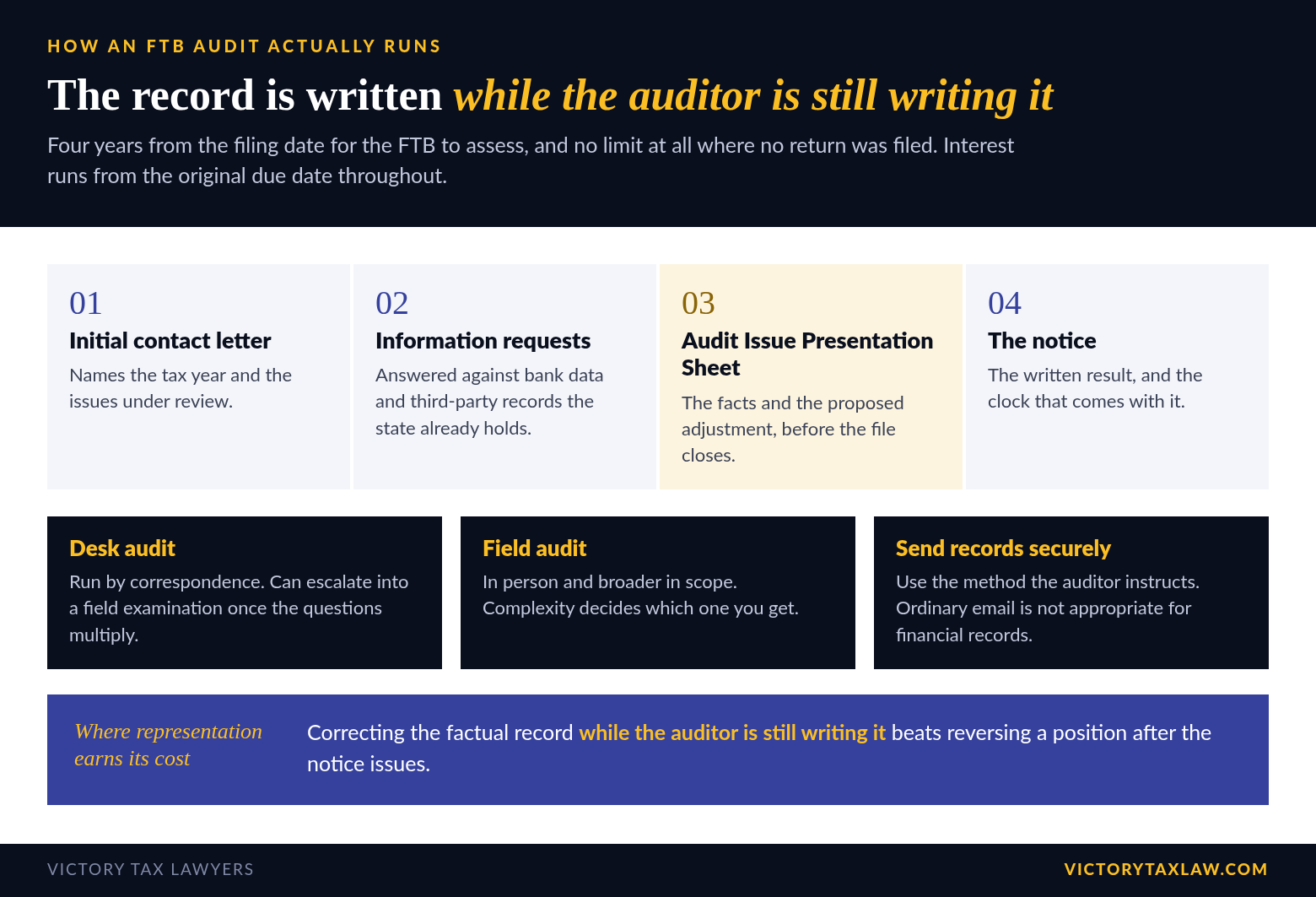
To understand what representation does, you need to understand how FTB tax audits actually run. As the FTB explains in its overview of the audit process, audits typically begin with an initial contact letter that identifies the tax year and the issues under review. The FTB generally has four years from the return filing date to issue an assessment, and no limit at all if no return was filed. The auditor then builds an audit plan and issues information document requests, known as IDRs, to gather records.
The auditor reviews what you produce, along with bank accounts, deposits, and third-party data already in the state's hands. Complexity determines the format. The FTB can conduct desk or field audits, and a desk audit run by correspondence can escalate into a field examination once the questions multiply. Use secure methods as instructed by the auditor, because ordinary email is not appropriate for financial records.
Before the file closes, the auditor typically issues an Audit Issue Presentation Sheet setting out the facts and the proposed adjustment. This is the moment representation earns its cost. Carefully evaluate the proposed changes from the FTB. Correcting the factual record while the auditor is still writing it beats reversing a position after the notice issues.
Once the FTB determines its position, the audit results arrive in writing. The table below sets out what you may receive and the deadline attached to each, because the notice date starts a clock that does not stop for negotiations.
| Outcome or Notice | What It Means | Your Deadline |
|---|---|---|
| No Change Letter | The FTB accepted the return as filed, and no additional tax is owed. | None |
| Notice of Proposed Assessment | The FTB proposes additional tax, penalties, and interest. | 60 days to file a written protest |
| Notice of Proposed Overassessment | The audit determined you overpaid for the tax year. | Respond as instructed in the notice |
| Notice of Proposed Adjusted Carryover Amount | A carryover item is reduced, without additional tax for the year examined. | 60 days to protest the proposed adjustment |
| Notice of Action After Protest | The FTB has issued its decision on your protest. | 30 days to appeal to the Office of Tax Appeals |
| Final Assessment | The tax liability is fixed and generally collectible. | Pay, seek a resolution, or pay and pursue a refund claim |
The deadlines are the whole ballgame. You have 60 days to file a protest after a Notice of Proposed Assessment, and failing to file by the deadline makes the assessment final. If a Notice of Action goes against you, you can appeal to the Office of Tax Appeals within 30 days. Taxpayers who exhaust that route may still pay the tax and file suit in California Superior Court.
Interest is running the entire time. Interest accrues from the original due date of the return until the balance is paid in full, so a long dispute has a carrying cost. Where the tax is likely owed, we sometimes recommend a tax deposit to stop interest while the substantive fight continues.
"By the time a client calls us, the facts are usually already fixed. What is still open is how those facts get presented, and which deadline is protected," says Parham Khorsandi, Esq., Managing Attorney of Victory Tax Lawyers. "Early representation makes all the difference between a negotiation and a bill."
What Are the Steps in the FTB Audit Representation Process?

The sequence below is how a California FTB audit runs when we handle it from the start. Each step limits what the auditor can assess in the next one, so the order is not cosmetic.
Step 1: Initial Consultation and Case Evaluation.
We start with a free initial consultation to review the audit notice, the tax returns at issue, and the records you already hold. You leave that meeting knowing your rights, your obligations, and a realistic view of the exposure.
Step 2: Filing the Power of Attorney.
We file the authorization that makes us your authorized representative. From that point, the FTB auditor contacts our office rather than you.
Step 3: Customized Strategy Development.
We identify the issues the FTB is actually testing and build the position around them. That means gathering documentation and evidence, reconstructing support for deductions, and, where appropriate, evaluating amended tax returns before the auditor reaches the same ground.
Step 4: Managing Requested Information.
Once the audit begins, every response we send is built to close an issue rather than open one. We answer each information document request in full and on time. Failure to respond to an Information Document Request can lead to penalties, and a pattern of non-response invites the worst available inference about your records.
Step 5: Representation During the Audit.
We act as the liaison between you and the FTB, handle all communications and negotiations, and challenge the auditor's methodology as the file develops. Critical mistakes at this stage, such as an offhand answer that contradicts a return, are the ones we exist to prevent.
Step 6: Reviewing the Proposed Assessment.
When the Audit Issue Presentation Sheet or Notice of Proposed Assessment arrives, we test the math, the legal basis, and the tax years covered. Anything unsupported gets challenged in writing.
Step 7: Protest and Appeal.
We prepare a protest letter that clearly states the reasons for disagreement and attaches the support. The protest process is informal, allows additional documentation, and includes the right to an oral hearing before a hearing officer. If it does not resolve the issue, the appeals process continues at the Office of Tax Appeals.
Step 8: Resolution and Post-Audit Support.
Where tax is genuinely owed, we move to resolution, including the FTB settlement process, penalty abatement, or an installment agreement. We also stay available for the next tax year, because the FTB often revisits taxpayers it has already examined.
What Are the Most Common Issues During FTB Audits?
Most audits we defend involve a small set of recurring problems. A clear grasp of them explains why so many California taxpayers receive a notice for something they believed was settled years ago.
Unreported income: Third-party reporting captures far more than most people expect, including brokerage proceeds, rental platforms, and payment processors. When reported income does not match those records, the FTB assumes the difference is taxable until proven otherwise.
Documentation failures: Deductions claimed without receipts, mileage logs reconstructed from memory, and business expenses paid from personal bank accounts all collapse under examination. The deduction may have been legitimate. Without proof, the IRS disallows is, and you owe additional tax on the difference.
Residency and sourcing disputes: A California resident who moves mid-year, or a nonresident with California-source income, faces a fact-intensive review of the entire year. These cases turn on evidence, not intent.
Federal conformity issues: A taxpayer resolves an IRS audit, pays the federal bill, and never reports the change to California. Two years later, a notice arrives showing they still owe California tax on the same adjustment, now carrying interest from the original due date.
California also imposes civil penalties that surprise people who only know the federal system. A 25 percent penalty applies where a taxpayer fails to provide information after a formal demand. The state also has unique additions, such as the noneconomic substance transaction penalty. For taxpayers who end up on the FTB's list of top delinquent accounts, the state can move against professional licenses and even suspend a driver's license.
How Do We Mitigate Risk and Prevent Future Audits?
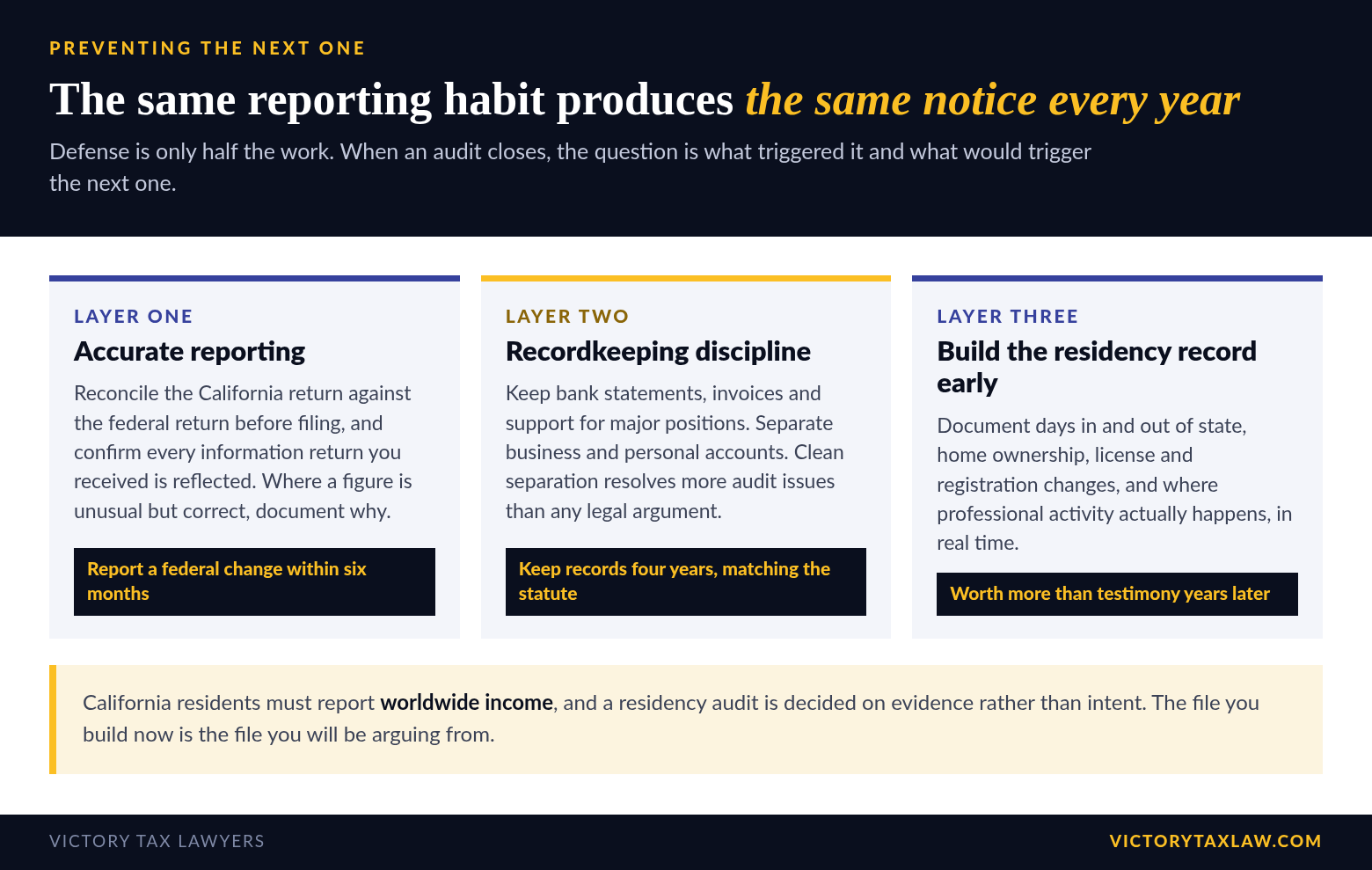
Defense is only half the work. When an audit closes, we look at what triggered it and what would trigger the next one, because the same reporting habit produces the same notice every year. Accurate reporting is the foundation. Reconcile your California return against your federal return before filing, and confirm that every information return you received is reflected. If a figure is unusual but correct, document the reason at the time, not three years later.
Recordkeeping discipline is the second layer. Keep bank statements, invoices, and support for major positions for at least four years, matching California's four-year audit statute of limitations. Separate business and personal accounts. In our experience, clean separation resolves more audit issues than any legal argument.
For clients with residency exposure, we build the record in advance. We document days in and out of state, home ownership, license and registration changes, and the location of professional and business activity in real time. That file is worth far more than testimony offered years later. Ongoing professional guidance closes the loop. Clients across Los Angeles, Sacramento, San Francisco, Orange County, and San Diego work with our team after the audit ends. Planning the next return is the cheapest audit defense available.
Why Should You Hire Victory Tax Lawyers for an FTB Audit?

Our attorneys practice tax controversy full time. We appear before the FTB, the IRS, and the California Department of Tax and Fee Administration, and our team includes a licensed enrolled agent for the procedural work. Handling IRS audits and California FTB audits under one roof matters when a federal adjustment drives the state case.
The scale of the state's enforcement explains why representation is worth the cost. According to the FTB's Taxpayers' Bill of Rights Annual Report to the Legislature, 418,776 personal income tax Notices of Proposed Assessment became final in fiscal year 2024/2025. Those notices carried about $2.58 billion in tax assessed, an average of $6,157 each. On the corporate side, 1,268 notices carried $522.4 million in tax, averaging above $412,000 per assessment.
Every engagement is built around the specific file. A residency case and a disallowed-deduction case share almost nothing except the deadline structure, so we do not run a template. We identify the issues that carry real exposure, concede what is not worth defending, and put the resources where the money is.
Support runs end to end. We handle the audit, the protest, the appeal at the Office of Tax Appeals, and the collection posture afterward. If an assessment becomes final and enforced, we defend against a tax levy or tax lien and negotiate the back tax balance. Fees are flat or hourly depending on complexity, so you know the cost before we begin. You can also review our broader California tax attorney practice or read about our team.
Why Does Professional Representation Matter in an FTB Audit?
An FTB audit is a legal proceeding wearing the clothes of a document request. The state has trained FTB agents, third-party data, and statutory authority to estimate what your records do not prove. You have the right to representation, and the file looks different from the day you use it.
Professional representation protects your rights, keeps the examination inside the issues and the tax years the FTB actually opened, and preserves every deadline in the appeals process. It also lets you go back to work while someone else answers the mail. For most clients, that is the part worth paying for.
Ready to Protect Your Business From an FTB Audit?
An FTB notice carries a deadline, and the deadline does not care how reasonable your explanation is. The earlier we get involved, the more we can shape the audit. Bring the notice and the return it references, and we will tell you where you actually stand.
Reach Out to Us at Victory Tax Lawyers Today to Build a Strong Case.
Frequently Asked Questions
These are the questions California taxpayers ask us most often after an FTB audit notice arrives.
What Is FTB Audit Representation?
FTB audit representation is professional representation for an individual or business under audit by the California Franchise Tax Board. A tax attorney handles the audit on your behalf, from the initial contact letter through any protest or appeal.
Why Do I Need FTB Audit Representation?
FTB audits are technical, and the deadlines are short and unforgiving. Representation protects your rights and reduces the risk of an assessment built on incomplete records.
How Can Victory Tax Lawyers Assist With FTB Audit Representation?
Our tax attorneys communicate with the FTB, gather and organize requested information, and respond to every information document request. We also negotiate on your behalf and file a protest if the FTB issues a Notice of Proposed Assessment is issued.
What Are the Potential Benefits of Hiring a Tax Lawyer for an FTB Audit?
A tax lawyer applies California tax law to your facts and keeps the audit within its proper scope. That can reduce the additional tax owed and support relief from penalties where reasonable cause exists.
How Can I Schedule a Consultation for FTB Audit Representation?
Call Victory Tax Lawyers at (800) 883-8301 or submit the form on our contact page. We will review your notice in a free consultation and explain the options before you commit to anything.
Legal Disclaimer: This page is for informational purposes only and does not constitute legal or tax advice. Reading it or contacting Victory Tax Lawyers does not create an attorney-client relationship. Tax outcomes depend on the specific facts of each matter, and past results do not guarantee future outcomes.