If your business is facing a California EDD audit, understanding the EDD audit process can help you protect your business and respond to potential tax liabilities. At Victory Tax Lawyers, our experienced tax attorneys help small business owners navigate an EDD audit by carefully reviewing business records, tax filings, employee wages, and financial records to identify discrepancies involving taxable wages, required payroll taxes, or independent contractor misclassification. We can help you prepare an effective EDD audit defense, respond to proposed assessments, and pursue a fair outcome through the appeals process when necessary.
Contact us today and let us help with your EDD audit.
Why Does the EDD Audit So Aggressively?

In our experience, this is because the money at stake is enormous. The California Attorney General’s office, citing a 2013 UCLA Labor Center report, put the state’s underground economy at $60 billion to $140 billion a year, costing California about $8.5 billion in uncollected tax. The Employment Development Department says the true size is hard to know. Payroll tax evasion and worker misclassification are a substantial part of it, which is why the EDD runs a dedicated enforcement program rather than treating classification as a paperwork issue.
That context is worth holding onto, because an EDD audit is rarely personal. It is a funded enforcement priority, and the auditor is working from a standard framework you can prepare for.
What Does an EDD Audit Examine?
An EDD audit examines your payroll records to verify that you reported wages correctly and paid California’s four payroll taxes. Those are unemployment insurance, employment training tax, state disability insurance, and personal income tax withholding.
We have found that audits arrive in two forms. A verification audit is a routine compliance check, selected without any particular suspicion. A request audit is opened in response to a specific event, most often a worker who was paid as an independent contractor filing for unemployment benefits. That claim prompts the EDD to ask why you made no contributions.
Other triggers include late payroll filings, discrepancies between your EDD filings and federal returns, employee complaints, and referrals from other agencies. The EDD coordinates with the IRS and with other California agencies, so a federal issue can surface here. The audit period typically covers the last three years, or twelve calendar quarters.
What Is the ABC Test and Why Does It Decide Most Audits?

The ABC test is California’s key standard for determining whether a worker is an employee or an independent contractor. This makes it especially important during an Employment Development Department (EDD) payroll tax audit. California’s ABC test generally presumes a worker is an employee unless the business can establish all required conditions for independent-contractor status.
If the EDD determines that workers were misclassified, it may issue a proposed notice and extend its review to other workers or later periods. Proactive preparation, proper documentation, and careful maintenance of audit information can reduce audit risk and protect workers’ rights while giving the business a stronger position if classification issues arise.
Worker classification is central to nearly every EDD audit, and California applies one of the strictest tests in the country. Assembly Bill 5 codified the ABC test, effective from January 2020. A worker is presumed to be an employee unless the hiring entity establishes all three of the following:
- The worker is free from the control and direction of the hiring entity in performing the work
- The worker performs work outside the usual course of the hiring entity’s business
- The worker is customarily engaged in an independently established trade, occupation, or business of the same nature as the work performed
Failing any one prong makes the worker an employee for payroll tax purposes. The second prong is where most businesses lose. Take a marketing agency engaging a freelance copywriter. That work sits squarely within the usual course of the agency’s business, no matter how independent the writer is in practice or what the contractor agreement says. A signed contract does not settle the question. The EDD looks at the working relationship, not the paperwork describing it.
What Happens If the EDD Finds Misclassification?
The assessment covers unpaid payroll taxes for the entire audit period, not just going forward. That means back unemployment insurance, employment training tax, state disability insurance, and personal income tax withholding for every misclassified worker across three years. A 15% late payment penalty under section 1112 of the California Unemployment Insurance Code is added, plus interest under section 1113.
In our experience, two consequences catch business owners off guard. The first is personal liability. Under section 1735 of the Unemployment Insurance Code, individuals who are responsible persons within the business can be held personally liable for unpaid contributions. Incorporating does not insulate you from an EDD assessment, as many owners assume.
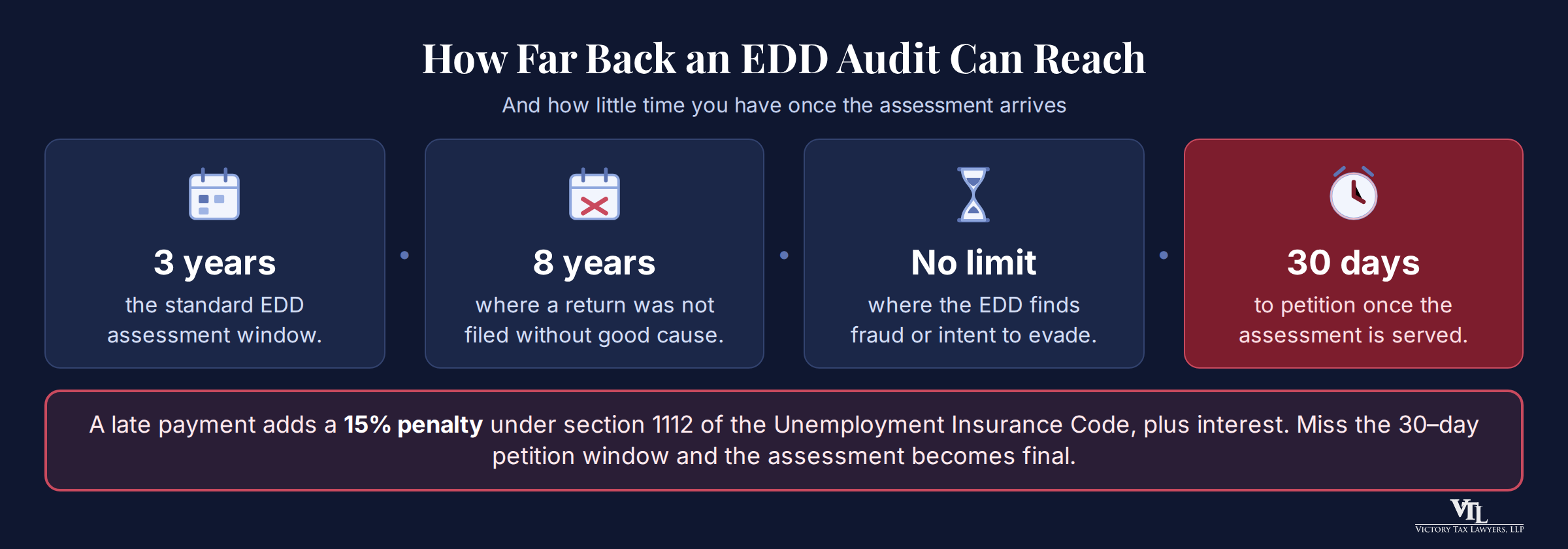
The second is the lookback period. The EDD generally has three years to issue a notice of assessment under section 1132. Where a return was not filed without good cause, that extends to eight years. Where there is fraud or intent to evade, there is no limitation period at all.
| Situation | EDD assessment window |
|---|---|
| Returns filed, no fraud | 3 years |
| Return not filed without good cause | 8 years |
| Fraud or intent to evade | No limit |
How Do You Appeal an EDD Assessment?
You have 30 days from service of the Notice of Assessment to file a Petition for Reassessment with the California Unemployment Insurance Appeals Board. The petition itself is filed in writing with the Board, and EDD information sheet DE 1009 sets out how the process runs once it is. An administrative law judge may grant one additional 30-day period if you show good cause. Beyond that, the assessment becomes final and is enforceable, which means missing the deadline forfeits your right to contest the debt entirely regardless of how wrong the assessment is. That deadline is the single most important date in an EDD matter, and it is short.
How Should You Respond to an EDD Audit Notice?
If you are facing an EDD audit, what you do before and during the document review can decide the outcome. The goal is to respond accurately, protect the audit scope, and address potential worker classification issues before they become larger liabilities. Follow these steps to prepare and avoid the common mistakes.
Step 1: Respond on Time
The audit is largely decided during the document phase, before any determination is made. Respond to the EDD’s document requests by their deadlines. Late or partial responses can invite a broader examination and make the audit more difficult.
Step 2: Organize Your Records
Organize your records before handing anything over. Gather payroll records, bank statements, financial statements, 1099s and W-2s, contracts and independent contractor agreements, and general ledger detail for the audit period. Organized records make it easier to support your position and address gaps.
Step 3: Run an Internal Review
Identify which workers’ classifications are genuinely arguable and which are not. Understand your potential exposure before the auditor does. This analysis can help determine whether to defend the classification, address specific workers, or focus on limiting the audit period.
Step 4: Provide Only What Is Requested
Do not volunteer unnecessary information. Broad or unfocused disclosures can expand the audit to additional years, workers, or issues that were not originally under examination.
Step 5: Get Representation Early
Consider getting professional representation before answering the auditor’s questions about your business. Once an auditor forms a view about your business or worker classifications, changing that perception can be much harder than addressing the issues properly at the outset.
"The classification argument is usually won or lost in the first document production, not at the appeal," says Amir Boroumand, Esq., Managing Attorney at Victory Tax Lawyers, LLP. "By the time a Notice of Assessment issues, the auditor has already built a file. What we want is to be involved while the record is still being made, because prong B of the ABC test turns on how the working relationship is actually described, and businesses describe it badly when they answer on their own."
How Does Victory Tax Lawyers, LLP Handle EDD Audits?

We begin with an assessment of exposure. That means reviewing the audit notice, the period at issue, and the worker population. We then apply the ABC test to each category honestly, so you know the realistic range before anything is submitted.
We then build the document response. The EDD’s requests are broad, and our work is to produce what is required, organized to support your position, without expanding the audit’s scope. We handle the auditor directly under a power of attorney, so document requests, interviews, and the classification discussion run through us rather than through your staff.
If a Notice of Assessment is issued, we file the Petition for Reassessment within the 30-day window and represent you before the Appeals Board. Where personal liability under section 1735 is asserted against an owner or officer, that is defended separately.
Our tax audit representation page covers our general audit practice. Our California tax attorney page covers combined state and federal matters, which is common when the EDD and the IRS are both reviewing the same workers. If an assessment has already become final and collection has started, our tax levy page explains what you can still do.
Ready to Talk to an EDD Audit Attorney?
The two dates that matter in an EDD matter are the document response deadline and the 30-day appeal window. Both are short, and the second one is absolute. Bring your audit notice, your payroll records for the period, and any contractor agreements to a free consultation. We will tell you where your real exposure sits and what the defensible position looks like.
Reach Out to Us at Victory Tax Lawyers Today to Build a Strong Case.
Frequently Asked Questions
These are the questions California business owners ask most often when an EDD audit opens. We did our best to answer them.
What Does an EDD Audit Examine?
It is an examination by California’s Employment Development Department to verify that you reported wages correctly and paid the four state payroll taxes. Most audits center on whether workers paid as independent contractors should have been treated as employees.
What Triggers an EDD Audit?
The most common trigger is a worker paid as an independent contractor filing for unemployment benefits, which prompts the EDD to ask why you made no contributions. Late filings, discrepancies against federal returns, worker complaints, and referrals from other agencies also trigger audits, and some are simply random verification checks.
How Far Back Can an EDD Audit Go?
The EDD generally has three years to issue a notice of assessment, and audits typically cover twelve calendar quarters. That extends to eight years where a return was not filed without good cause, and there is no limitation period at all in cases of fraud or intent to evade.
Can I Be Held Personally Liable for an EDD Assessment?
Yes, because section 1735 of the Unemployment Insurance Code allows the EDD to assess responsible persons personally for unpaid contributions. Operating through a corporation or LLC does not automatically protect an owner or officer.
How Long Do I Have to Appeal an EDD Assessment?
Thirty days from service of the Notice of Assessment, by filing a Petition for Reassessment with the California Unemployment Insurance Appeals Board. An administrative law judge may allow one further 30-day period for good cause, after which the assessment becomes final and can no longer be contested.
Legal Disclaimer: The information on this page is provided for general educational purposes and is not legal or tax advice. EDD audit procedures, assessment periods, penalty rates, and appeal deadlines depend on the specific facts of each matter and change over time. Worker classification turns on the particular working relationship, and no general description can determine how the ABC test applies to your workers. Reading this page does not create an attorney-client relationship with Victory Tax Lawyers, LLP. For advice about an audit notice you have received, consult a licensed tax attorney or certified public accountant.