
The IRS pursues criminal charges when it finds evidence of intentional tax fraud, willful tax evasion, or deliberate attempts to hide income, falsify records, or obstruct an investigation. The IRS usually does not prosecute honest mistakes or simple filing errors. Criminal charges are more likely when there is a clear pattern of deception or repeated violations of tax laws. If you suspect the IRS is investigating you, acting early and consulting a qualified tax attorney can significantly improve your chances of protecting your rights and limiting potential penalties.
At Victory Tax Lawyers, our seasoned tax professionals can help you defend against criminal charges. Schedule a free tax attorney consultation today.
This blog explains when the IRS pursues criminal charges, what triggers investigations, and how to reduce your risk of prosecution.
When Does the IRS Pursue Criminal Charges?
The IRS pursues criminal charges when a taxpayer intentionally violates the Internal Revenue Code, rather than simply making mistakes or struggling with tax debt. Conduct such as hiding income, submitting fraudulent tax filings, manipulating records, or attempting to commit tax fraud can turn ordinary tax issues into a serious tax crime with major legal consequences.
Civil tax matters usually involve unpaid tax liabilities, late tax payments, or disputes that may result in civil fraud penalties, financial tax penalties, or a federal tax lien as the IRS works to collect tax owed. Criminal cases, however, involve deliberate misconduct such as business tax evasion, fraudulent tax claims, or fictitious deductions, which can lead to severe tax evasion charges and penalties. In 2023, the IRS prosecuted a man from France who collected $2.2 million in refunds from 1,701 fraudulent tax returns. The man was sentenced to 34 years in federal prison.
Investigations are handled by the IRS’s Criminal Investigation Division (CID), which reviews bank statements, tax records, and complex financial transactions, often in coordination with law enforcement agencies. If criminal conduct is suspected, taxpayers may face fines, imprisonment, and additional tax penalties, making it critical to seek legal representation as early as possible.
What Are the Most Common Crimes Prosecuted by the IRS?

The IRS commonly prosecutes tax evasion, which involves intentionally hiding income, falsifying records, or using deceptive methods to avoid paying taxes owed. For example, an individual or business might conceal revenue in offshore accounts or underreport income to reduce tax liabilities.
Filing false tax returns is another frequent charge, occurring when taxpayers knowingly provide inaccurate information, claim fictitious deductions, or submit fraudulent tax filings to obtain a larger tax refund. A typical example is overstating business expenses or inventing dependents to lower tax obligations.
Failure to file tax returns can also lead to criminal charges when it is willful and persistent rather than accidental. For instance, a taxpayer who repeatedly ignores filing requirements despite earning taxable income may face prosecution.
The IRS also pursues cases involving fraudulent claims, such as submitting false refund requests or using stolen identities to claim tax credits. These offenses are often treated as serious tax crimes because they involve deliberate deception and can trigger severe legal repercussions, including fines and imprisonment.
What Key Factors Does the IRS Consider Before Pursuing Criminal Charges?
The IRS evaluates whether a taxpayer intentionally tried to evade taxes, which requires clear evidence of willfulness, deceptive conduct, or repeated violations of tax rules. Actions such as filing false tax returns, making fraudulent tax claims, or engaging in criminal tax fraud may indicate deliberate criminal activity rather than simple errors in meeting tax obligations.
The amount of money involved and the pattern of behavior also play a major role in determining whether a case becomes criminal. Large unpaid balances, repeated attempts to reduce tax liabilities, suspicious tax refund requests, or long-standing unpaid taxes owed can strengthen the case for prosecution and increase the likelihood of serious legal repercussions, including severe tax evasion penalties.
The IRS also considers how the taxpayer responds during investigations and audits. If an IRS auditor uncovers irregularities and the taxpayer obstructs the process or provides misleading information, the case may escalate and become subject to criminal investigation, sometimes involving other law enforcement agencies and inquiries into related financial crimes.
Finally, prior warnings, notices, or unresolved IRS tax issues can influence whether the IRS refers a case for criminal prosecution. When audits, summonses, or repeated noncompliance reveal intentional misconduct rather than negligence, the IRS is more likely to pursue criminal charges and impose significant penalties.
What Is the Role of IRS Criminal Investigation (CI) in Tax Enforcement?
The IRS Criminal Investigation Division (CID) is tasked with investigating potential criminal violations of the Internal Revenue Code (IRC), including tax fraud, tax evasion, and related financial crimes such as money laundering. CID agents gather evidence using a combination of advanced technology and traditional investigative skills, conduct interviews with taxpayers and third parties, and sometimes directly visit homes or businesses without prior notice to assess potential criminal activity.
During investigations, the most critical issue in federal criminal tax cases is proving intent, which the IRS must establish to secure a conviction. Evidence collected may include bank statements, tax returns, financial documents obtained via subpoena, and information from third parties to build a strong case. According to IRS Criminal Investigation data, adjudicated criminal cases from FY 2022 through FY 2024 resulted in a 97.3% conviction rate.
Once CID determines that sufficient evidence exists, they collaborate closely with the Department of Justice (DOJ) prosecutors and, when necessary, other law enforcement agencies to pursue prosecution. The division operates discreetly, and most individuals are unaware they are under investigation until CID has collected substantial evidence of potential criminal activity.
How Do IRS Criminal Investigations Differ from Civil Audits?
A civil audit is a routine review by an IRS auditor to verify income, deductions, and compliance with tax rules, usually focused on resolving errors, adjusting taxes owed, or assessing penalties. In contrast, a criminal investigation is handled by the IRS’s Criminal Investigation Division (CID) and targets suspected tax crime, fraud, or intentional violations of tax laws.
Escalation from a civil audit to a criminal investigation typically occurs when the IRS finds evidence of willful misconduct, such as fraudulent tax filings, false statements, hidden income, or complex financial transactions designed to evade taxes. While civil audits generally result in additional taxes or civil penalties, criminal investigations can lead to serious legal consequences, including prosecution and potential imprisonment.
During a criminal investigation, taxpayers have stronger reasons to seek legal representation, as their rights, statements, and financial records may be scrutinized more aggressively than in a civil audit. A clear grasp of these differences helps taxpayers recognize the severity of criminal tax matters and the importance of responding strategically when IRS tax issues move beyond routine compliance.
What Are a Taxpayer’s Rights During an IRS Investigation?
Taxpayers under investigation by the IRS have key rights that protect them throughout the process. They have the right to legal representation, which is critical when facing inquiries from the IRS Criminal Investigation Division (CID), especially in cases involving suspected tax fraud, tax evasion, or related financial crimes.
Individuals also have the right to remain silent, ensuring they do not inadvertently provide statements that could be used to prove intent to defraud the government, which is the most critical issue in federal criminal tax cases. Additionally, taxpayers have the right to challenge evidence, including documents obtained via subpoena, bank statements, or other materials collected during audits and investigations, to ensure the IRS’s case is accurate and legally sound.
Exercising these rights is particularly important because the CID often operates discreetly, may interview third parties, and can escalate cases to the Department of Justice (DOJ) if sufficient evidence of criminal activity is found. Knowing and asserting these protections can help taxpayers navigate IRS investigations safely while preserving their legal defenses.
Civil vs. Criminal Tax Cases: Key Differences
| Civil Tax Case | Criminal Tax Case |
|---|---|
| Usually involves unpaid taxes or errors | Involves intentional fraud or evasion |
| Results in fines and penalties | Can result in prison time and criminal records |
| Lower burden of proof | Proof must show willful intent |
| Often resolved through payment plans | Prosecuted by federal authorities |
Knowing the difference helps taxpayers understand when a situation becomes legally dangerous.
Civil Resolution vs. Criminal Defense: Trade-Offs

Choosing how to respond to IRS allegations involves important trade-offs between pursuing a civil resolution and preparing for a criminal defense. A civil resolution generally carries lower legal risk because it does not result in a criminal record, and it focuses primarily on repaying taxes owed, along with penalties and interest. This path is often faster and less disruptive, but it may still require substantial payments, and it is not available if the government believes there was intentional fraud or willful misconduct.
A criminal defense approach is necessary when the IRS alleges deliberate wrongdoing. It protects your constitutional rights, allows your attorney to challenge the government’s evidence, and may lead to reduced charges, negotiated outcomes, or even dismissal in some cases. However, criminal proceedings are typically more expensive, take much longer to resolve, and can become public, potentially harming your reputation and professional relationships.
Real IRS Criminal Investigation Case Example
In one real case, a small business owner failed to report significant cash income for several years while claiming inflated deductions. After an IRS audit uncovered discrepancies, the case was referred to the Criminal Investigation Division (CID). The taxpayer ultimately faced criminal charges, paid substantial fines, and served prison time.
In our experience, cases like this often start as routine audits but escalate when the IRS finds evidence of intentional misconduct rather than simple error. “As tax attorneys, we often see clients assume that the IRS only pursues large corporations,” says Parham Khorsandi, an experienced attorney at Victory Tax Lawyers. “In reality, individuals and small business owners are frequently targeted when there is evidence of intentional wrongdoing.” This highlights why early legal guidance is critical when facing potential criminal tax exposure.
What Constitutes a Criminal Tax Violation?
Not all tax violations are considered to be crimes. However, when there is clear evidence that you have a pattern of taking deliberate actions to avoid having to pay taxes, the IRS may opt to pursue criminal charges. One of the primary discerning factors between criminal and non-criminal cases is willful action. If you end up underpaying because you were careless and rushed through your tax return, your actions were negligent. As a result, you may face a civil penalty but not criminal charges.
Deliberate tax evasion, on the other hand, is when you purposefully fail to report business income to evade paying taxes. Remember that the burden of proof varies depending on whether you are facing criminal or civil charges: Criminal offenses require the evidence to establish your guilt beyond a reasonable doubt, while civil offenses only require the evidence to be unambiguous and compelling.
The IRS frequently imposes civil penalties on individuals convicted of tax crimes because the proof requirements for civil violations are less stringent than those for criminal violations. Understandably, the IRS is quiet about the specifics of how it tracks and investigates suspected offenders. However, all taxpayers should know that some actions carry a high likelihood of triggering an IRS criminal investigation. Some of them are listed below.
Repeatedly Failing to File Taxes
If you have a stressful year and forget to file your taxes, the IRS may not investigate you right away. However, because most people who repeatedly fail to file taxes are doing so in a deliberate effort to avoid paying what they owe, the IRS often treats repeated failure to pay as a crime.
Significantly Underreporting Income
Some people trying to avoid paying taxes may still file, but they choose to report far less income than they actually earned. If the IRS notes that you’re making far more than you claim, you might face criminal charges.
Not Paying Payroll Taxes (If You Have Employees)
Every employer knows (or should know) that they are required to collect and pay payroll taxes. However, some of them pay employees “under the table” in an effort to avoid these taxes. This is illegal and may lead to criminal prosecution.
Leading an Unexplainably Lavish Lifestyle
If your reported earnings are close to the poverty line, but you’re buying multiple luxury cars and making other extravagant purchases, the IRS will notice something doesn’t add up. Conspicuous spending that isn’t in line with your reported income is very likely to trigger a criminal investigation.
Making Suspicious Transactions
The IRS often looks for unusual transactions that may suggest money laundering. Things like quickly moving money between different accounts, making multiple transactions just below reporting limits, frequent cross-border transactions, and large transactions from small banks to larger ones may suggest to the IRS that something fishy may be ongoing.
Usually, the IRS pursues criminal charges against taxpayers who have committed egregious violations of tax laws. Criminal charges and sentencing are intended to punish taxpayers for intentional wrongdoing, and they can also be an effective way to deter would-be offenders.
What Does the IRS Consider for Criminal Charges?
The IRS does not base its decision to file criminal charges rather than levy a civil penalty, on a single factor. However, the IRS usually takes into account three factors before determining whether to file criminal charges: intentionality, significant understatement of income, and failure to file returns.
Intentionality, the first component, is among the most crucial. The IRS is aware that mistakes can be made and that taxes are extremely complicated for the typical American. For example, you are unlikely to face criminal charges if you fail to file and pay on time. However, you run a greater risk of facing criminal charges if you knowingly provide false information on your tax return.
The second factor, substantial understatement of income, is often an indication of fraud. The IRS defines substantial understatement as understating your tax liability by the greater of 10% of your total tax liability or $5,000. “The IRS does not pursue criminal charges lightly.” Says Parham Khorsandi, Managing Attorney at Victory Tax Lawyers, “By the time a case reaches prosecutors, investigators typically believe they can prove intent beyond a reasonable doubt.”
If there is an isolated incident of underreporting, you will likely only face an accuracy-related penalty. However, if you continue to underreport, the IRS is more likely to view your behavior as deliberate and more likely to pursue criminal charges against you.
Lastly, failure to file tax returns can be a crime. The IRS generally only pursues criminal charges if you deliberately avoid filing in order to avoid paying taxes. For example, if you make an average income and forget to file your return one year, you probably won’t be charged. However, if you fail to file taxes for multiple years, earn millions of dollars from business ventures during that time, and do not make any estimated tax payments, it is evident that you are attempting to evade your tax obligations.
How Do You Know If The IRS Is Investigating You?
If you think you may have triggered an IRS investigation against you, the uncertainty surrounding your situation can be immensely stressful. If you notice one or more of the following, there’s a good chance you’re being investigated, and you should contact a tax attorney immediately.
Unexpected Letters From the IRS
The IRS often sends letters to communicate. If you have an installment agreement, you’ll likely receive reminders before each payment is due. If you file taxes and owe additional money, you also might receive a letter asking you to pay the balance immediately. However, if you start getting unexpected letters asking you detailed questions about your past tax returns, that’s usually a good sign the IRS has begun investigating you.
Visits From IRS Agents
If an IRS agent takes the time to show up at your door, you can be certain that your situation is serious. Just like when police question you about a crime they think you were involved in, choosing to stay silent is best. If you ask for the agent’s card and give it to your tax attorney, your attorney should be able to help you determine what steps to take next.
Receiving a Subpoena or Summons
A subpoena is essentially a legal order. If you receive a subpoena for documents, the IRS is mandating that you provide specific documents that may be pertinent to the investigation of your alleged crimes. If you receive a subpoena for testimony, the IRS believes you have information related to an investigation involving you or another individual.
The IRS will also sometimes issue a summons, which is an administrative request for information or testimony. If you do not comply with the summons, the IRS might attempt to have it enforced by a court. If you receive either one, you should reach out to a tax attorney before doing anything.
Frozen Bank Accounts or Asset Seizures
If you have unpaid taxes and have repeatedly refused communication with the IRS, the IRS might freeze your bank account or even seize your assets. However, it can do the same if it suspects you are involved in illegal activity. If you are suddenly unable to make purchases with your debit card or otherwise access the funds in your bank account, it may have been frozen.
Contact From Third Parties
When conducting a criminal investigation, the IRS usually won’t only talk to you. It might reach out to your bank, your employer, your accountant, and people you do business with. These contacts may damage your reputation and relationships. In particular, business associates may start to see you as untrustworthy.
What Should You Do if You Are Under Investigation?

It’s easy to panic if you find out you’re under investigation by the IRS, or even if you simply think you are. However, before you do anything, you should take a deep breath. If your anxiety overtakes you, you may be more likely to make irrational decisions that can only hurt your case.
If the IRS begins asking you about a specific tax return or certain activities, say as little as possible. Because you may be asked to produce financial documents, it can’t hurt to make sure your financial records are organized and accessible.
Cooperating with the investigation is also critical. In many cases, your lawyer can help you avoid some of your criminal penalties by voluntarily disclosing information to the IRS. However, the less cooperative you are, the more likely you are to face stiffer penalties.
Being investigated by the IRS can be scary, but you still have rights. The right to retain representation is especially relevant during criminal investigations. You also have the right to due process, privacy, and confidentiality.
If the IRS is investigating you, your assets and your freedom are in jeopardy. You need a knowledgeable advocate to represent you when dealing with the IRS’s often thorough and persistent investigators. The Victory Tax Lawyers team has a track record of success against the IRS. Get in touch for a free attorney consultation today.
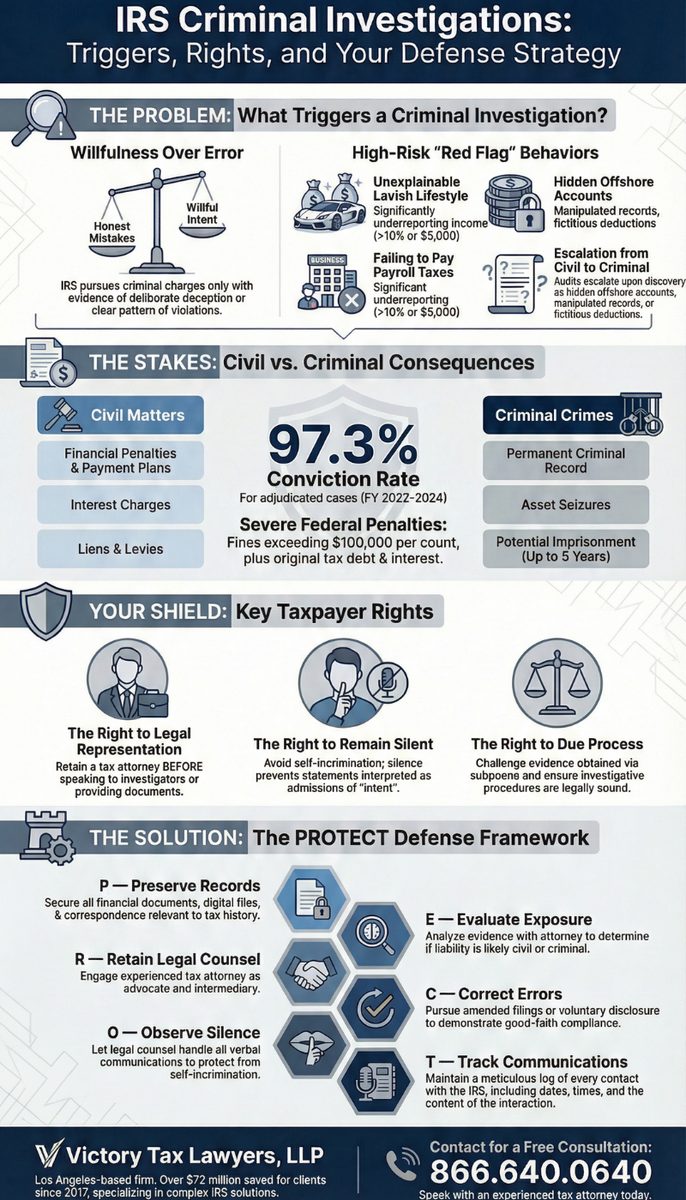
The “PROTECT” Framework for IRS Criminal Risk Situations
To help clients respond effectively to potential criminal tax exposure, we use a structured approach summarized by the PROTECT framework:
P — Preserve Records: Secure all financial documents, correspondence, and digital files immediately.
R — Retain Legal Counsel: Engage an experienced tax attorney before communicating with investigators.
O — Observe Silence: Avoid making statements that could be interpreted as admissions of intent.
T — Track Communications: Document every contact with the IRS, including dates and content.
E — Evaluate Exposure: Analyze potential criminal versus civil liability based on available evidence.
C — Correct Errors: Pursue amended filings or voluntary disclosure when appropriate.
T — Take Strategic Action: Develop a defense or resolution plan tailored to your circumstances.
What Are the Consequences of IRS Criminal Investigations?
If the IRS selects you for an audit and discovers violations, the consequences can escalate quickly. An IRS criminal investigation can lead to serious legal, financial, and reputational damage that may last for years. Even misdemeanor tax offenses can result in fines of up to $25,000 and up to one year in prison. More serious federal tax crimes may carry penalties of up to five years in prison and fines of $100,000 or more. Because these penalties are applied per count, total fines and prison time can increase dramatically.
Yes, it is possible to go to jail as a result of an IRS criminal investigation. Federal authorities actively prosecute tax crimes, and real cases show how severe the consequences can be. Defendants have received multi-year prison sentences for tax fraud, tax evasion, and related financial crimes, including cases involving millions of dollars in unpaid taxes. Public figures and high-profile individuals are not exempt from prosecution.
Beyond jail time and fines, felony tax charges can permanently damage your reputation. Allegations of tax fraud often undermine trust with employers, clients, and business partners. As a result, individuals may face lost income, limited career opportunities, and long-term harm to their professional standing. In many cases, the reputational impact of an IRS criminal investigation can be just as damaging as the legal penalties.
How Do You Avoid IRS Criminal Charges?
The most effective way to avoid IRS criminal charges is to prevent tax problems before they escalate. Staying compliant with tax laws can be complex, but working with a reputable tax preparer helps reduce the risk of accidental violations. In many cases, having experienced tax attorneys who understand federal tax law can make a significant difference in protecting you from serious legal consequences.
If you discover an error on a previous tax return, correcting it quickly is critical. You can usually fix mistakes by filing an amended return using Form 1040-X, which can often be submitted online. The IRS generally allows you to amend a return within three years of the original filing date or within two years of paying the tax owed, whichever is later. Filing Form 1040-X requires more than a simple correction. You must complete the entire form and include all supporting documents from the original return, even if those documents have not changed.
Also, if you disclose tax non-compliance before the IRS finds it, you may be able to avoid criminal prosecution through the IRS voluntary disclosure program. After obtaining a preliminary acceptance letter, you must cooperate with a civil examiner, complete Part II of Form 14457 if granted pre-clearance, submit Part I of the form, and wait for the IRS to decide whether you qualify for pre-clearance. Before making any disclosures, you should speak with an experienced tax lawyer to make sure your rights are fully protected because this process is intricate and legally delicate.
What Are the Legal Consequences and Defense Strategies for IRS Criminal Charges?
IRS criminal charges can lead to severe legal consequences, including prison time, substantial fines, additional tax penalties, and long-term financial and reputational damage. Convictions may also result in ongoing obligations to pay taxes owed, interest, and civil penalties on top of criminal sanctions.
Hiring an experienced tax attorney is critical because criminal tax cases involve complex legal standards, strict procedural rules, and high stakes that go far beyond typical tax disputes. A skilled attorney can protect your rights, communicate with the IRS and prosecutors, and develop a strategy tailored to the specific facts of your case.
Common defense strategies include proving a lack of willfulness, demonstrating that errors were unintentional, challenging the accuracy or legality of IRS evidence, and showing reasonable reliance on professional advice. In some cases, plea bargains or negotiated resolutions may reduce charges or penalties, making early legal representation essential for achieving the best possible outcome.
What Should You Do If You Receive an IRS Criminal Investigation Notice?
If you receive an IRS Criminal Investigation notice, do not ignore it, as prompt action is crucial. First, carefully read the notice to understand the allegations and deadlines. Avoid discussing the matter with anyone other than your attorney to prevent self-incrimination.
Contact a qualified tax attorney immediately, as they can guide you through the process and protect your rights. Do not provide any documents or statements to the IRS without your attorney present. Keeping detailed records of all communications and correspondence is essential for building your defense.
Many resources simply list penalties or definitions. This guide focuses on real triggers for criminal investigations, warning signs drawn from actual cases, and actionable steps taxpayers can take immediately to protect themselves. By combining legal insight, practical guidance, and structured response strategies, it provides a more comprehensive roadmap than general informational content.
Need Help With an IRS Criminal Charge?
While criminal prosecutions receive significant attention, most IRS disputes remain civil matters. The agency generally prioritizes cases involving substantial losses to the government, organized schemes, or clear evidence of intent. Taxpayers who cooperate, correct errors, and demonstrate good-faith compliance often resolve issues without criminal charges. However, once investigators suspect deliberate misconduct, the process becomes far more serious and requires immediate legal attention.
With over $72 million saved for clients since 2017, Victory Tax Lawyers, a Los Angeles-based tax firm, delivers experienced legal help you can count on to get real IRS solutions. Get the help you deserve. Contact us for a free consultation today!
Frequently Asked Questions
During the process of writing this blog, we encountered some frequently asked questions related to the IRS criminal charges. We did our best to answer some of them.
What Crimes Does the IRS Prosecute?
The IRS prosecutes crimes such as tax evasion, filing false returns, and failure to report income, which can trigger a criminal investigation. These offenses often result in additional tax penalties added to the owed amounts, as well as possible criminal prosecution.
How Does the IRS Decide to Pursue Criminal Charges?
The IRS reviews evidence of intentional wrongdoing, financial records, and compliance history before opening a subject criminal investigation. If they find clear evidence of fraud or willful violations, they may pursue criminal charges and additional tax penalties added to the case.
What Are My Rights if the IRS Starts a Criminal Investigation?
You have the right to remain silent and the right to legal representation during a criminal investigation. Exercising these rights can help prevent statements that might lead to additional tax penalties added to your liability.
Can I Avoid Criminal Charges by Paying Back Taxes?
Paying back taxes may reduce civil penalties, but it does not automatically prevent a criminal investigation. The IRS can still pursue criminal charges and additional tax penalties if intentional wrongdoing is suspected.
How Can a Tax Attorney Help With IRS Criminal Investigations?
A tax attorney can guide you through a subject criminal investigation, protect your rights, and communicate with the IRS on your behalf. They can also help minimize or contest additional tax penalties added while negotiating settlements or defense strategies.
Legal Disclaimer: This content is for informational purposes only and does not constitute legal or tax advice. Reading this article does not create an attorney-client relationship. Tax laws and IRS enforcement practices vary based on individual circumstances. For advice regarding your specific situation, consult a qualified tax attorney or licensed tax professional.
✓ Attorney-Reviewed Content
This content was written and reviewed by the licensed tax attorneys at Victory Tax Lawyers, LLP. Our attorneys specialize in IRS tax relief and are licensed members of the California State Bar with a nationwide practice.
Last Reviewed: 2026 · Meet Our Attorneys →