The Internal Revenue Service may send you a letter to inform you about an issue or update related to your tax account. Common reasons include unpaid tax balances, adjustments to your tax return or refund, delays in processing, or requests for additional information. In some cases, the letter may notify you about identity verification, an audit, or potential collection actions. Reading and responding to the letter promptly can help you save time, avoid penalties, and resolve the matter more efficiently.
At Victory Tax Lawyers, our seasoned tax professionals can help clients who have received an IRS letter. Schedule a free tax attorney consultation today.
This guide is for taxpayers who have received an IRS notice or letter and explains why the IRS contacts taxpayers, how to respond, and steps you can take to prevent future IRS correspondence.
What Are the Common Reasons Why the IRS Sends You a Letter?
The IRS communicates with taxpayers by mail across several distinct notice categories. A single matter can produce several notices over weeks or months as the agency escalates. The notice number printed in the top right corner of any notice from the IRS identifies the issue and the tax year. Read that number first. Everything else flows from it.
According to the U.S. Department of the Treasury, the IRS sends around 170 million notices to individual taxpayers annually. Many of which are automatically generated when the agency’s systems detect discrepancies between tax returns and information reported by employers or financial institutions. Below are some of the most common reasons why the IRS sends letters.
Unpaid Tax Balances and Delinquent Taxes
In our experience, this drives the largest share of mail from the IRS. The CP14 is the initial balance-due notice. It states the tax liability, the assessed penalties, and the interest accrued to date. If the balance stays open, the CP501, CP503, and CP504 follow in sequence.
CP504 is the final notice before the IRS can file a federal tax lien or pursue a levy on wages, a bank account, or even Social Security benefits. The IRS does accept a partial payment even when the full balance is out of reach. A short-term plan, an installment agreement, and a request for currently-not-collectible status are the more common payment options at this stage.
Adjustments to Tax Returns or Refunds
The CP2000 is the most common underreporter notice. It surfaces when third-party data (W-2, 1099, brokerage forms) does not match what the taxpayer reported. The result may be a smaller refund, a higher balance, or sometimes no change at all. CP24 and CP49 address refund offsets, money applied to a prior balance rather than issued back. Filing an amended return on Form 1040-X is the right response when the original return contained an error the IRS has not yet caught.
Requests for Additional Information or Documentation
The IRS asks for records that back up specific items on a return. Schedule C deductions, dependents claimed, Earned Income Tax Credit eligibility, and education credits are the items most often pulled for verification. The letter spells out what is needed and sets a due date. Missing that date turns the request into a denial of the item in question.
Identity Verification Notices
Letter 4883C and Letter 5071C are identity verification requests from the IRS. The agency sends them when a return has flags suggesting it may have been filed by someone other than the listed taxpayer, or that the return contains information that does not match prior years. The response is straightforward but time-sensitive. Verification can be completed online through the IRS website or by phone using the number printed on the letter.
Audit Notifications
In our experience, most IRS audits are conducted by mail rather than in person. These are correspondence audits. The letter names the tax year, lists the items in question, and requests specific documentation by a stated due date. Field audits and office audits exist for higher-dollar or higher-complexity cases, but the mailed correspondence audit is what most taxpayers actually receive.
Collection Actions
The CP504 is a final notice of intent to levy at the state-refund level. The LT11, also issued as Letter 1058, is the formal Notice of Intent to Levy and the Notice of Right to a Collection Due Process Hearing under IRC § 6330. A taxpayer has 30 days from the date of that letter to request a collection due process hearing, which pauses most enforcement of collection while the hearing is pending.
Federal tax lien notification often arrives as Letter 3172, the Notice of Federal Tax Lien Filing. The clients who reach our office at this stage almost always have one of these three letters on the kitchen table when they call.
How Do You Identify Genuine IRS Letters and Avoid Scams?

Every legitimate notice from the IRS includes a notice number or letter number in the top-right corner. CP designations refer to computer paragraph notices, such as CP14, CP2000, and so on. LTR and Letter designations cover the rest, including Letter 4883C, Letter 1058, Letter 3172. The taxpayer’s name, address, and either Social Security Number or Employer Identification Number appear on the document.
Most notices reference a specific tax year and a specific issue. If the letter is vague about the year and the item, that is the first red flag. The IRS does not initiate contact via email, text message, or social media. That single rule rules out most IRS scam letters and fraudulent messages circulating today. Any IRS email landing in an inbox is a scam. In our experience, any text claiming to be from the IRS is a scam. The IRS communicates by mail first. Phone contact happens only after several notices have already been sent.
Verifying a suspicious letter takes one phone call. Call 800-829-1040 to verify a suspicious IRS letter. We advise clients to place that call independently using a number confirmed on the IRS website, not a callback number printed on the suspicious letter itself. Scam letters often print a fraudulent callback number that routes to a fake call center. The legitimate verification line is the public IRS individual taxpayer assistance line.
Several warning signs separate scams from real IRS contact. A demand for immediate payment over the phone is not how the IRS operates. A request for payment via gift cards, prepaid debit cards, or wire transfer is always a scam. The IRS does not accept any of these methods. Threats of arrest, deportation, or license revocation made by phone are scams. A demand that the taxpayer pay without the right to question or appeal the amount owed is also a scam. None of these reflect legitimate IRS practice.
The IRS communicates through certified mail for important notices, such as statutory notices, deficiency letters, and final notices of intent to levy. Routine notices arrive in regular mail. In-person field contact is rare and reserved for specific circumstances detailed in the next section. A certified letter from the IRS is the form of contact that should command the most attention. It usually carries a statutory deadline.
How Should You Respond When You Receive a Letter from the IRS?
If you receive an IRS notice, demand, or correspondence, taking prompt action can help resolve the issue quickly and prevent additional interest and penalty charges. Following a few steps can help you handle the situation properly.
Step 1: Read the Letter Carefully
Read the letter carefully and note the due date. Every notice from the IRS has a response deadline. Many run 30 days or 60 days from the date printed on the notice. The clock starts on the notice date, not the date the envelope was opened. A response that is timely but mailed to the wrong address can also miss the deadline, so check the return address on the notice and use it exactly.
Step 2: Verify the Notice Is Legitimate
Make sure the letter includes an official IRS contact phone number and clear instructions. Check the notice number to confirm the letter’s legitimacy. Many legitimate notices also include a contact stub used when responding. Be cautious of scams that pretend to be IRS communications.
Step 3: Compare the Letter with Your Tax Records
This is especially important if the notice or letter has to do with mismatches in tax amounts, personal details, or a corrected tax return. If the notice is correct, pay through one of the listed payment options or set up a payment plan. The IRS website lists the available payment options, including direct debit, debit or credit card, IRS Direct Pay, and installment agreements. A partial payment can be made at any time, even without a formal plan in place.
If the notice is incorrect, respond in writing within the deadline using the specific instructions on the notice. Include supporting documentation, send the response by certified mail with return receipt, and keep copies of everything sent. A certified letter back to the IRS creates a record that protects the taxpayer if the matter escalates.
Step 4: Gather the Necessary Documents
We always advise clients to collect relevant tax records, including your return and supporting paperwork. For example, if the notice references a replacement refund check, you may need documentation showing the original payment was not received.
Step 5: Complete the Requested Action
Follow the instructions provided in the notice and submit any required information. Taking timely action can help resolve the issue faster and reduce the chance of further interest and penalty charges.
Step 6: Contact a Tax Professional
If you don’t understand the IRS notice or you’re not sure how best to respond, don’t hesitate to reach out to Victory Tax Lawyers for help. Experienced tax attorneys and enrolled agents can take over IRS contact under Form 2848, the Power of Attorney form. From that point, the IRS communicates with the representative, not the taxpayer. We can help you understand what the letter is about, the right steps to take, and even represent you in tax court if necessary.
Step 7: Keep Records of Everything
Be sure you keep a copy of the IRS letters you receive, your responses, and any documents involved in the IRS correspondence. The references can come in handy when you need to follow up on an issue to provide evidence. The IRS recommends that you keep records for at least 3 years from the date you filed your federal tax returns.
When the letter has moved past routine correspondence into deficiency, levy, lien, or audit territory, it is time to consider tax relief options. Bring in a tax attorney before the next statutory deadline closes.
The 5-Step IRS Notice Response Framework
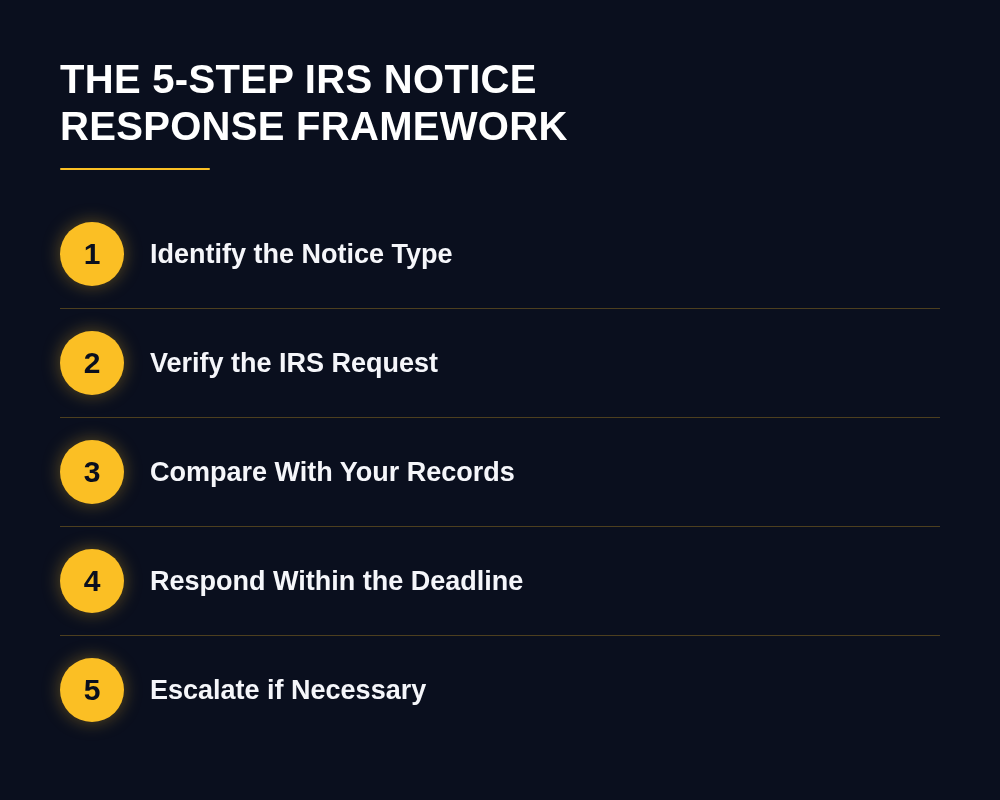
At Victory Tax Lawyers, we often guide clients through a simple five-step process when they receive IRS notices and letters. Whether the correspondence from an IRS office states that the IRS intends to take collection action or involves a notice of deficiency, taking the right steps early can improve your chances of resolving the issue successfully. The tax tips below can help you respond effectively to IRS communications, including serious notices such as a CP90 notice that warns of asset seizure due to unpaid taxes.
Step 1: Identify the Notice Type - Locate the notice number in the upper right corner to determine the issue. For example, the IRS sends a Notice of Deficiency with a 90-day response period.
Step 2: Verify the IRS Request - Review the notice carefully and confirm that the communication is legitimate and related to your tax account.
Step 3: Compare With Your Records - Check the information in the notice against your tax return, W-2 forms, and other financial documents.
Step 4: Respond Within the Deadline - Most IRS letters require a response within 30 days. Acting promptly helps prevent additional penalties.
Step 5: Escalate if Necessary - If the notice involves audits, large balances, or potential collection actions, working with a tax attorney can help protect your rights and negotiate with the IRS.
This structured approach helps taxpayers respond to IRS letters more confidently and reduces the risk of escalation.
What Are the Types of IRS Letters and What Do They Mean?
The IRS sends several types of letters depending on the issue related to a specific tax year. A proper grasp of what each notice means can help you respond correctly and take steps to minimize additional interest if a balance is owed.
A CP2000 notice is sent when the IRS finds a difference between the income reported on your tax return and information reported by employers or financial institutions. The notice explains the discrepancy and may propose additional taxes for that tax year. You may need to agree with the changes and pay the amount due or provide documentation if you disagree.
The CP501 notice, on the other hand, is usually the first reminder that you owe taxes from a prior tax year. It lists the balance owed and any accrued charges. Paying the balance promptly or setting up an installment agreement can help minimize additional interest and penalties.
If the balance remains unpaid, the IRS may send a CP503 notice as a follow-up reminder. This letter emphasizes that the payment is still overdue and encourages you to resolve the balance quickly. Paying the amount owed or arranging an installment agreement can prevent further collection action.
Finally, an IRS audit notice means the agency wants to review certain items on your return for a specific tax year. The letter usually asks for documents such as receipts, income records, or other supporting information to verify the accuracy of your filing. Responding with the requested documentation can help resolve the review and minimize additional interest if adjustments are made.
Comparison of Common IRS Letters
Depending on the problem with your tax return or account, the Internal Revenue Service will send you a variety of letters. It’s crucial to comprehend the particular notice you received because every letter presents a different issue and might call for a different solution. The following comparison table lists typical IRS letters, their objectives, their contents, and any necessary steps that taxpayers may need to take.
| Letter Name | Purpose | Typical Content | Required Action | Response Deadline |
|---|---|---|---|---|
| CP2000 | Notifies you of discrepancies between your tax return and third-party income reports. | Details of mismatched income, proposed tax adjustments, and recalculated tax owed or refund amount. | Review the proposed changes, agree and pay if correct, or respond with documentation if you disagree. | Usually, 30 days from the notice date. |
| CP501 | First reminder that you have an unpaid tax balance. | Summary of the amount owed, including penalties and interest. | Pay the balance in full or set up a payment arrangement with the IRS. | Typically, 21 days to respond or pay. |
| CP503 | Second notice for unpaid taxes after the first reminder. | Updated balance due and a warning that the debt remains unpaid. | Make a payment promptly or contact the IRS to arrange a payment plan. | Generally, 10–15 days to take action. |
| Audit Notice | Informs you that the IRS will review specific items on your tax return. | Request for documents, explanation of items being reviewed, and instructions for submitting records. | Gather and submit the requested documentation or consult a tax professional for assistance. | Often, 30 days, depending on the specific notice. |
While many IRS letters require action, not all notices indicate a serious problem. Some letters simply confirm account updates or provide informational notices. Reviewing the letter carefully before reacting helps you determine whether immediate action is necessary or if the notice is simply informational.
How an IRS CP503 Letter Turned Into a Tax Resolution
We worked with a client who received a CP503 notice indicating that their unpaid tax balance had reached the third reminder stage. He contacted Victory Tax Lawyers for assistance at this point. The taxpayer had initially ignored the earlier CP501 notice, believing it had been sent in error. By the time he sought legal help, penalties and interest had significantly increased the amount owed.
After reviewing the IRS notices and evaluating the taxpayer’s financial circumstances, our team negotiated a manageable installment agreement with the IRS. This resolution prevented the account from advancing to a CP504 Final Notice and reduced the risk of levy action. This case highlights the importance of responding promptly to IRS notices. Taking action early can help taxpayers avoid additional penalties, interest, and more aggressive collection measures.
What Happens if You Ignore an IRS Letter?
Some taxpayers think they can avoid a tax issue or buy more time simply by avoiding the notice or letter. But that’s not true at all. Instead, ignoring an IRS letter or notice may lead to consequences that can turn a simple issue into a more complicated matter.
If you ignore an IRS letter, you can lose your right to challenge the decision if you disagree. Oftentimes, the IRS issues a deadline to appeal or dispute whatever they’re saying. If you ignore the letter and miss these deadlines, you may find it much more difficult to dispute when the IRS has made a final decision.
Note that late payment penalties and interest will continue to accumulate even if you decide to ignore a notice about your tax debts. In the long run, the total amount you owe can get way bigger than you would’ve paid if you had attended to the letter.
The IRS may also delay your refund or deny it completely if they mail you for more information and you fail to respond. That way, you may lose out on earned income credit or deductions you qualify for. Moreover, the IRS can start collection actions, such as liens, if they’ve tried to reach out to you, but you seem to ignore the letters.
How Can You Avoid Receiving IRS Letters in the Future?
Although you may not be able to avoid all IRS letters since some of them are random or just to pass on information, you can still avoid many IRS letters that are initiated by issues you can easily prevent. Let’s give you some tips to minimize the letters the tax agency sends you in the future.
First, pay all your taxes as and when due. You’ll hardly get into trouble with the IRS if you’re prompt and accurate with your tax payments. If you can’t afford the entire tax amount, you can reach out to our experienced tax lawyers to help you find the most suitable tax relief option. We can negotiate with the IRS on your behalf for an installment agreement, apply for an Offer in Compromise (OIC), or find an IRS forgiveness program you’re eligible for.
Confirm that all information on your tax return is accurate. This is because missing information, typos, or math errors can easily trigger an IRS letter. Secondly, make sure you report all your income. If the IRS finds any difference between your income reports and the ones on forms from your employers or clients, you’ll most likely get a letter.
In case you get any IRS notice, respond as quickly as possible. Prompt response helps resolve tax issues faster and prevents further complications that may attract more letters. Meanwhile, keep good records of all your tax-related documents, whether they’re receipts or adjustment notices.
Moreover, avoid filing too early or too late. When you file too early, you might miss some income that arrives later, still within your filing period. On the other hand, when you file too late, you may attract penalty charges or interest due to missed deadlines. Therefore, make sure you have every detail you need before you file, but do so within the IRS deadline.
Ultimately, work with a tax professional if you want to stay away from IRS troubles as much as possible. In fact, if you’re in a complex tax situation, have back taxes, or own a business, working with a tax professional is essential. You’ll need a tax professional to double-check and be sure there are no loose ends that might trigger tax issues for you.
When Should You Seek Professional Help for IRS Letters?

Receiving a letter from the IRS can increase anxiety for many taxpayers. The IRS sends millions of letters each year for administrative and enforcement reasons, and many IRS notices can be handled without contacting the IRS, which can help reduce anxiety.
However, ignoring a letter from the IRS is never advisable. The IRS has over 150 varieties of CP notices addressing different issues related to a tax return or account. Some notices involve simple corrections. For example, CP11 indicates a math error on a return that results in a balance due, while CP12 indicates a refund adjustment due to a math error. The IRS uses automated processes to match income reported on tax returns with data from employers and financial institutions, and discrepancies can trigger these notices.
Unpaid tax balances also generate notices. Initial notices are typically CP14, followed by reminders such as CP501, CP502, and CP503 if the balance remains unpaid. The CP503 notice is the third warning and provides an opportunity to pay the balance or arrange a payment plan. The CP504 notice is the final opportunity to avoid a tax lien or levy.
More serious letters require immediate attention. Letter 1058 or LT11 serves as the final legal notice before the IRS can seize assets or garnish wages. Formal letters are also sent if a return has been selected for a detailed audit or examination.
“Delaying a response can worsen the situation, but many IRS letters are easier to resolve than people think,” says Parham Khorsandi, managing attorney at Victory Tax Lawyers. "According to our observations, taxpayers who respond to IRS notices promptly typically have more options for handling their tax problems."
You should consult a tax professional if you do not understand the letter, cannot afford to pay the balance, or are being audited. When you receive an IRS notice, your first step should be to call a tax professional immediately and provide them with a copy of the notice. Victory Tax Lawyers assists taxpayers with IRS correspondence, disputes, and resolution strategies to help address tax issues quickly and effectively.
What Is the IRS Contact Information, and How Do You Get in Touch with the IRS?
The IRS publishes several official contact numbers, each routed to a different type of taxpayer. The individual taxpayer assistance line is 800-829-1040; the line handles most personal tax inquiries. Business taxpayers use 800-829-4933. The TTY line for hearing-impaired callers is 800-829-4059. Taxpayers in active collection routed to the Automated Collection System reach 800-829-0922. Walk-in service at a local IRS office requires an appointment booked through 844-545-5640, the Taxpayer Assistance Center appointment line.
The IRS ended most unannounced Revenue Officer home and business visits in 2023, a policy shift the Commissioner announced publicly. Unannounced field visits are now rare and reserved for specific situations, including criminal investigation activity, summons enforcement, and asset seizure.
Most collection contact now arrives by mail first. If an agent does appear at the door, ask for credentials. Legitimate IRS field staff carry an HSPD-12 PIV card and an IRS pocket commission. Record the agent’s name and ID number. Consider calling tax representation before an extended conversation. The IRS does not require an on-the-spot interview.
Verifying any IRS contact is the safest habit a taxpayer can build. A phone call demanding immediate payment is not from the IRS. Hang up and call independently to verify. Walk-in visits to an IRS office should be scheduled rather than approached cold. These tax tips on contact and verification cost nothing and prevent most scam losses. The table below maps the three search variants to the number that actually answers them.
| Search Term | Meaning | Recommended Use | Number to Call |
|---|---|---|---|
| IRS Phone Number | The primary IRS taxpayer assistance line and the most commonly searched contact number. | Individual tax questions, notice responses, payment issues, refund inquiries, and account assistance. | 800-829-1040 |
| IRS Contact Number | Another common term used to refer to the main IRS assistance line. | General taxpayer support, balance inquiries, and responding to IRS notices. | 800-829-1040 |
| IRS Contact Phone Number | A search variation of the same IRS customer service number. | Questions about tax returns, payment arrangements, IRS letters, and account information. | 800-829-1040 |
All three terms resolve to the same individual taxpayer assistance line at 800-829-1040. The other channel numbers above cover specific use cases: business at 800-829-4933, TTY at 800-829-4059, Automated Collection System at 800-829-0922, and appointment scheduling at 844-545-5640. When the IRS intends to escalate, the right next call is to representation first and the IRS second.
Need a Tax Attorney For Your IRS Letter?
Many resources explain IRS notices in general terms. This guide goes further by outlining common IRS notice types, response steps, and real-world scenarios based on the cases tax attorneys encounter regularly. By understanding both the notice itself and the potential consequences of ignoring it, taxpayers can make more informed decisions about how to respond.
With over $72 million saved for clients since 2017, Victory Tax Lawyers, a Los Angeles-based tax firm, delivers experienced legal help you can count on to get real IRS solutions. Get the honest, effective tax relief you deserve. Contact us for a free consultation today!
Frequently Asked Questions
In the process of writing this blog, we came across some frequently asked questions related to IRS letters. We did our best to answer some of them as past results do not guarantee future outcomes.
Why Would You Be Receiving a Letter from the IRS?
Most letters arrive for one of six reasons: an unpaid balance, an adjustment to a return, a request for documentation, an identity verification check, an audit notification, or a collection action. The notice or letter number printed in the top right corner identifies the specific issue and the tax year involved.
What Are the Most Common IRS Notices?
CP14 (balance due), CP2000 (underreporter), CP504 (final notice before lien or levy), and Letters 4883C and 5071C (identity verification) are among the most frequent notices the IRS issues. Each notice cites a specific tax year and a specific issue, with a due date for response.
What Do IRS Audit Letters Look Like?
Audit letters arrive on official IRS letterhead with a notice or letter number such as CP2000 or Letter 2205-A in the top right corner, identify the tax year under examination, list the items in question, and provide a deadline to respond with documentation. Most audits are conducted by mail rather than in person.
How Do You Know If the IRS Is Investigating You?
Civil collection cases generate written notices with notice and letter numbers, never a direct knock at the door. Criminal investigations are conducted by IRS Criminal Investigation (IRS-CI) special agents, and any contact from a special agent identifying themselves as IRS-CI warrants immediate representation.
What Happens If I Ignore an IRS Letter?
Ignoring a letter from the Internal Revenue Service can lead to escalating consequences such as additional penalties, interest, and further enforcement notices. In some cases, continued inaction may result in collection actions like tax liens, levies, or audits.
Can I Call the IRS Directly to Discuss the Letter?
Yes, you can contact the Internal Revenue Service directly using the phone number listed on the notice you received. An IRS representative can explain the issue, clarify required documents, and help you understand your available options.
How Long Do I Have to Respond to an IRS Letter?
Most letters from the Internal Revenue Service require a response within 30 days, although the exact deadline will be listed on the notice. Responding before the deadline helps prevent additional penalties, interest, or escalation of the issue.
When Should I Hire a Tax Attorney for an IRS Notice?
You may want to hire a tax attorney if the letter involves an audit, a large tax debt, or potential legal action from the Internal Revenue Service. Professional guidance can help protect your rights, handle complex disputes, and improve the chances of resolving the issue efficiently.
Legal Disclaimer: The information provided on this blog is for general informational purposes only and does not constitute legal advice. Reading this content does not create an attorney-client relationship. Laws and regulations vary by jurisdiction and may change over time, so you should consult a qualified tax attorney for advice regarding your specific situation. Past examples, case studies, or hypothetical scenarios are illustrative only and do not guarantee similar results.