When the Internal Revenue Service (IRS) begins collection actions, it’s trying to recover unpaid tax debts through serious measures like issuing federal tax liens, levies, or wage garnishments. Thankfully, taxpayers have appeal rights. Additionally, you have the right to a Collection Due Process (CDP) hearing.
A Collection Due Process (CDP) hearing is held to determine whether an IRS collection action is proper. It’s your opportunity to challenge IRS collection actions before they’re enforced, as it ensures the IRS is acting within the bounds of the Internal Revenue Code.
At Victory Tax Lawyers, we’ve represented countless clients in CDP hearings. We’ve helped them avoid harsh collection actions, and negotiate manageable tax relief solutions. If you’re unsure how to respond to an IRS notice, schedule a free consultation with us today. We will review your case and guide you toward a solution.
In this article, we’ll discuss what a CDP hearing is and when you have the right to request one. You’ll get a clear picture of what to expect during the hearing. Furthermore, you’ll find out how the process works and what issues can be raised.
What Is a Collection Due Process Hearing?

A Collection Due Process hearing is your legal right to challenge certain IRS collection actions before they take place, not a courtesy or a favor from the IRS. It was established under the IRS Restructuring and Reform Act of 1998 to give taxpayers a stronger voice when dealing with the IRS. Before the IRS can carry out any collection actions, they must give you the opportunity to respond through a CDP hearing. You have the chance to explain your situation, present alternatives to enforced collection (like a payment plan or Offer in Compromise), or even dispute the amount you owe.
Taxpayer Rights During a CDP Hearing
During a Collection Due Process (CDP) hearing, you have several rights designed to protect you from unfair or premature IRS collection actions.
1. Right to Representation
One of the most critical rights is the right to representation. You don’t have to face the IRS alone; a qualified professional, such as a tax attorney or enrolled agent, can speak on your behalf.
2. Right to challenge the collection action
You have the right to challenge the amount of your tax liability. If you believe the IRS made an error, or if you’ve already paid the debt in full, you can raise these issues during your hearing. You also have the right to petition the U.S. Tax Court if you disagree with the determination issued after your CDP hearing.
3. Right to propose alternatives
You can propose reasonable alternatives to the collection. If you’re temporarily unable to pay, you can set up an installment agreement. Another alternative is to apply for an Offer in Compromise (OIC) to settle for less than you owe. You can also request a Currently not Collectible (CNC) status.
4. Right to request innocent spouse relief
If your tax issue involves a jointly filed return, you have the right to request innocent spouse relief. This protects you from being held responsible for a spouse’s or ex-spouse’s tax debts.
When Can You Request a CDP Hearing?
You can only request a CDP hearing after receiving certain official notices from the Internal Revenue Service. The two main notices that activate your CDP rights are:
- A Final Notice of Intent to Levy: This means the IRS intends to take enforcement actions. You ought to act fast to stop the tax levy before it happens.
- A Notice of Federal Tax Lien Filing: This notice informs you that the IRS has filed a tax lien against your property due to unpaid tax debt. This lien can hurt your credit and make it difficult to sell or refinance your assets.
Note that you have 30 days from the date listed on the notice to request a CDP hearing regarding your particular tax debt. This deadline is strict. If you miss it, you may lose your right to a full CDP hearing. You may also face the serious consequences tied to these notices, such as bank levies, wage garnishments, or seizure of a state tax refund. Therefore, it’s critical to act fast.
How to Request a Collection Due Process Hearing

Follow these steps to request a CDP hearing:
Obtain Form 12153: Get the IRS Form 12153 (Request for a Collection Due Process or Equivalent Hearing). You can download it from the IRS website or request a copy by mail.
Fill Out the Form: Enter your personal information. This includes your name, address, and taxpayer identification number. Indicate which IRS notice you’re responding to, it could be a Final Notice of Intent to Levy or Notice of Federal Tax Lien. Explain why you disagree with the IRS action. Also, indicate what relief you’re requesting (such as an installment agreement, offer in compromise, or innocent spouse relief).
Mail the Form: Send the completed form to the IRS office listed on your IRS notice. Make sure to send it by certified mail with a return receipt for proof of delivery.
Tips for Properly Filling Out Form 12153
- Be Accurate and Clear: Double-check all identifying information (such as name, address, and taxpayer identification number) for accuracy.
- Specify the Type of Notice: Mark the box that corresponds to the IRS notice you received clearly. Also, attach a copy of the notice, if possible.
- Explain Your Position Briefly: In the section that asks for your reason for requesting a hearing, clearly state your disagreement with the IRS action. Keep it concise but specific, for example: “I am seeking an installment agreement”, “I believe the debt was already paid”, “I qualify for innocent spouse relief,” etc.
- Request Specific Relief: Indicate the resolution you’re seeking, such as an Installment Agreement, an Offer in Compromise, a Withdrawal or Subordination of a Lien, or an Innocent Spouse Relief.
- Include Documentation If Possible: Supporting documents are not required at this stage, but including them can strengthen your request and help the IRS understand your case.
- Sign and Date the Form: An unsigned form will be rejected. Make sure to sign and date it before mailing.
- Send by Certified Mail: Always send the form using certified or registered mail with a return receipt so you have proof the IRS received it on time.
Submitting Form 12153 within the 30-day window halts most IRS collection actions while your hearing is pending. This pause gives you time to prepare and potentially resolve the issue without immediate enforcement.
What Happens During a CDP Hearing?

A Collection Due Process hearing is not a court trial, but a conversation between you (or your representative) and an impartial IRS Settlement Officer. It is typically conducted over the phone or through written correspondence, making the IRS settlement officer more accessible and less intimidating.
You can use the CDP hearing to raise several issues, such as the validity of the tax liability. In addition, you can request a payment plan, such as an Installment Agreement or propose an Offer in Compromise if you can’t afford to pay the full amount. If your tax debt resulted from a joint return, you might qualify for innocent spouse relief. You can also suggest other collection alternatives or dispute the amount you owe. This is valid if you haven’t already had the chance to do so earlier in the process.
Expect to provide supporting documentation, such as proof of financial hardship, income details, or a proposal for how you plan to resolve the debt to back up your claims. You will be notified of your hearing date once your request is submitted. It will usually be scheduled within a few weeks to a couple of months.
Victory Tax Lawyers can help guide you through this process. Our attorneys understand how the IRS operates and they can help prepare your documentation and advocate on your behalf.
What Happens After a Collection Due Process Hearing?
After a Collection Due Process hearing, a written determination will be issued by the IRS Independent Office. The document outlines their findings and the decision made regarding your case. This determination may approve your proposed resolution, or it may uphold the IRS’s original intent to proceed with collection actions. Either way, the written notice will clearly state the outcome and any next steps required from you.
If you agree with the decision, your responsibility is to follow through with the terms laid out in the determination. This might mean beginning monthly payments under an installment agreement. It could mean submitting the agreed settlement amount in an Offer in Compromise, or fulfilling any other conditions requested by the IRS. You are expected to keep up with these obligations. Also, monitor your IRS account to ensure your compliance is being properly recorded. Should liens or IRS levies be paused or removed as part of the resolution, verify that those changes have been reflected in your records.
If you disagree with the outcome, you can file a petition with the U.S. Tax Court. This must be done within 30 days of the determination. Alternatively, you may consider using the Collection Appeals Program (CAP). The Collection Appeals Program allows you to challenge specific IRS collection actions outside of the formal CDP process. Note that CAP decisions can’t be appealed to the Tax Court. However, it’s an appealing option for some taxpayers, as the process is often quicker and more flexible. Furthermore, you’re allowed additional negotiation if new information becomes available or your financial situation changes. No matter the outcome, staying proactive is key.
CDP Hearing vs. Equivalent Hearing
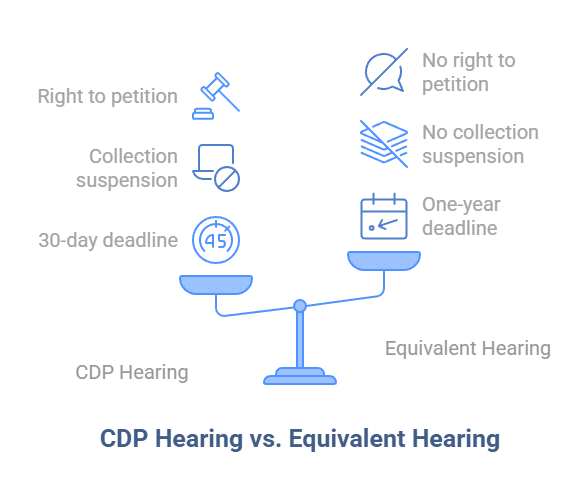
A Collection Due Process hearing and an equivalent hearing are similar in structure. But there are key differences that you should understand.
An equivalent hearing is available if you miss the 30-day deadline to request a CDP hearing. You can still submit Form 12153 within one year of the date on your IRS notice, and the IRS will grant you an equivalent hearing with the Office of Appeals.
However, unlike a CDP hearing, requesting an equivalent hearing does not suspend IRS collection actions. The IRS can still levy your assets while your case is being reviewed. You also do not have the right to petition the U.S. Tax Court if you disagree with the outcome of an equivalent hearing.
Need a Tax Attorney for Your IRS Hearing Request?
When you receive an IRS collection notice, timing is everything. Acting quickly can make the difference between protecting your assets and facing aggressive collection actions.
Keep in mind that the Collection Due Process hearing gives you a critical window to assert your rights, challenge the IRS’s actions, and find a reasonable solution to your tax issue before things escalate. This is your legal right, but exercising it effectively takes more than just filling out a form. With the help of an experienced tax attorney, you can present your case properly, explore relief options like an installment agreement or Offer in Compromise, and increase your chances of a favorable outcome.
At Victory Tax Lawyers, we help taxpayers navigate CDP hearings with confidence. If you’ve received a collection notice from the IRS, don’t wait. Schedule a free consultation with one of our tax professionals today.
FAQs
Here are some of the most common questions taxpayers ask about CDP hearings:
Is a CDP Hearing the Same as an Audit?
No. An audit reviews your tax return for accuracy. On the other hand, a CDP hearing allows you to challenge IRS collection actions before they’re enforced.
Can I Stop a Levy by Requesting a CDP Hearing?
Yes. The IRS is required to pause collection actions if you request a CDP hearing within 30 days of receiving a Final Notice of Intent to Levy. Therefore, your tax levy stops until the hearing process is completed.
Do I Have to Attend the Hearing in Person?
No. Most CDP hearings are conducted by phone or through written correspondence. You won’t normally need to appear in person unless specifically required or you request an in-person meeting.
Can I Still Pay My Taxes During the CDP Process?
Yes. You can and often should make voluntary payments during the CDP process. This can show good faith and help reduce penalties and interest while you work toward a resolution.
Can I Request More Than One CDP Hearing?
Generally, you’re entitled to one CDP hearing per tax period and type of collection action. However, you can qualify for another hearing in some cases. If new collection actions occur or you receive a new Final Notice, you can make another CDP hearing request.
How Long Does a Due Process Hearing Take?
Many hearings are resolved within a few months. The complexity of your case, responsiveness to IRS requests, and availability of documentation all influence the time duration.