IRS ACS Support Stop 5050 is a temporary hold placed on a taxpayer’s account within the Internal Revenue Service (IRS) Automated Collection System to pause certain collection actions. If you cannot keep up with payments, you can request a hardship hold on collections while you sort out your options. It does not cancel or reduce your tax debt and is usually applied due to pending payments, disputes, or missing filings, such as an incomplete form. The stop typically lasts 30 to 90 days, giving you a limited window to address the issue before IRS employees resume enforcement. During this period, it’s important to act responsibly by verifying your balance, setting up a payment plan, or consulting a tax professional to resolve your obligations.
At Victory Tax Lawyers, our seasoned tax professionals can help with an ACS Support Stop 5050 notice. Schedule a free tax attorney consultation today.
This guide explains how ACS Support Stop 5050 works, why it’s applied, and what steps you can take to avoid serious IRS enforcement.
What Is an IRS ACS Support Stop 5050?
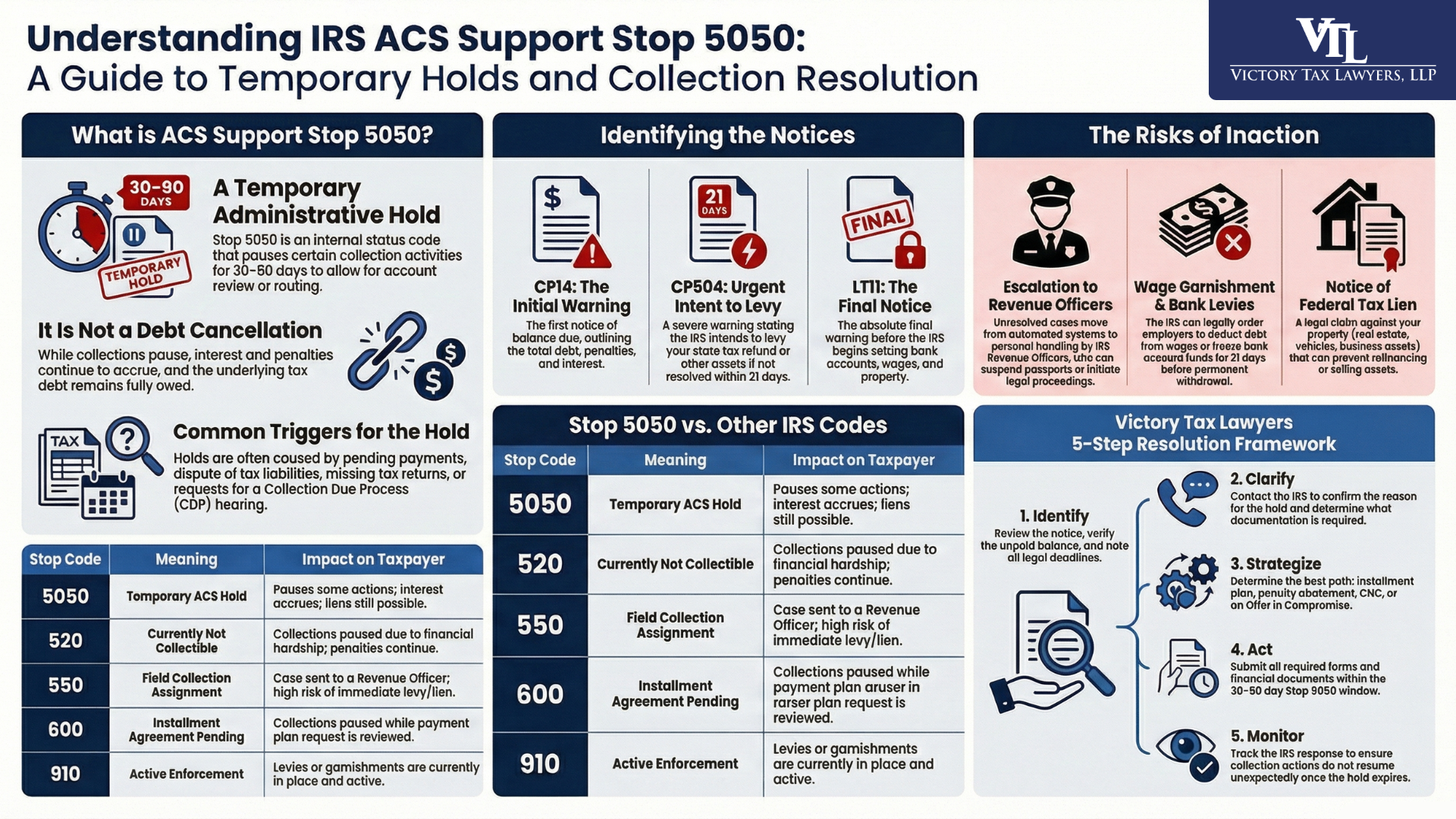
If you’re wondering what an IRS ACS support stop 5050 is, it refers to a temporary hold placed within the IRS’s Automated Collection System (ACS) that pauses certain collection activities on a taxpayer’s account. This internal status code is used by the IRS to ensure accuracy while reviewing a case, resolving discrepancies, or verifying information before moving forward with enforcement.
When there are unresolved tax problems that need more investigation, such as pending paperwork, balance disputes, or claims of reasonable cause for noncompliance, the IRS usually applies a support stop 5050. During this period, collection efforts like levies or aggressive follow-ups may be delayed, but the account is not considered resolved or in good standing.
This stop code serves an administrative purpose. It allows the IRS to prevent premature or incorrect additional actions while giving time to assess the taxpayer’s situation properly. In many cases, it is triggered by taxpayer communication, requests for relief, or internal reviews initiated by the IRS to confirm the correct course of action.
How Does the IRS ACS System Typically Operate in Collecting Debts and Contacting Taxpayers?

ACS operates by issuing notices, making phone calls, and sometimes enforcing tax collection measures. According to the IRS Data Book, in FY 2024, the IRS collected $77.6 billion in unpaid taxes after credits, illustrating how active the agency’s collection function remains. Once a taxpayer's overdue tax liability is entered into the ACS system, the IRS begins a structured collection process which includes;
- Initial Contact and Notices from IRS: The IRS will first send a series of notices to make the taxpayer fully aware of their outstanding tax balance. These notices include CP14 (balance due notice), CP504 (urgent intent to levy notice), and LT11 (final levy warning).
- Phone Communication from ACS Agents: ACS employees or agents will contact the taxpayer by phone when no action is taken after the initial notices. The taxpayer will receive incoming calls from an IRS office regarding their payment arrangements or warnings about impending enforcement actions.
- Enforcement Actions if No Response: ACS has full authority to take enforcement actions if the taxpayer fails to respond to the call from the IRS office. The actions could be to file a tax lien, issue a levy on the bank accounts of the person involved, or apply offsets to future tax refunds.
- Resolution Options for Taxpayers: Taxpayers can request various relief options under the IRS Fresh Start Program to prevent further enforcement actions. The options include installment agreements, Offer in Compromise, or Currently Not Collectible (CNC) status. This means that enforcement actions can be paused under a specific condition: ACS Support Stop 5050.
IRS ACS Support Stop 5050 vs Other IRS Stop Codes
Within the IRS collection system, each code denotes a distinct status that can have a substantial impact on enforcement actions, processing schedules, and your options for resolution. It is easier to understand what your situation entails and what actions you should take to maintain compliance and prevent escalation when you compare Stop 5050 with other common IRS stop codes.
| Stop Code | Meaning | Common Causes | Impact on Taxpayer | Recommended Action |
|---|---|---|---|---|
| 5050 | Temporary hold for account review or routing within ACS | Incorrect filings, pending appeals, IRS processing errors, and CDP consideration | May pause some collection actions, but interest accrues, and liens can still be filed | Verify notice, contact IRS, resolve underlying issue quickly |
| 520 | Account placed in Currently Not Collectible (CNC) status | Financial hardship, inability to pay | Collection actions are generally paused, but penalties and interest continue | Submit financial information and maintain compliance |
| 530 | Account deemed uncollectible (unable to locate taxpayer or no assets) | IRS cannot contact the taxpayer or collect | Temporary halt in collections, but the case may be reopened later | Update contact details and resolve outstanding filings |
| 550 | Case assigned to a revenue officer for field collection | High balance, complex case, non-response to notices | Increased enforcement risk, possible liens or levies | Respond immediately and consider professional representation |
| 600 | Installment agreement pending or under review | Request for payment plan submitted | Collection actions may be paused while the request is reviewed | Provide the required documents and follow up with the IRS |
| 910 | Active levy or enforcement action in place | عدم payment or unresolved debt after notices | Bank levies or wage garnishments may occur | Act urgently, contact the IRS, or seek professional help |
What Are the Common Reasons for an IRS ACS Support Stop 5050?
Several situations can trigger an IRS ACS support stop 5050, and most of them relate to the IRS needing time to review a taxpayer’s account before taking further collection steps. One common reason is a pending payment or recently submitted financial information. In this case, the IRS may temporarily pause collection efforts to ensure accuracy and confirm that the payment or arrangement has been properly processed.
Another frequent cause involves disputes over tax liabilities, such as when a taxpayer challenges the amount owed or submits documentation to support adjustments. The IRS uses this hold to evaluate the claim and determine whether corrections are necessary before resuming enforcement. Similarly, claims of reasonable cause, such as hardship or unforeseen circumstances, can prompt a stop while the IRS reviews eligibility for penalty relief or alternative resolutions.
Administrative holds are also a key trigger. These may occur when a case is being transferred within the IRS, assigned to a different unit, or flagged for internal review. During this time, the ACS system pauses automated collection actions to prevent errors or duplicate enforcement.
Each of these scenarios directly affects how the IRS proceeds with collections. While the stop 5050 may delay actions like levies or repeated contact, it does not place the account in good standing or eliminate the underlying tax problems. Instead, it reflects a procedural safeguard within IRS rules, allowing the agency to verify information and avoid taking incorrect or premature additional actions against the taxpayer.
How Do You Respond to an IRS ACS Support Stop 5050?

When your account is marked with an IRS ACS Support Stop 5050, it means your case is under review, not resolved. While this may temporarily pause certain collection actions, it does not stop your obligations. Acting quickly and correctly during this window can prevent penalties, liens, or sudden enforcement once the hold is lifted.
Step 1: Understand the Stop 5050 Status
Stop 5050 is primarily a mail-routing marker within the IRS Automated Collection System (ACS), created in the 1980s to handle overdue accounts more efficiently. It is typically triggered when your account needs further review due to incorrect filing, pending appeals, or IRS processing errors, and may also apply while the IRS considers your eligibility for a Collection Due Process (CDP) hearing.
Step 2: Verify Your Notice and Balance
Verification of the notice and the associated tax amounts is critical for taxpayers during this period to ensure accuracy and understanding of their status. Double-check all figures, deadlines, and instructions before taking action.
Step 3: Contact the IRS for Clarification
Call the number on your notice to confirm why the hold was placed and what is required from you. This prevents guesswork and helps you respond appropriately.
Step 4: Take Immediate Action
You can respond to an IRS notice by paying your balance in full, setting up an installment agreement, or requesting Currently Not Collectible status if you are facing financial hardship. In our experience, it is best to choose the option that fits your situation and act promptly.
Step 5: Protect Your Rights if Needed
You can request a Collection Due Process hearing if you disagree with the IRS’s actions, but you must do so within 30 days of receiving a notice of intent to levy. Missing this deadline can limit your options.
Step 6: Track the Hold Timeframe
The hold associated with Stop 5050 typically lasts 30 to 90 days and is a temporary measure, not a cancellation of debt. To prevent collection actions from resuming, it is important to act within the timeframe specified in the IRS notice.
Step 7: Account for Ongoing Costs
Interest and penalties continue to accrue during the Stop 5050 hold period, and the IRS can still file a notice of Federal Tax Lien even while the hold is in effect.
Step 8: Stay Prepared for the Next Steps
Once the IRS completes its review or the hold ends, collection actions can resume quickly without further warning. Staying organized and responsive helps you avoid escalation.
Victory Tax Lawyers 5-Step ACS Resolution Framework

An IRS ACS Support Stop 5050 temporarily pauses collection actions, but your tax debt and penalties continue to grow. Avoiding liens, levies, and other enforcement requires prompt action. Victory Tax Lawyers can guide you through a simple 5-step framework to protect your finances and resolve your account efficiently.
- Identify – Review your notice, verify your unpaid balance, and note all deadlines.
- Clarify – Call IRS employees to confirm why the hold was placed and what documentation is needed.
- Strategize – Determine the best resolution: installment plan, penalty abatement, CNC, or Offer in Compromise.
- Act – Submit required forms and documentation within the Stop 5050 timeframe.
- Monitor – Track IRS responses and ensure collection actions do not resume unexpectedly.
Real Case Example
For example, one client received a Stop 5050 while disputing a $12,500 balance. With our guidance, they submitted documentation and qualified for the Currently Not Collectible status. Collection actions were paused, and penalties totaling $2,300 were reduced under first-time penalty abatement.
Why Did You Receive a Notice from ACS Support Stop 5050?
Once you receive a notice from ACS Support Stop 5050, it implies that the ACS has temporarily halted collection actions on your account as a result of unresolved tax issues or pending reviews. Here are the common reasons why this temporary stop may have been applied.
Unpaid Taxes or Overdue Tax Liabilities
If you have pending taxes to pay and have not set up a payment plan, ACS may temporarily hold collections while deliberating on the following action. This often applies when you contact ACS to discuss a resolution, but you have not finalized an agreement with them.
IRS Tax Liens and Levies
If the IRS is about to issue a tax lien or tax levy, a temporary stop may be placed while they check your ability to pay or while there's a pending appeal. However, once the review period ends, the IRS will move on with enforcement unless action is taken.
Incorrect or Missing Tax Return Filings
Stop 5050 is also applied to verify your filing history if the IRS has incomplete or missing tax return records. In other words, it is applied if the IRS finds unfiled returns or discrepancies in your reported income.
Mis communication or Clerical Errors in IRS Records
You'll also receive a notice from ACS Support Stop 5050 when there's an internal processing error or incorrect information on your account. In such cases, additional documentation will be required by the IRS before the stop is removed or further action is taken.
Despite all these reasons, maintain proper communication with the IRS to avoid delays in resolution. The IRS does not provide indefinite holds, and if you fail to respond or take corrective action, collection activities will restart.
Types of Notices Sent by ACS Support Stop 5050
When the IRS places an ACS Support Stop 5050 on your account, they send notices to inform you of the temporary hold and your overdue tax that needs resolution. These have different purposes and severity for issuance, but all require immediate attention.
The most common types of notices sent by ACS Support Stop 5050 include:
- CP504, an urgent notice of intent to levy.
- LT11, the final notice before levy action.
- CP14, the first notice of balance due.
CP504: Urgent Notice of Intent to Levy
The CP504 notice is an urgent, severe warning sent to taxpayers with overdue tax debts. It informs you that the IRS has an urgent intent to levy your state tax refund. The letter is issued after multiple attempts have been made to contact you regarding unpaid taxes.
CP504 contains your tax liability details, interest, penalties, and payment deadline. Once the 21-day deadline elapses without a response, the IRS may move forward with a levy on your state tax refund, bank accounts, or wages.
LT11: Final Notice Before Levy Action
LT11 is one of the IRS's most serious warnings before enforcing collection actions. It informs taxpayers that their assets may be seized if they do not take immediate action. This letter serves as the IRS's final notice before levying bank accounts, wages, and other property.
An LT11 notice means the IRS is prepared to take action. Once the deadline in the letter passes, they can proceed with enforcement actions, even if the ACS Support Stop 5050 is currently applied. The only way to stop a levy is to pay the tax debt, set up a payment plan, or request a CDP hearing.
CP14: First Notice of Balance Due
The CP14 notice is the IRS’s initial warning that you have an unpaid balance. It is the first letter in the collection process and typically arrives well before more serious notices, such as CP504 or LT11. This notice outlines your total tax debt, including any penalties and interest, clearly states your payment deadline to avoid additional charges, and provides options for resolving the balance, such as setting up an installment agreement or exploring tax relief programs. If the balance carries over from prior years, it is wise to work with a back-tax attorney to resolve your IRS balance before enforcement resumes.
Although a CP14 does not signal immediate enforcement, it should not be ignored. If left unresolved, the IRS will continue escalating the collection process, which can lead to more aggressive actions and higher costs over time.
Other IRS Notices Related to ACS Support Stop 5050
Beyond CP504, LT11, and CP14, taxpayers dealing with ACS Support Stop 5050 may also receive other IRS letters, including the CP501 notice. An early-stage reminder that you have an unpaid tax balance. This notice is sent after the initial CP14 balance due notice, but you have still not responded or made a payment.
The CP503 notice is the second follow-up letter sent to taxpayers who have yet to respond to the CP501. This notice increases the urgency and warns you that the IRS may take further action if payment is not made. It demands immediate payment of the outstanding balance and provides a final deadline before enforcement begins.
CP2000 is another type of notice. However, it does not necessarily indicate unpaid taxes, which makes it different from other collection notices. Instead, it informs you of the discrepancies the IRS has noticed in your tax return.
Lastly, you'll receive a CP523 notice when you fail to stick to your payment plan after reaching an installment agreement with the IRS. It warns that the IRS may terminate the agreement and proceed with enforcement actions if the issue is unresolved.
You may have believed you are automatically protected from enforcement once an installment agreement is set up. However, defaulting on payments puts you back into the collection process, which increases your risk of facing serious IRS actions.
When Should You Seek Professional Help From a Tax Professional?
You should consider seeking help from a tax professional when you are dealing with a complex or unresolved ACS Support Stop 5050 notice. IRS communications often contain technical language that can be difficult to interpret, and a tax attorney or CPA can help you understand your obligations, verify your unpaid balance, and determine the next responsible step toward resolution.
Another clear sign you need professional support is when you have received multiple IRS notices and have not taken action. Notices such as CP504, LT11, or CP14 indicate that the IRS is moving closer to enforcement, and delays can lead to additional costs, including failure to pay penalties that increase the amount of money you owe. A tax professional can step in early to negotiate tax relief options, including installment agreements or first-time penalty abatement, helping you work toward the best possible outcome.
Handling IRS agents and navigating the Automated Collection System can also become overwhelming, especially in cases involving liens or levies. A tax professional brings experience and structure to these interactions, ensuring that your case is presented clearly and that you remain compliant while protecting your financial position.
If you are facing financial hardship and cannot afford to pay your tax debt in full, professional guidance becomes even more important. A qualified expert can assess your situation and help determine whether you qualify for relief programs such as Currently Not Collectible status or an Offer in Compromise.
“In our experience, ACS Support Stop 5050 gives taxpayers a short but critical window to act responsibly,” says Parham Khorsandi, Managing Attorney at Victory Tax Lawyers. “Ignoring it can quickly escalate into liens, levies, and wage garnishments, even while the stop is technically in place.”
Finally, if your case is assigned to an IRS revenue officer, it signals a more serious stage of enforcement. At this point, having a tax attorney represent you can make a significant difference, as they can negotiate directly with the IRS, protect your assets and income, and help you reach a resolution that aligns with what you can realistically afford.
What Happens If You Ignore an ACS Notice?
If you ignore an ACS notice, you'll incur IRS enforcement actions, including collection process escalation, wage garnishment, bank levies, and asset seizures until you resolve your tax debt. The IRS Automated Collection System (ACS) is designed to enforce tax laws efficiently, and once you fail to respond, the agency moves forward with the following enforcement measures:
IRS Collections Process Escalation to Revenue Officers
When the IRS does not receive a response to ACS notices, the collection process automatically moves forward. The CP14 notice serves as a warning, but as time passes, the IRS begins issuing more serious letters, such as CP504 and LT11.
If you still don't give a response, the ACS agent will transfer your case to the Collection Field Function (CFF), where IRS revenue officers personally handle enforcement. At this stage, the IRS will likely restrict you from obtaining credit, suspend your passport, or initiate legal proceedings to enforce collection.
Potential Wage Garnishment and Bank Levies
Wage garnishment is a very severe consequence of ignoring an ACS notice. If you fail to arrange for a resolution, the IRS can decide to contact your employer or manager and place an order for a significant portion of your wages to be deducted automatically until your debt is fully paid.
Besides wage garnishment, the IRS may issue a bank levy, allowing it to freeze and seize funds directly from your bank account. Once this levy is placed, you have only 21 days to resolve the issue before the IRS permanently withdraws the funds.
Tax Liens and Asset Seizures
The IRS may file a tax lien or a legal claim against your assets if you ignore any ACS notice for a long time. It gives the IRS a secured interest in your personal and business property. This makes selling assets, refinancing your home, or even getting new credit difficult. The IRS may also proceed with asset seizure, which gives them full access and ownership over your assets to satisfy the debt.
What Is the Impact of IRS ACS Support Stop 5050 on Taxpayer Accounts and Collections?
An IRS ACS Support Stop 5050 can temporarily pause certain collection actions, but it does not eliminate your tax debt or remove enforcement risk. In many cases, actions like wage garnishment or bank levies may be delayed while the IRS reviews your account, especially if the hold is tied to a dispute, appeal, or internal processing issue. However, this pause is not guaranteed to stop all enforcement activity, and it should not be viewed as long-term protection.
This status can also lead to delays in IRS processing, including the approval or continuation of installment agreements or other payment arrangements. Since Stop 5050 is often triggered by issues such as incorrect filings, pending appeals, or document processing errors, the IRS may need additional time to verify information before moving forward. These delays can prolong uncertainty and extend the time it takes to fully resolve your account.
At the same time, Stop 5050 still operates within the broader IRS collection framework. It can coexist with other enforcement tools, meaning the IRS may still file a Notice of Federal Tax Lien even while the hold is active. Once the review is complete or the hold period ends, collection activities can resume quickly, sometimes without additional notice. In our experience, it is important to treat the hold as a short window to resolve issues rather than a pause you can ignore.
Need Help With an ACS Support Stop 5050?
Victory Tax Lawyers stand out because we combine years of IRS negotiation experience with a structured, client-focused approach. We specialize in ACS Support Stop 5050 cases, offering tailored strategies to reduce penalties, protect assets, and achieve the best possible outcome. In many cases we can also help you ask the IRS to abate the penalties that inflated your balance. While Stop 5050 can temporarily pause some collection actions, it is not a guarantee. IRS employees can still file liens or resume levies once the review is complete, so acting quickly remains essential.
With over $100 million saved for clients since 2017, Victory Tax Lawyers, a Los Angeles-based tax firm, delivers experienced legal help you can count on to get real IRS solutions. Get the help you deserve. Contact us for a free consultation today!
Frequently Asked Questions
During the process of writing this blog, we encountered some frequently asked questions related to the ACS Support Stop 5050. We did our best to answer some of them.
What Does IRS ACS Support Stop 5050 Mean on My Tax Account?
An IRS ACS Support Stop 5050 indicates that your account has been placed on a temporary hold for internal review or routing within the Automated Collection System. It is often triggered by issues like pending appeals, incorrect filings, or processing errors, and does not mean your tax debt has been resolved.
How Long Does an IRS ACS Support Stop 5050 Last?
An IRS ACS Support Stop 5050 typically lasts between 30 and 90 days, depending on the complexity of the review. It is a temporary measure, and collection actions can resume quickly once the hold is lifted.
Can I Resolve a Stop 5050 Without Paying the Full Amount Owed?
Yes, you can resolve a Stop 5050 without full payment by setting up an installment agreement, requesting Currently Not Collectible status, or pursuing other IRS relief options. The best approach depends on your financial situation and the reason the hold was applied.
What Happens if I Ignore an IRS ACS support stop 5050?
Ignoring a Stop 5050 can lead to the resumption of IRS collection actions, including levies or liens, once the hold period ends. Interest and penalties will continue to accrue, increasing your overall balance.
How Can Victory Tax Lawyers Help With IRS Collection Stops?
Victory Tax Lawyers can review your IRS account, identify the reason for the Stop 5050, and develop a strategy to resolve it efficiently. They can also communicate with the IRS on your behalf, help secure payment arrangements, and protect you from escalated enforcement actions.
Legal Disclaimer: This content is provided for informational purposes only and does not constitute legal or tax advice. Reading this article does not create an attorney-client relationship. Tax situations vary, and you should consult a qualified tax attorney or tax professional regarding your specific circumstances before taking action.