
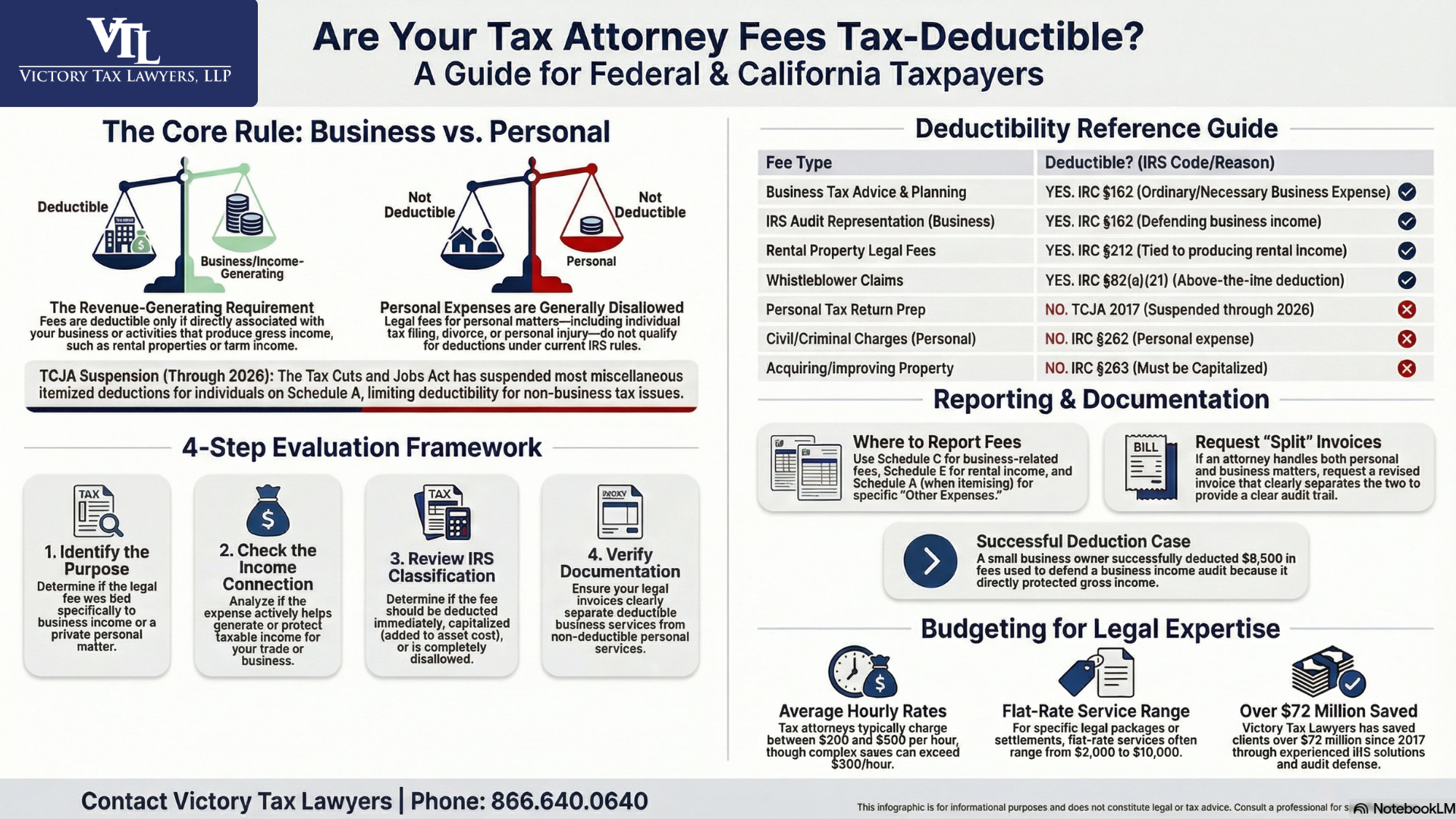
Tax attorney fees are tax-deductible, but only if they are directly associated with your business or activities that generate revenue. In general, fees for managing farm income, rental properties, or other income-related matters, as well as for business tax advice and IRS audit representation, are deductible. Generally speaking, legal fees for non-business tax issues, civil or criminal charges, personal injury, and personal matters are not deductible. Federal regulations generally apply in California, but state-specific details may have an impact on deductibility, so it’s advisable to speak with a tax expert.
At Victory Tax Lawyers, our seasoned tax professionals can help with sorting out deductible fees tax. Schedule a free tax attorney consultation today.
This blog explains when tax attorney fees are deductible, how they affect your federal and California tax returns, and practical tips for documenting and reporting them correctly.
When Are Tax Attorney Fees Deductible?
Tax attorney fees are deductible when the costs incurred are directly related to producing or protecting gross income, especially in a business context. A taxpayer can claim deductible attorney fees as ordinary expenses for a legal case involving business income, including audit defense, disputes with an insurance company, and related court costs or other costs within the same tax year.
However, fees tied to non-business tax issues are generally not deductible. Personal legal expenses, even if tax-related, do not qualify under IRS rules such as those in Publication 529, unless specific exceptions apply. According to U.S. Government Accountability Office data, IRS audit rates have dropped to roughly 0.25% in recent years.
In limited cases, deductible attorney fees may include expenses from whistleblower claims or employment disputes where an employee seeks taxable compensation. These situations may allow deductions if the costs are connected to income recovery, though other rules and the structure of the agreement can affect eligibility.
How Do Tax Attorney Fees Impact Your Tax Return?
Tax attorney fees can directly affect how much tax you owe, depending on where and how they are reported. Business-related fees are typically deducted on Schedule C, while fees tied to rental income are reported on Schedule E, and legal fees are deductible if they are common, accepted, and helpful in the taxpayer’s trade or business.
Certain legal fees can be deducted above the line, reducing Adjusted Gross Income directly, such as those related to discrimination suits or specific employment claims. However, the Tax Cuts and Jobs Act (TCJA) suspended most miscellaneous itemized deductions, including many attorney fees, through 2026, limiting what individuals can claim on Schedule A. The treatment also depends on the nature of the service, as business-related tax advice, IRS audit representation, and tax planning are typically deductible.
Whereas some costs, such as those tied to acquiring assets or improving property, must be capitalized instead of deducted immediately. Legal invoices must clearly distinguish between deductible and non-deductible services, and large or unusual deductions may increase the likelihood of IRS scrutiny.
“In our experience working with taxpayers, one of the most common issues is misclassifying personal legal fees as business expenses, which can significantly increase audit risk and lead to denied deductions,” says Parham Khorsandi, Managing Attorney at Victory Tax Lawyers. Since reporting errors can impact your return or trigger an audit, it is prudent to consult with an experienced tax accountant before committing to a specific treatment on tax returns.
How Much Do Tax Attorneys Charge?
The cost of hiring a tax attorney isn’t fixed. It often depends on several factors, including experience, location, and the complexity of the case involved. For instance, you might pay anywhere from $100 to $400 per hour for a straightforward consultation. Whereas for more complex cases, such as handling audits or perhaps negotiating settlements, you could pay $500 an hour or more. In general, a tax attorney would often charge anywhere between $200 to $500 per hour or $2,000 to $10,000 for flat-rate services.
Beyond fees, understanding the services a tax attorney provides helps you truly appreciate the value they bring to every case. Of course, while not every tax case requires the expertise of a tax attorney, knowing when to hire one is critical. These legal professionals offer assistance in diverse areas, including tax planning, audit defense, IRS negotiations, and legal representation. Without experienced representation, you risk making costly mistakes that could lead to more than just financial losses. They could also result in irreversible consequences or, even worse, criminal charges.
While hiring a tax attorney involves upfront costs, it can often prevent larger financial losses from penalties, disallowed deductions, or IRS disputes. However, for straightforward matters, such as basic tax filing questions, the cost of legal representation may outweigh the benefit, making it important to evaluate the complexity of your situation.
The 4-Step Framework to Determine If Your Legal Fees Are Deductible

To simplify IRS rules, we recommend using this quick framework as a practical way to evaluate whether your tax attorney fees qualify for a deduction before you file your return. Instead of navigating complex tax code sections, this approach breaks the decision into clear, logical steps that focus on purpose, income connection, IRS classification, and documentation. By following this structure, you can quickly identify potential issues, avoid misclassification, and improve your chances of claiming deductions correctly.
- Identify the Purpose – Was the legal fee tied to business income or personal matters?
- Check the Income Connection – Does the expense help generate or protect taxable income?
- Review IRS Classification – Is it deductible, capitalized, or disallowed?
- Verify Documentation – Do your invoices clearly separate deductible and non-deductible fees?
This approach helps taxpayers quickly assess whether their legal expenses qualify before filing.
When Are Tax Attorney Fees Deductible in Different Scenarios?
When it comes to deductions, the IRS is quite specific. You can deduct legal fees that are ordinary and necessary business expenses. Personal legal fees, however, are no longer deductible under the Tax Cuts and Jobs Act (TCJA).
When Are Tax Attorney Fees Deductible?
Typically, you can claim a deduction on your tax attorney fees when:
- The fees are incurred for business-related tax issues – Legal fees that were strictly incurred for your business, such as fees paid for audits, compliance issues, or tax planning, are considered tax-deductible.
- The fees are associated with income generation – Attorney fees incurred on generating additional income for your business, such as fees incurred on legal advice for investments, rental income, or royalties, generally qualify.
- Self-employment deductions – Self-employed individuals can deduct legal fees related to their trade or business. For example, fees paid to hire a tax attorney to negotiate on your behalf during an IRS audit of your business income would be deductible.
When Are Tax Attorney Fees Not Deductible?
Not all tax lawyer fees are deductible, particularly if they are related to personal issues rather than activities that generate revenue. You can lower the possibility of problems with your tax return and avoid claiming prohibited expenses by being aware of these restrictions. Here are some cases that won’t meet the tax cut:
- Personal Tax Advice – Fees that relate to non-business tax issues or tax advice, such as filing your personal taxes or handling disputes over your individual tax refund, aren’t deductible.
- Criminal Tax Investigations – If you’re facing criminal charges for tax fraud or evasion, the legal fees incurred in your defense typically don’t qualify for a deduction, especially if the issue isn’t linked to a business.
- Non-Business Tax Disputes – Disputes over personal tax issues, such as challenging penalties on your return or addressing other IRS-imposed punishments, aren’t deductible.
- Personal tax expenses – All fees incurred on personal expenses, such as fees on will contests, disputes over inheritance, custody battles, divorce proceedings, house purchases, personal vehicle purchases, and the rest, are not tax-deductible.
For instance, if you hire a lawyer to handle a personal lawsuit involving a divorce or inheritance dispute, those legal fees are not deductible. However, if the same legal service is tied to rental properties or business income, the outcome may be different.
Comparison of Deductible vs. Nondeductible Tax Attorney Fees
This table provides a quick reference to help you determine whether specific tax attorney fees qualify for a deduction based on IRS guidelines.
| Fee Type | Deductible? (Yes/No) | IRS Code Reference | Notes/Examples |
|---|---|---|---|
| Business tax advice and planning | Yes | IRC §162 | Ordinary and necessary expenses for running a business |
| IRS audit representation (business-related) | Yes | IRC §162 | Includes defending business income during an audit |
| Legal fees for rental properties | Yes | IRC §212 | Expenses tied to producing rental income |
| Tax advice for farm income | Yes | IRC §162 | Applies to income-generating farming activities |
| Whistleblower claims | Yes | IRC §62(a)(21) | May qualify for above-the-line deduction |
| Employment-related claims (e.g., discrimination) | Yes | IRC §62(a)(20) | Deductible if tied to taxable compensation |
| Personal tax return preparation | No | TCJA (2017) | Miscellaneous deductions suspended through 2026 |
| Divorce or personal legal disputes | No | IRC §262 | Considered personal expenses |
| Civil or criminal charges (personal) | No | IRC §262 | Not related to income production |
| Personal injury legal fees | No | IRC §104 | Typically excluded from taxable income and deductions |
| Fees to acquire or improve property | No (Capitalized) | IRC §263 | Must be added to asset cost, not deducted immediately |
| Nonbusiness tax issues | No | TCJA (2017) | Most personal tax-related fees are not deductible |
This comparison helps clarify that fees connected to generating or protecting income are generally deductible, while personal legal expenses are not, unless a specific IRS exception applies.
How Can You Claim Tax Attorney Fees on Your Tax Return?

Depending on the type of legal services and how they connect to your income or business operations, you may be able to claim tax attorney fees on your tax return. You can maximize your eligible deductions and prevent expensive filing errors by knowing where and how to report these expenses.
1. Itemize Your Deductions
The first thing you need to do is itemize your deductions rather than take the standard deduction. The standard deduction reduces your taxable income by a fixed amount. In contrast, itemizing your deductions allows you to list specific expenses, like tax attorney fees, that might eventually add up to more than the standard deduction.
Tax attorney fees typically fall under the Other Expenses category when itemizing on Schedule A of your Form 1040. If you’re still unsure which fees qualify for a tax break, you need to hire a tax attorney to help you so you don’t make mistakes.
2. Document All Fees
Documentation is essential when dealing with the IRS, as it supports every tax deduction you claim. Keep detailed records of all legal fees, including invoices, contracts, and receipts, and ensure each clearly describes the services provided. Legal fees incurred in the ordinary course of business are generally tax-deductible, and attorney fees related to business matters are often considered tax-deductible expenses when tied to income-producing activities.
For example, fees to defend a lawsuit or resolve a business-related tax dispute are typically deductible because they arise from profit-seeking activities, while fees for personal tax advice or criminal cases are not. Some costs must be treated differently, as fees to defend or perfect a title to real estate must be capitalized, and costs for initial patent applications are typically amortized over 15 years.
If your attorney’s invoice does not clearly separate deductible and nondeductible services, request a revised version. This is especially important for legal settlements, where taxpayers must report awards at their gross value regardless of attorney fees deducted, though fees may still be deductible if paid in the same year. Legal fees related to whistleblower claims or certain ERISA disability claims may also qualify under specific conditions, making proper documentation critical for compliance.
3. Report Fees on the Tax Return
Once you’ve confirmed which legal fees are deductible, the next thing is to report them correctly. Here’s how you should go about this:
- Complete Schedule A on your Form 1040.
- Locate the Other Miscellaneous Deductions section.
- Enter the total amount of your deductible legal fees.
4. IRS Forms & Supporting Documentation
In addition to Form 1040 and Schedule A, it’s advisable to keep handy all supporting documents, such as detailed invoices and statements from your attorney specifying the services they have provided. While you may not need to submit them with your return, they are necessary since the IRS can request verification at any time.
5. Consult a Tax Professional
Tax laws are complex, and the tax codes are almost always changing. Consulting a tax professional is your fail-proof way of ensuring you claim your deductions correctly, especially if you have a complicated case.
Many professionals also offer free consultations to help you assess your needs and budget. While many deductions are straightforward, more complex cases involving mixed-use legal services or large expenses may require professional guidance to ensure compliance and avoid disputes with the IRS.
How Can You Budget for Tax Attorney Fees?
With a bit of planning and budgeting, you may be able to keep costs under control. Here are some ways to take control of your budget:
1. Get a Detailed Estimate
Before you hire an attorney, discuss their fees in detail. Get clarity on their billing structure. Do they charge hourly, offer flat fees, work on contingency fees, or prefer a retainer? Understand what happens to unused retainer funds. Ask about payment plans and any potential additional costs. Make sure you know to the letter what services are being covered in your payment.
2. Set a Budget for Legal Services
Decide how much you’re willing to spend and stick to it. Don’t be afraid to discuss payment options or negotiate a flat fee if that works for you. The point is to be clear about the payment terms from the start so that you don’t encounter surprises down the line.
As we mentioned, attorneys set their fees based on different factors. This means you may get the same service at a more affordable or pricey rate, depending on who you’re meeting. But as we all know, the cheapest option may not provide the best service. Value and expertise often justify higher rates, so rather than sacrifice value, aim for a balance between cost and quality.
3. Keep Track of Billing and Hours
Ask for itemized billing so that at the end of the day, you’re only being billed for the services they provide. If you’re being charged by the hour, make sure you’re keeping an eye on the time spent on your case. If you need to ask your attorney upfront what you’re being billed for, do so. Transparency is right once you’ve made a financial commitment.
4. Consult Before Taking Action
Sometimes, a consultation alone is all you need. Use initial meetings to evaluate whether there’s a need for full representation. A good tax attorney can save you money and problems in the long run, so take your time to make the best choice for you. In doing so, prioritize value over cost.
Real Example: When Tax Attorney Fees Were Successfully Deducted

In our experience, one of the most common successful scenarios involves business owners facing IRS audits. For example, a small business owner incurred $8,500 in legal fees while defending a business income audit. Because the legal case was directly tied to protecting gross income, those costs were fully deductible as ordinary business expenses.
On the other hand, we have seen individuals attempt to deduct similar fees related to personal tax disputes, only to have those deductions denied. This contrast highlights how critical the income connection requirement is when determining deductibility.
How Should You Document and Report Tax Attorney Fees?
Proper documentation and reporting are key to ensuring a tax deduction for attorney fees is allowed and withstands IRS scrutiny. Invoices about non-business tax matters, personal injury, civil or criminal charges, or unlawful discrimination claims are typically not deductible, so taxpayers should maintain thorough records that clearly identify which services are associated with deductible tax issues.
To ensure that there is a clear link between the legal service and taxable income, it is advisable to speak with tax lawyers or your attorney regarding how fees will be reported. To prevent mistakes, clearly identify deductible fees when reporting on tax forms or schedules. Additionally, make sure to adhere to IRS guidelines for the appropriate distribution of funds. Common errors that can lead to denied deductions or increased audit risk include combining personal and business-related legal costs or improperly itemizing deductible fees.
Need Help with Tax Issues?
Unlike general overviews, this guide breaks down IRS rules into practical, real-world scenarios and provides a clear framework for determining deductibility. By combining legal principles with actionable steps and examples, it helps you avoid costly mistakes and confidently apply tax rules to your specific situation.
With over $72 million saved for clients since 2017, Victory Tax Lawyers, a Los Angeles-based tax firm, delivers experienced legal help you can count on to get real IRS solutions. Get the help you deserve. Contact us for a free consultation today!
Frequently Asked Questions
During the process of writing this blog, we encountered some frequently asked questions related to deductible tax attorney fees. We did our best to answer some of them.
Are Tax Attorney Fees Deductible for Personal Tax Audits?
Tax attorney fees for personal tax audits are generally not deductible because they are considered non-business expenses. Unless there is a direct connection to income-producing activities like rental properties or property claims, these costs cannot reduce your taxable income.
How Do I Report Tax Attorney Fees on My Tax Return?
You report deductible tax attorney fees on the appropriate schedule based on their purpose, such as Schedule C for business or Schedule E for rental properties. Make sure the fees clearly show a connection to income, and separate them from any personal lawsuit or non-business expenses.
Can I Deduct Fees Paid for Criminal Tax Defense?
Fees paid for criminal tax defense are generally not deductible, especially if they relate to personal conduct. Even if the case involves money or financial issues, deductions are usually denied unless there is a strong connection to a legitimate business activity.
What Documentation Do I Need to Deduct Tax Attorney Fees?
You need detailed invoices, payment records, and descriptions of services that show a clear connection between the legal work and income-producing activities. Proper documentation helps support your tax position and provides security in case of an IRS review or audit.
Does the Tcja Affect My Ability to Deduct Tax Attorney Fees?
Yes, the Tax Cuts and Jobs Act significantly limits deductions by suspending most miscellaneous itemized deductions through 2026. This means many personal legal fees, including those from a lawsuit not tied to business income, are no longer deductible.
Legal Disclaimer: This content is provided for informational purposes only and does not constitute legal or tax advice. Reading this article does not create an attorney-client relationship. Tax situations vary, and you should consult a qualified tax attorney or tax professional regarding your specific circumstances before taking action.