An Offer in Compromise (OIC) lets taxpayers settle their tax debt for less than the full amount owed, but not everyone qualifies. The IRS may deny an OIC for reasons such as submitting an offer that’s too low, missing or incomplete information, failing to file all required tax returns, or filing for bankruptcy. Other valid issues can also lead to rejection. Addressing these potential problems upfront can improve your chances of getting your OIC approved.
At Victory Tax Lawyers, our seasoned tax professionals can help with customized Offer in Compromise strategies. Schedule a free tax attorney consultation today.
In this post, we’ll explore why the IRS might reject your Offer in Compromise, how to respond, and tips to boost your chances of approval.
How Do You Know If You Qualify for an IRS Offer in Compromise?
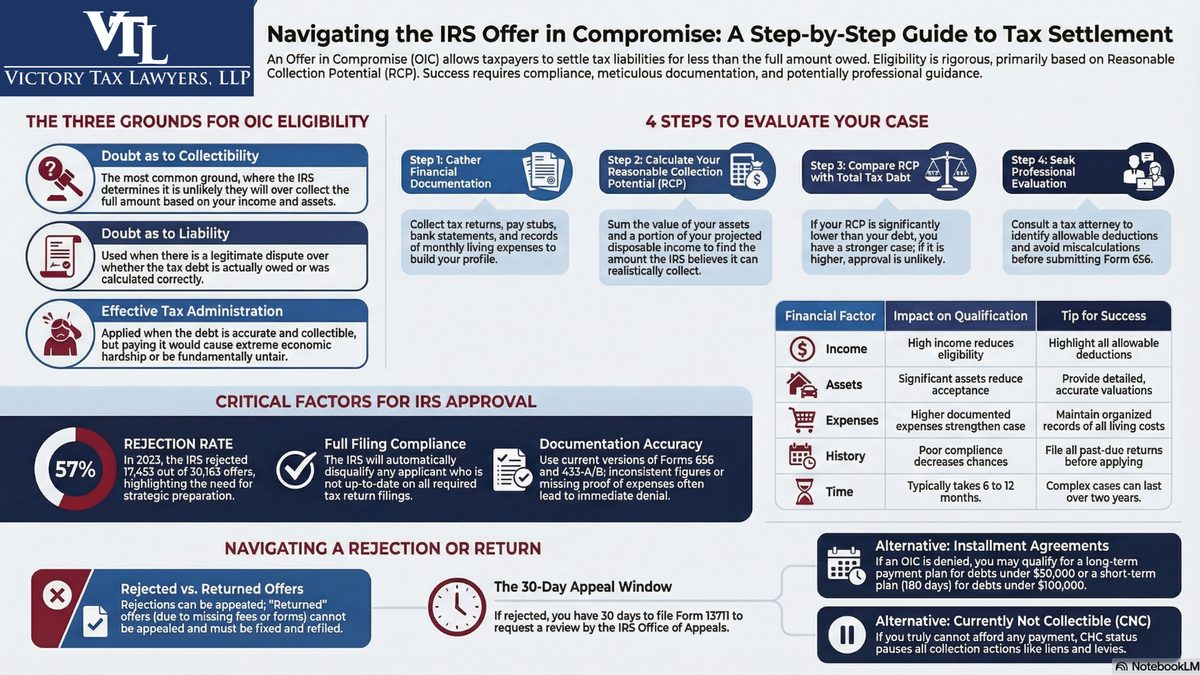
Qualifying for an IRS Offer in Compromise (IRS OIC) depends on whether the IRS believes you cannot fully pay your tax debt or that there is legitimate doubt about the amount owed. The IRS compromise program recognizes three main grounds for eligibility, including doubt as to collectibility, doubt as to liability, and effective tax administration OICs.
In evaluating eligibility, the IRS office conducts a detailed financial analysis of the taxpayer’s ability to pay, including income, monthly payments, monthly installments, taxpayer’s assets, and future earning potential, which applies to both wage earners and self employed individuals facing additional tax debt. Applicants must submit Form 656, a Collection Information Statement, and extensive supporting documentation, including a financial statement and proof of income, expenses, and liabilities.
An offer specialist reviews the taxpayer’s offer to determine whether the proposed dollar amount reflects what the taxpayer can reasonably pay. Depending on the outcome, the IRS offer may result in an accepted offer, a rejected offer, or in rare cases be deemed accepted. If disputes arise, taxpayers may pursue the appeals process, exercise appeal rights, or ultimately face a final court decision, guided by standards in the Internal Revenue Manual and legislative history.
Ultimately, the IRS evaluates economic hardship, special circumstances, and whether collecting the full amount would be in the best interest of fairness and public policy. Approval often depends on whether the taxpayer agrees to comply with filing obligations, whether the IRS determines the taxpayer can fully pay through other means, and whether detailed instructions and accurate disclosures support the claim that an IRS OIC is justified.
What Factors Affect Your Chances of Approval for an Offer in Compromise?
Several factors determine your chances of approval for an Offer in Compromise (OIC), with your financial situation being the most influential. The IRS closely evaluates your income, assets, and allowable expenses to determine your reasonable collection potential and whether the proposed settlement reflects what you can realistically pay.
Applicants must also provide detailed instructions and accurate financial disclosures, as any inconsistencies or omissions can weaken the application. Submitting all required IRS returns is equally critical, since unfiled irs returns can automatically disqualify an OIC request and signal noncompliance.
Documentation quality and compliance history further shape the outcome of your application. During the review, the IRS may issue an Information Document Request (IDR) to verify financial records, bank statements, property ownership, and other supporting evidence, making thorough preparation essential.
Prior compliance issues, such as repeated late filings, unresolved tax debts, or ongoing IRS collections like liens or levies, can reduce approval likelihood. Professional legal assistance can significantly improve results by ensuring accurate filings, anticipating IRS scrutiny, and strategically presenting your financial profile in a way that strengthens your case and increases the probability of acceptance.
What Is the Role of Financial Documentation and IRS Requests in an Offer in Compromise?
Responding fully and on time to IRS Information Document Requests (IDRs) is critical in the Offer in Compromise process because the IRS relies on verified financial data to assess your ability to pay. Incomplete, inaccurate, or delayed responses can lead to rejection, as they signal noncompliance or uncertainty about your financial situation. Providing clear, consistent documentation helps the IRS accurately evaluate your income, assets, expenses, and overall financial profile, increasing your credibility and improving your chances of approval.
The IRS typically requests documents such as tax returns, bank statements, pay stubs, proof of monthly expenses, property records, loan statements, and evidence of business income or liabilities. These documents are used to calculate your reasonable collection potential and determine whether your offer reflects what the IRS could realistically collect through other means. By organizing and submitting these records promptly and accurately, you reduce the risk of misunderstandings, strengthen your application, and demonstrate good faith throughout the review process.
Key Financial Factors and Their Impact on Offer in Compromise Eligibility
| Financial Factor | Description | Impact on Qualification | Tips to Improve |
|---|---|---|---|
| Income | All sources of earned and unearned income, including wages and investments | High income can reduce eligibility; lower income may improve chances | Accurately report all income and highlight allowable deductions and expenses |
| Assets | Cash, savings, investments, property, and other valuables | Significant assets increase RCP, reducing likelihood of acceptance | Provide detailed valuations and consider liquidating non-essential assets |
| Expenses | Monthly living costs, including housing, utilities, and essential payments | Higher documented expenses can lower RCP and strengthen your case | Maintain organized records and include all allowable living expenses |
| Compliance History | Timely filing of tax returns and payment of prior taxes | Poor compliance can decrease approval chances | File all past-due returns and remain current on tax obligations |
| Documentation Accuracy | Completeness and correctness of financial statements and forms | Inaccurate or missing documents can lead to denial | Double-check forms, use the latest IRS versions, and respond promptly to IDRs |
How Can You Evaluate Your Offer in Compromise Eligibility Step by Step?

Evaluating your eligibility for an Offer in Compromise (OIC) requires a clear understanding of your financial situation and how the IRS measures your ability to pay. Following a structured approach can help you assess your chances realistically and avoid errors that could weaken your application.
Step 1: Gather Financial Documents
Start by collecting essential records such as tax returns, pay stubs, bank statements, and documentation of monthly living expenses. These documents form the basis of your financial profile and are necessary to accurately present your income, assets, and liabilities to the IRS.
Step 2: Calculate Your Reasonable Collection Potential (RCP)
Next, determine your Reasonable Collection Potential, which reflects the amount the IRS believes it can collect from your assets and future income. This calculation combines the value of your assets with a portion of your projected disposable income, making it a critical factor in OIC eligibility.
Step 3: Compare RCP with Total Tax Debt
Compare your RCP with your total tax liability to estimate your likelihood of qualifying for an Offer in Compromise. If your RCP is significantly lower than your tax debt, you may have a stronger case for settlement. If it is close to or higher than your debt, approval may be less likely.
Step 4: Consider Professional Evaluation
For a more accurate assessment, consider consulting a qualified tax professional or attorney. Although the cost of hiring a tax attorney may vary, professional guidance can help you avoid miscalculations, identify allowable deductions, and present your case more effectively, potentially increasing your chances of approval.
To support taxpayers in this process, the IRS provides the Offer in Compromise Pre-Qualifier Tool, an online resource that helps you estimate your eligibility before submitting an application. By entering information about your income, expenses, assets, and tax debt, the tool gives a preliminary assessment of whether an OIC may be viable. Although it does not guarantee approval, it offers valuable insight and helps you decide whether to proceed with an application or seek professional assistance.
What Are the Common Reasons for Offer in Compromise Rejections, and How Can You Avoid Them?
Offer in Compromise (OIC) applications are often rejected due to incomplete or inaccurate documentation. When submitting an OIC, a taxpayer must use the most current version of Form 656 and submit a Collection Information Statement with supporting financial records. Missing information, inconsistent figures, or outdated forms can lead to denial, so accuracy and completeness are essential. The IRS will not accept an OIC if it determines that the taxpayer can fully pay the tax liabilities through an installment agreement or other means, making realistic financial disclosure critical.
Another frequent reason for rejection is underestimating income or asset values and failing to remain compliant with IRS filing and payment requirements. The IRS carefully evaluates whether alternatives such as an Installment Agreement or partial payment installment agreements (PPIAs) are more appropriate, especially when the taxpayer has insufficient assets to liquidate or limited income.
If an OIC is rejected, the IRS will provide a letter explaining the reasons for the rejection and detailed instructions on how to appeal the decision. The IRS Office of Appeals will review your appeal and may reconsider your OIC if the appeal is successful, while an unsuccessful appeal still leaves options such as submitting a new OIC application, particularly if your financial situation has changed significantly.
Delays in responding to IRS requests, including Information Document Requests, can further reduce approval chances. Professional guidance can help prevent these issues by ensuring timely responses, accurate financial analysis, and strategic positioning of your offer. By understanding the reasons for rejection and preparing your application carefully, you can significantly improve your likelihood of approval and make informed decisions about alternative solutions for resolving your tax debt.
What Is the Impact of Wage Garnishment and IRS Collection Actions on an Offer in Compromise?
Ongoing IRS collection actions, such as wage garnishment, tax liens, and bank levies, can significantly influence the Offer in Compromise (OIC) process because they reflect the IRS’s active efforts to recover unpaid taxes. While these actions do not automatically disqualify an OIC, they highlight the urgency of your case and the IRS’s assessment of your ability to pay. If wage garnishment is already in place, the IRS will closely examine your income, expenses, and assets to determine whether your offer truly represents your maximum reasonable payment or whether continued collection actions are justified.
Wage garnishment exemptions play an important role in OIC qualification because they determine the portion of your income that the IRS cannot legally seize to cover basic living expenses. The IRS uses standardized exemption thresholds based on filing status, dependents, and allowable expenses to calculate disposable income, which directly affects your reasonable collection potential. If garnishment leaves you with limited disposable income after exemptions, it may strengthen your case for an OIC by demonstrating financial hardship, while accurate documentation of exemptions and expenses helps ensure your financial capacity is evaluated fairly.
What to Do if Your OIC is Rejected?
No taxpayer wants a situation where their Offer in Compromise is rejected because it can be discouraging. However, an OIC rejection does not imply that you’ve exhausted all options. In most cases, you can choose to appeal the decision or opt for an alternative resolution after you’ve carefully reviewed why your offer was denied.
Carefully Review the OIC Rejection Letter
Once you receive the rejection letter, read it thoroughly. The letter will indicate the specific reason or reasons your offer was not accepted. Usually, it’d revolve around the reasons we discussed earlier. When you understand why your offer was rejected, it will be easier to figure out what to do next.
Also, keep in mind that in some cases, the IRS may not necessarily reject your offer but instead return it. This may occur if your application was incomplete, lacked required documentation, or if you failed to include the application fee or initial payment. Unlike a rejection, a returned offer cannot be appealed. Instead, you’ll be required to fix the issues that led to the return and reapply.
File an Appeal if You Disagree With the Rejection
In a situation where you strongly believe the rejection was unfair or based on incorrect assumptions by the IRS, you can submit an appeal to the IRS Office of Appeals using Form 13711 (Request for Appeal of Offer in Compromise). The appeal must be made within 30 days of receiving the rejection letter. Make sure you submit a written statement explaining why you don’t agree with the rejection and submit additional documents to support your claims.
The good thing is that while your OIC is under review, the IRS suspends the Collection Statute Expiration Date (CSED). If your offer is rejected, the CSED is also suspended during the 30-day appeal window. Also, once you file an appeal for the rejection, the agency suspends the CSED until it reaches a conclusion regarding your appeal.
Consider an Installment Agreement
If the IRS declines your offer but your finances allow you to pay the full amount over time, opting for an IRS payment plan can be a practical next step. Most taxpayers qualify for a payment plan. Luckily, the eligibility and approval process isn’t usually stringent.
If your current tax liabilities are under $100,000, you can apply for a short-term payment plan, which allows you to pay within 180 days. However, for debts below $50,000, a long-term installment agreement may be a better option as it allows you to spread payments over several years.
Additionally, you can set up a partial payment installment agreement to pay a reduced amount monthly if you cannot afford the full payment but do not qualify for an OIC.
Explore Currently Not Collectible (CNC) Status
Alternatively, you may be eligible for the Currently Not Collectible (CNC) status if you genuinely cannot afford to make any payment. Once you’re approved for CNC status, the IRS pauses all collection actions such as federal tax lien, wage garnishments, or tax levies on your account. To qualify for CNC, you must accurately fill out and submit Form 433-A to prove that your income barely covers your basic living expenses.
Speak With a Tax Professional
Working with a qualified tax professional can help you avoid costly errors and make informed decisions when navigating IRS tax relief options. Because the IRS applies strict financial and procedural standards, misunderstanding requirements such as required estimated tax payments, asset valuation, or documentation can weaken your case and reduce your chances of approval.
A tax attorney can evaluate your financial profile, including income, assets, and net equity, to determine how the IRS may assess your ability to pay. For a business owner, this review may also involve payroll obligations, ongoing estimated tax payments, and the impact of a pending or completed bankruptcy filing. During the review process, the IRS often assigns an appeals officer to reassess disputed decisions, and understanding how the IRS considers these factors can be critical to building a strong legal strategy.
By working with experienced legal counsel, you can better interpret IRS notices, respond effectively to requests for documentation, and explore the most appropriate resolution options, whether through an appeal, an installment agreement, or other tax relief programs.
How Hard Is It to Get an Offer in Compromise?
Getting an Offer in Compromise can be quite difficult, though not impossible. According to the IRS 2023 Data Book, the IRS rejected over 57% of the total OIC offers in 2023 (17,453 offers out of 30,163). That means that chances are pretty slim, unless you have strategic legal guidance. One of the most effective ways to increase your chances of getting your Offer in Compromise application approved is to work with a tax lawyer.
As a legal professional who specializes in tax matters, a tax attorney understands tax law and can help make sure that your offer is submitted correctly. They handle your documentation process, ensuring that all necessary documents are included at the first contact to avoid delay. In addition, an attorney will craft a compelling statement and an explanatory memorandum. These materials, when combined with your information, give the IRS a clear picture of your financial standing, enabling them to make a prompt decision.
Why Would an OIC Be Accepted?
The IRS accepts an Offer in Compromise (OIC) only if the taxpayer meets one of three conditions: Doubt as to Collectibility, Doubt as to Liability, or a strong reason why paying would cause extreme hardship. These conditions help the IRS determine whether settling the back taxes for less than the full amount is reasonable.
Doubt as to Collectibility
Doubt as to collectibility is one of the most common reasons OICs are accepted. If the IRS believes they are unlikely to ever collect the full amount based on your income, assets, and overall financial situation, they’ll approve your OIC.
In this case, the IRS evaluates whether it’s more practical to collect your Reasonable Collection Potential now rather than having to pursue full collection over many years with no guarantee of recovery. Your application must also clearly show that the offer is equal to or greater than your RCP, and you’ll need to include detailed financials through Form 433-A or 433-B along with Form 656.
Doubt as to Liability
Doubt as to liability applies when there’s a genuine question about whether you actually owe the tax debt in the first place. This could happen if the IRS made a mistake in assessing your taxes or if new information has come to light that wasn’t available when your original return was filed. This type of OIC is far beyond your financial ability to pay; you’ll have to show proof that the amount itself is inaccurate or unfairly calculated.
Effective Tax Administration
If you’re in a situation where you can technically pay your full tax debt, however, doing so may cause serious financial hardship or would not be fair based on what you’re going through, the IRS may accept your OIC. This effective tax administration option is often utilized by taxpayers with situations like a chronic illness, permanent disability, or an elderly taxpayer with a fixed income. ETA also covers other situations where enforcing collection would undermine public confidence in the tax system.
How Do I Get an OIC Approved?
The IRS does not easily approve an Offer in Compromise. However, if you prepare carefully and make efforts to prove financial hardship, you may increase your chances of getting your OIC approved.
- Make sure you’re eligible before applying: Use the IRS OIC Pre-Qualifier Tool or consult a tax attorney to confirm you meet the core requirements. Submitting an offer when you’re not eligible will cause you an instant rejection.
- Get all your past tax returns filed: The IRS won’t consider your OIC if you’re behind on any required filings. See to it that you’re up to date on all past returns, no matter how old the tax return may be.
- Offer an amount based on your financial situation: Your offer must reflect your reasonable collection potential (RCP). Should there be a case where your offer is low, the IRS will reject it.
- Stay cooperative and responsive during the review: You may be requested to send additional documents or clarification. Once you receive the request, respond quickly and keep copies of every document that was sent.
- Submit complete and accurate documentation: Make sure to include Forms 656 and 433-A or 433-B, along with proof of income, expenses, debts, and assets. Missing documents can lead to a denial or return of your application.
- Be prepared to appeal if rejected: If your OIC is denied, don’t be anxious. You have 30 days to appeal using Form 13711. You should also provide a clear explanation, along with any new supporting evidence to back up your claim.
How Long Does the OIC Process Take?
The Offer in Compromise process usually takes over 6 to 12 months. However, you should also know that the review process can last for over two years, depending on how complex your case is and the workload of the agency. Other factors that can make the process shorter or longer include how complete your application is, how quickly you respond to IRS requests, and whether you need to appeal a rejection.
An OIC application goes through several stages, which include:
- Initial review stage: begins once an application is submitted alongside the appropriate supporting documents. This takes about 2-4 weeks.
- Additional information: the IRS may request additional information, like proof of income. This can take around 4-6 weeks.
- Detailed Review: at this stage, the IRS has all they need and is carrying out an in-depth review of your reasonable collection potential. A detailed review will take 6-12 months.
Offer in Compromise (OIC) vs. Other Common IRS Resolution Options
| Resolution Option | Eligibility | Pros | Cons | Typical Timeline |
|---|---|---|---|---|
| Offer in Compromise (OIC) | Taxpayers who cannot pay their full tax liability and meet IRS financial criteria; must have filed all required returns | Can settle debt for less than full amount; stops collections once accepted | Strict eligibility; complex application; long review process | 6–8 months on average, longer for complex cases |
| Installment Agreement | Taxpayers able to pay their tax debt over time | Allows manageable monthly payments; avoids immediate collection actions | Interest and penalties continue; may take years to pay off | Usually approved within a few weeks to 2 months |
| Partial Payment Installment Agreement (PPIA) | Taxpayers with insufficient income/assets for a full payment plan | Allows partial payment over time; avoids immediate collections | Must remain compliant; requires detailed financial documentation | Typically several months for IRS review |
| Currently Not Collectible (CNC) Status | Taxpayers unable to pay taxes due to financial hardship | Pauses collection activity; protects assets | Debt is not forgiven; interest and penalties continue | Can take a few weeks to process once eligibility is determined |
When Should You Consult a Tax Attorney to Improve Your Offer in Compromise Qualification?
You should consider consulting a tax attorney when your financial situation is complex, you owe taxes across multiple years, or you have previously received an IRS denial for an Offer in Compromise (OIC). These scenarios often involve detailed financial analysis, strict compliance requirements, and strategic positioning that can be difficult to manage alone.
If an OIC is rejected, the IRS will provide a letter explaining the reasons for the rejection and detailed instructions on how to appeal the decision, making it crucial to understand the issues outlined in the rejection letter before moving forward. The IRS Office of Appeals will review your appeal and may reconsider your OIC if the appeal is successful, while an unsuccessful appeal still leaves other avenues to address your tax debt, such as submitting a new OIC application or exploring alternatives like installment agreements or partial payment installment agreements.
Professional representation can improve your chances of success by ensuring accurate documentation, effective negotiation with the IRS, and a clear evaluation of your options. Victory Tax Lawyers help clients analyze financial profiles, prepare compliant OIC submissions, respond to IRS requests, and understand long-term obligations, including the requirement to file all tax returns for five years after acceptance. While the cost of legal assistance varies by case complexity, it often delivers strong value by reducing errors, improving approval odds, and identifying the most effective strategy to resolve your tax debt.
Need Help With Your Offer in Compromise?
If your tax bills feel like a mountain, consider an Offer in Compromise. It might just be the fresh start you need. The bad news, however, is that a large percentage of offers do not make it to the success list, largely because the average taxpayer does not understand IRS collections and tax relief services such as the OIC. But we don’t want you to make mistakes; that’s why we’ve put this guide together for you.
With over $72 million saved for clients since 2017, Victory Tax Lawyers, a Los Angeles-based tax firm, delivers experienced legal help you can count on to get real IRS solutions. Get the help you deserve. Contact us for a free consultation today!
Frequently Asked Questions
During the process of writing this blog, we encountered some frequently asked questions related to the IRS Offer In Compromise (OIC). We did our best to answer some of them.
What Financial Criteria Does the IRS Use to Approve an Offer in Compromise?
The IRS evaluates your income, assets, and allowable expenses to determine your Reasonable Collection Potential (RCP), which is the amount it believes can be collected. Your OIC must offer at least this amount, or show that paying more would create financial hardship.
Can Wage Garnishments Affect My Ability to Qualify?
Ongoing wage garnishments do not automatically disqualify you, but the IRS will factor your remaining disposable income when assessing your OIC. Garnishments can actually strengthen your case if they demonstrate financial hardship and limited ability to pay.
How Long Does the Offer in Compromise Process Take?
The IRS typically reviews an OIC within 6 to 8 months, though more complex cases can take longer. Processing time depends on the accuracy of your documentation and the responsiveness to any IRS Information Document Requests (IDRs).
What Documentation Do I Need to Submit?
You must submit the most current Form 656, a Collection Information Statement (Form 433-A or 433-B), and supporting financial records such as tax returns, pay stubs, bank statements, and proof of expenses. Accurate and complete documentation is critical to avoid delays or rejection.